
Best Pruning Saw for Apple Trees: 5 Proven Picks Compared
Quick answer: The best pruning saw for apple trees is one that fits the branch, the space around it, and your hand. For routine work, the Silky F180 is our versatile folding pick. Choose a compact FELCO 600 for tight access, or a longer Corona RS16150B for larger, reachable limbs.
Table of Contents
Key Takeaways
- Everyday choice: The Silky F180 coarse-tooth model offers a 7-inch folding blade intended for green wood and fruit tree pruning.
- Compact choice: The FELCO 600 has a 150 mm straight blade and a folding handle for close work.
- Longer curved choice: The Corona RS16150B has a 10-inch curved blade, but it needs space around the branch.
- Best buying rule: Select by blade shape, tooth pattern, replacement parts, and the location of the cut, not advertised speed.
- Tree care comes first: Support heavy branches, protect the branch collar, and leave hazardous overhead work to a qualified professional.
Shopping for the best pruning saw for apple trees can get confusing quickly. The best pruning saw for apple trees is not necessarily the biggest: a small folding saw is convenient between crowded scaffold limbs, but it may be slow or awkward on a thick branch; a long curved blade can become an obstacle when branches grow close together.
This roundup is designed for US backyard growers who need a realistic way to compare saws before buying. It weighs manufacturer-published specifications against orchard tasks described by university extension guidance. Our research team has not conducted hands-on saw tests, so the picks are fit-for-purpose judgments, not measured performance rankings.
Best pruning saw for apple trees: quick comparison
Start with your most common job. Selecting the best pruning saw for apple trees starts with recognizing that a dwarf tree with occasional crowded branches does not need the same saw as an older standard tree undergoing gradual renovation.
Reading the table: “Best” means best matched to the stated use, not winner of a cutting-speed trial. Product configurations can change, so match the model code, blade length, and tooth option before ordering.
Pruning context: Penn State University’s pruning and training video is listed by University of Maryland Extension. It demonstrates orchard pruning principles rather than comparing the saw models below.
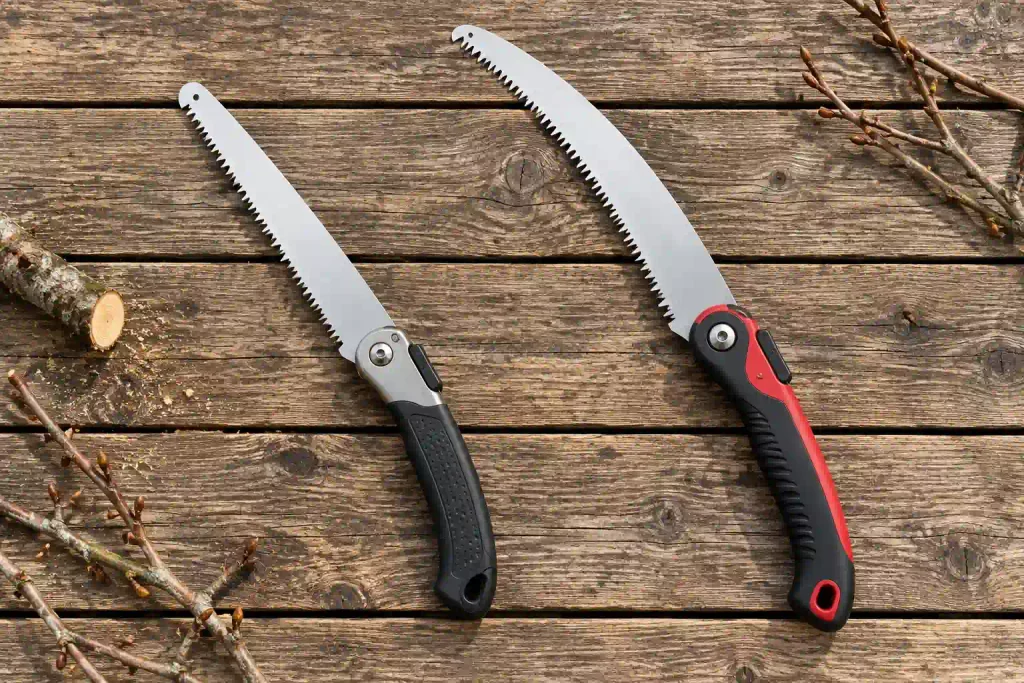
Five pruning saws worth comparing
For the best pruning saw for apple trees, the useful comparison is between distinct jobs; the best pruning saw for apple trees depends on the job, not five nearly identical promises of sharpness. Each recommendation below includes a practical reason to buy and a reason to look elsewhere.
1. Silky F180 coarse teeth: best overall for a small home orchard
Our first candidate for the best pruning saw for apple trees, the coarse-tooth Silky F180 (model 143-18), has a 180 mm straight folding blade and two locking cutting positions. Silky identifies fruit tree pruning as an intended application, which makes this a sensible starting point for growers with a few trees and a range of moderate cuts.
Its short blade is easier to carry between trees than a fixed 12-inch saw. However, a seven-inch cutting edge also means shorter strokes when you move into larger wood, and forcing a thin pull saw sideways can damage the blade.
Buy it if: most cuts are reachable from the ground and you want a one-hand saw to complement secateurs. Skip it if: nearly every job involves large mature limbs or you regularly need a longer stroke.

Best Overall
Silky F180 (143-18)
A compact folding pruning saw designed for green wood, ideal for routine apple tree maintenance and accessible branches.
- 7-inch coarse-tooth blade designed for cutting green wood.
- Lightweight folding design for easy carrying and storage.
- Ergonomic handle with rubber grip and two locking blade positions.
- Replaceable blade for continued use.
Best for: Everyday backyard apple tree pruning
Price, rating, and availability may change.
Affiliate disclosure: We may earn a commission from qualifying purchases made through this link, at no additional cost to you.
2. FELCO 600: best compact saw for crowded branches
The FELCO 600 is a compact contender for the best pruning saw for apple trees and uses a 150 mm straight pull-stroke blade and folds to protect the teeth during storage. FELCO lists a 160 g tool weight and offers a replacement blade, two details that matter when the saw travels with you during repeated pruning sessions.
The shorter blade can be easier to position near a branch junction where a larger curved saw would touch an adjacent limb. In exchange, the FELCO 600 gives up cutting reach; for bulky wood, a longer blade may make the work less tiring.
Buy it if: your apple trees have closely spaced branches or you want a compact backup.
Skip it if: your priority is longer strokes through open, thick wood.

Best Compact
Felco Folding Saw (F 600)
A lightweight, compact folding saw with a short blade for controlled cutting in crowded apple tree canopies.
- Compact 150 mm blade for working around crowded apple branches.
- Pull-stroke cutting design with hardened teeth.
- Ergonomic non-slip handle for a secure grip.
- Folding design with replacement blades available.
Best for: Crowded branches and smaller cutting spaces
Price, rating, and availability may change.
Affiliate disclosure: We may earn a commission from qualifying purchases made through this link, at no additional cost to you.
3. Corona RazorTOOTH RS16150B: best long folding option for mature limbs
For accessible mature limbs, the Corona RS16150B is another candidate for the best pruning saw for apple trees. It has a curved 10-inch folding blade with three-sided hardened teeth and a rubberized handle. Corona specifies it for green or dry branches, and the extra blade length can help when working on reachable scaffold limbs with adequate room to saw.
A curved blade may keep more teeth engaged during a pulling motion, depending on the cut angle. However, it is harder to place precisely in a narrow crotch, and the manufacturer’s maximum branch claim is not a recommendation to remove large structural limbs without assessing the risk.
Buy it if: you maintain an established apple tree with accessible larger branches.
Skip it if: you mainly train young dwarf trees or need to work inside cramped branch unions.

Best for Mature Limbs
Corona RazorTOOTH RS16150B
A curved folding pruning saw with a longer blade for cutting larger, accessible branches on established apple trees.
- 10-inch curved blade for larger, reachable branches.
- Three-sided, impulse-hardened teeth designed for efficient cutting.
- Ergonomic, non-slip handle for improved grip.
- Locking folding blade with covered teeth for safer storage.
Best for: Larger, reachable branches
Price, rating, and availability may change.
Affiliate disclosure: We may earn a commission from qualifying purchases made through this link, at no additional cost to you.
4. Bahco Laplander 396-LAP: best multipurpose saw
The Bahco 396-LAP belongs on a shortlist for the best pruning saw for apple trees when versatility matters. It has a 190 mm straight folding blade, seven teeth per inch, a coated blade, and a lock that secures the saw when open or closed. Bahco lists uses across green and dry wood, making it a reasonable choice when orchard pruning is only part of your garden work.
Because its identity is multipurpose rather than specifically orchard-focused, it is less tailored to delicate positioning around fruiting wood than a narrow specialist saw. Still, its replaceable blade and compact form can simplify ownership for someone who wants fewer tools.
Buy it if: you prune apples, remove occasional dead garden wood, and value one folding tool.
Skip it if: your main work demands a specialized narrow pruning blade.

Best Multipurpose
Bahco Laplander 396-LAP
A versatile folding saw suitable for green and dry wood, useful for apple tree pruning and general garden maintenance.
- 7.5-inch blade suitable for both green and dry wood.
- Rust-resistant, low-friction blade coating.
- Comfortable two-component handle with a leather wrist strap.
- Safety lock secures the blade in open and closed positions.
Best for: Apple pruning and general garden cutting
Price, rating, and availability may change.
Affiliate disclosure: We may earn a commission from qualifying purchases made through this link, at no additional cost to you.
5. Silky Tsurugi Straight 200 mm: best specialist for tight branch unions
The Silky Tsurugi Straight is our specialist alternative when choosing the best pruning saw for apple trees. Its range includes a 200 mm fixed-blade configuration with a notably narrow blade profile. Its design prioritizes access into tight branch crotches, and the supplied scabbard provides storage for a blade that does not fold.
This is the least necessary purchase for an owner of one young apple tree. However, when precise positioning matters more than pocket storage, the slim blade gives the Tsurugi a clear reason to exist alongside general-purpose folding saws.
Buy it if: you repeatedly prune crowded mature canopies and prefer a fixed tool with a sheath.
Skip it if: compact storage and occasional use matter more than specialist access.
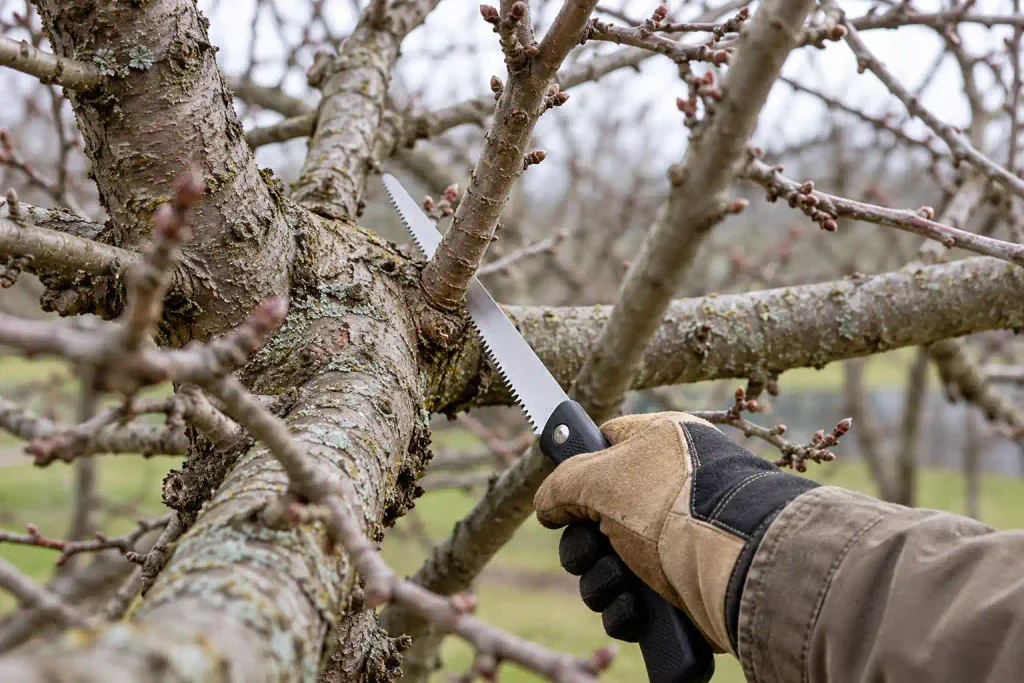
How we selected the saws, and what we did not test
To identify the best pruning saw for apple trees for distinct buyers, our shortlist uses five purchase criteria: suitability for common apple pruning cuts, blade length and profile, stated tooth configuration, safe storage, and published spare-part support. We also separated compact, longer curved, multipurpose, and fixed narrow-blade options so readers are not offered five variations of the same saw.
We did not compare measured cut speed, fatigue, blade life, or wet-wood performance. Those claims would require a controlled hands-on trial; consequently, no brand is described as objectively the fastest or most durable.
When evaluating the best pruning saw for apple trees, treat manufacturer blade specifications as checkable facts, while treating our use-case rankings as editorial recommendations. This distinction matters more than a star rating without a disclosed test method.
How to choose the best pruning saw for apple trees
Match blade length to the branch and working space
A shorter straight blade is easier to start and guide when twigs surround a branch collar. By contrast, a longer curved blade is often easier to use on an exposed limb where the saw has room to travel.
To find the best pruning saw for apple trees in your particular yard, look through the canopy before shopping and identify three representative cuts, including your most awkward one. If the only large branch is high overhead, buying a bigger hand saw will not make that job safe; ask a qualified arborist instead.
Choose tooth pattern for the wood you actually cut
To select the best pruning saw for apple trees by tooth pattern, remember that manufacturers sell fine and coarse patterns because wood condition and desired finish differ. For example, Silky distinguishes its coarse F180 configuration for green pruning wood from the fine-tooth version marketed for harder, dry wood.
Do not assume more teeth always means better apple pruning. Instead, check whether the exact blade option fits live branches, dead wood, or both, and avoid substituting a similarly named but differently toothed model.
Check the lock, grip, and replacement blade before checkout
The best pruning saw for apple trees must also stay secure in use; with a folding saw, the hinge and lock deserve as much attention as the cutting edge. Check whether the blade locks open, whether the folded teeth are covered, and whether the handle is comfortable with your usual work gloves.
Replacement availability also affects long-term value. Some saws use impulse-hardened teeth that are usually replaced rather than resharpened conventionally, so confirm the exact replacement blade code before considering a saw economical.
Decide whether a saw is even the right tool
A buyer asking about the best pruning saw for apple trees may not need a saw yet: young apple trees often need selective twig and small-branch cuts rather than frequent sawing. In that situation, start with pruning shears for apple trees and compare tool sizes in our pruning shears vs loppers guide.
When a branch is beyond the comfortable capacity of your loppers, a hand saw becomes appropriate. The best pruning saw for apple trees will not compensate for cutting an unnecessarily large branch, so choose your pruning target before the tool.
How to make a safer, cleaner saw cut on an apple tree
Even the best pruning saw for apple trees cannot fix an incorrect cut. The University of Minnesota Extension advises pruning close to the branch collar and starting larger limb removal with an underside cut to reduce bark tearing. University of Maryland Extension similarly emphasizes thinning cuts and warns against removing excessive wood from young or neglected trees.
Extension consensus: preserve the branch collar, support larger limbs with staged cuts, and remove only the wood needed to improve the tree’s structure, light and airflow. See the University of Minnesota and University of Maryland pruning guides in Sources.
- Identify the right branch. Remove dead, broken, crossing, or poorly placed wood when appropriate; first confirm that removal will not destabilize a major scaffold.
- Clear the work area. Keep both feet on stable ground where possible, wear eye protection and work gloves that allow a secure grip, keep your free hand out of the cut path, and avoid overhead sawing or branches under unpredictable tension.
- Relieve weight on a larger limb. Make a shallow underside cut away from the trunk, then cut from above farther out on the limb to release its weight without stripping bark.
- Finish at the collar. Make the final controlled cut just outside the raised branch collar, without leaving a long stub or cutting flush against the trunk.
- Clean and store the saw. Remove debris and follow the maker’s care directions. If working with suspected disease, seek local extension guidance on tool sanitation and disease-specific pruning.
For timing, the best pruning saw for apple trees is useful primarily during planned, appropriately timed pruning, not as an excuse to cut whenever a large limb is visible. University of Minnesota recommends most annual apple pruning in late winter or early spring after the worst cold has passed; local weather, tree age, and variety still matter.
For step-by-step canopy decisions, see how to prune apple trees and winter pruning for apple trees. Neither a fine blade nor an expensive handle makes an unsafe branch removal worthwhile.
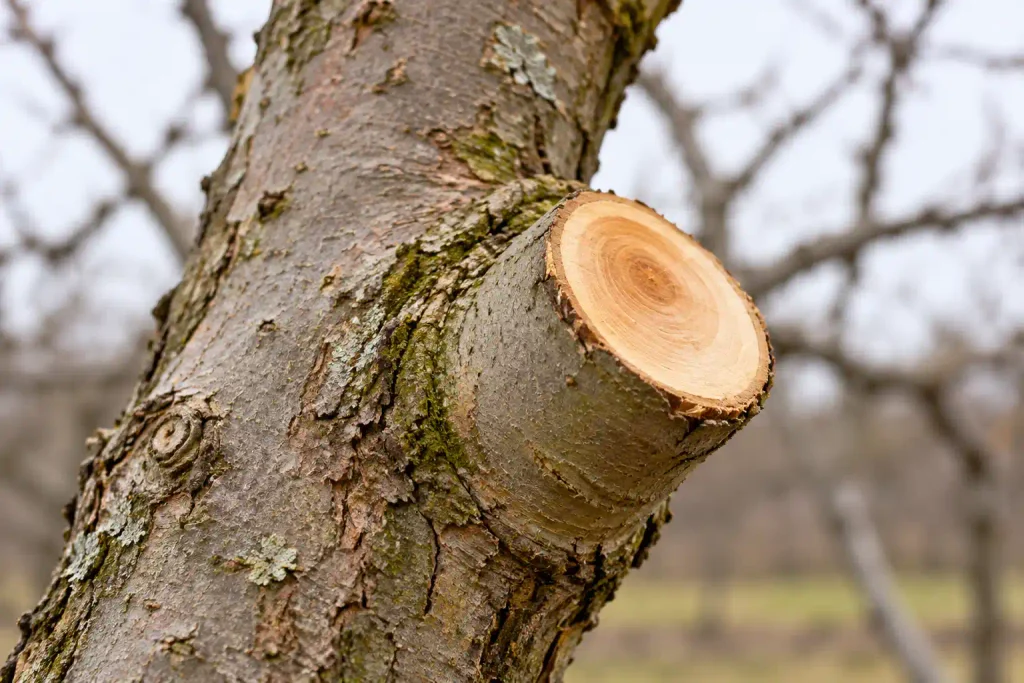
Which saw would we buy for a specific orchard?
One to three dwarf trees: For this use, the best pruning saw for apple trees is often the Silky F180, which covers many occasional saw jobs, while secateurs should remain the everyday cutting tool. If access is consistently tight, the shorter FELCO 600 deserves a closer look.
Several mixed-age backyard trees: The Silky F180 or Bahco 396-LAP makes sense as a portable baseline. Add the Corona only if larger reachable branches are a recurring need, rather than buying it simply because its blade is longer.
An older tree with crowded scaffold limbs: A narrow Tsurugi may help with positioning, but structural assessment comes first. If a limb is large, high, decayed, or heavily loaded, arrange professional help rather than trying to make an inappropriate cut.
Ultimately, the best pruning saw for apple trees is the saw you can place correctly and control comfortably. For most home growers choosing the best pruning saw for apple trees, a modest folding saw used on a well-chosen branch is more useful than a premium saw used to make the wrong pruning decision.
Frequently asked questions
Do I need a curved or straight pruning saw for an apple tree?
When comparing the best pruning saw for apple trees by blade shape, choose a straight saw when precise placement around crowded branches is your main concern. A curved blade is worth considering for more open, reachable limbs, but neither shape is automatically superior for every apple tree.
What size pruning saw works for a backyard apple tree?
When choosing the best pruning saw for apple trees for a small home orchard, a folding blade around 6 to 8 inches is a practical starting category rather than a universal requirement. If you repeatedly cut accessible large branches, consider longer saws, but do not use blade length to justify unsafe removals.
Can I use a pruning saw on a young dwarf apple tree?
Yes, occasionally, although most early training cuts should target small shoots that can be handled with appropriate pruning shears. University of Maryland recommends removing unwanted growth while it is small to avoid large wounds later.
Should I sharpen a pruning saw or replace its blade?
Follow the exact manufacturer’s instructions because tooth hardening and blade design vary. For the shears in your tool kit, our pruning shears sharpening guide addresses a different cutting edge and should not be applied to a hardened saw blade.
Related articles
- Best pruning shears for apple trees: the parent buying guide for smaller cuts.
- Pruning shears vs loppers: which manual tool to reach for first.
- How to sharpen pruning shears: care for your companion tool.
- Apple tree pruning tools: a broader toolkit overview.
- Apple tree pruning: general timing and technique.
Sources
- University of Minnesota Extension, Pruning and Training Apple Trees. Branch collars, staged larger-limb cuts, structural goals and seasonal timing.
- University of Maryland Extension, Growing Apple and Pear Trees in a Home Garden. Young-tree care, thinning cuts, older-tree renovation and avoiding unnecessary large wounds.
Product information note: Manufacturer specifications were checked for the specific Silky, FELCO, Corona, and Bahco models named above. Prices, stock, and configurations may change; confirm details with the seller. These products were not hands-on tested by Apple Tree Guide for this article.
Disclaimer: This article provides general pruning guidance based on university extension research. Pruning requirements vary by variety, rootstock, tree age, and regional climate. When in doubt, consult a certified arborist or your local cooperative extension service.