6 Easy Steps to Handle Apple Tree Bark Splitting in Winter
Apple tree bark splitting in winter often shows up as a vertical crack or a patch of dead, peeling bark on the trunk. Frost cracks and sunscald are common explanations, especially on exposed young trees. Check the damage before doing anything to the wound, leave sound bark alone, and watch how the tree grows in spring.
Table of Contents
Key Takeaways
- A narrow crack and a broad sunken patch may have different causes. Location, depth, and nearby damage offer better clues than the date you noticed them.
- Don’t use tar, glue, caulk, or wound paint to close the split. These products do not restore dead bark.
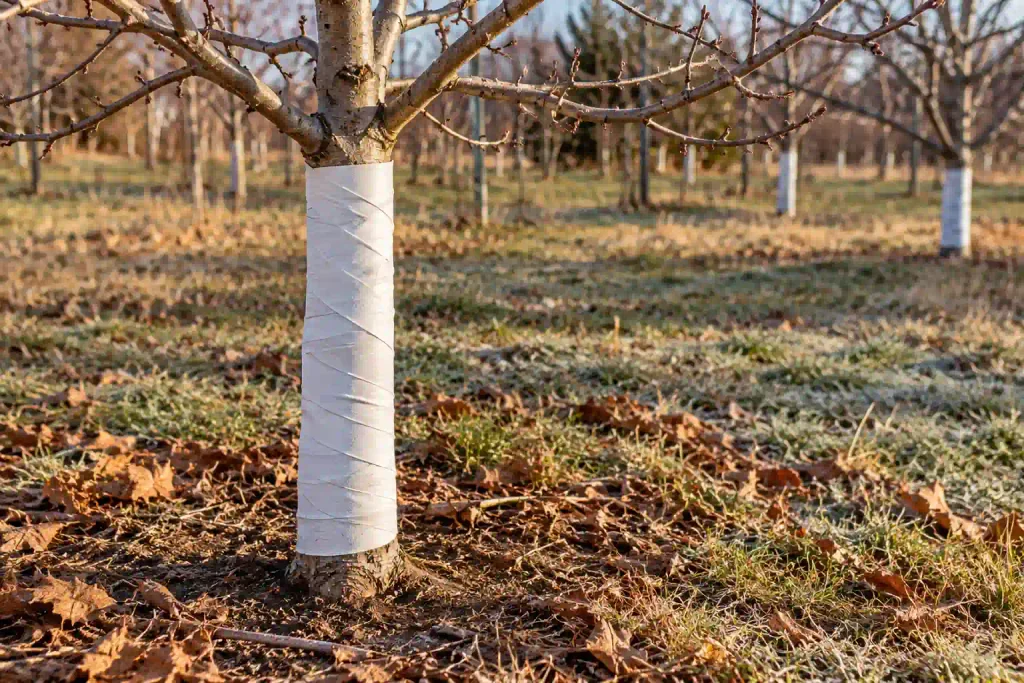
- Protect vulnerable, intact trunk bark before the next winter. A reflective white guard is for prevention, not a seal over an open wound.
- Large cracks through the wood, extensive bark loss, or a weakening trunk deserve an arborist’s assessment.
You may notice the damage while pruning in February. Or the trunk might look normal all winter, then shed a strip of bark when growth starts. Neither situation tells you, by itself, whether the tree is dying.
It helps to separate three questions: What kind of injury is this? Is the trunk still sound? What can you do without making the wound worse? That is the order we will follow. The guide is based on university extension advice for backyard fruit trees, with a simple observation record you can keep for your own orchard.
What apple tree bark splitting in winter can look like
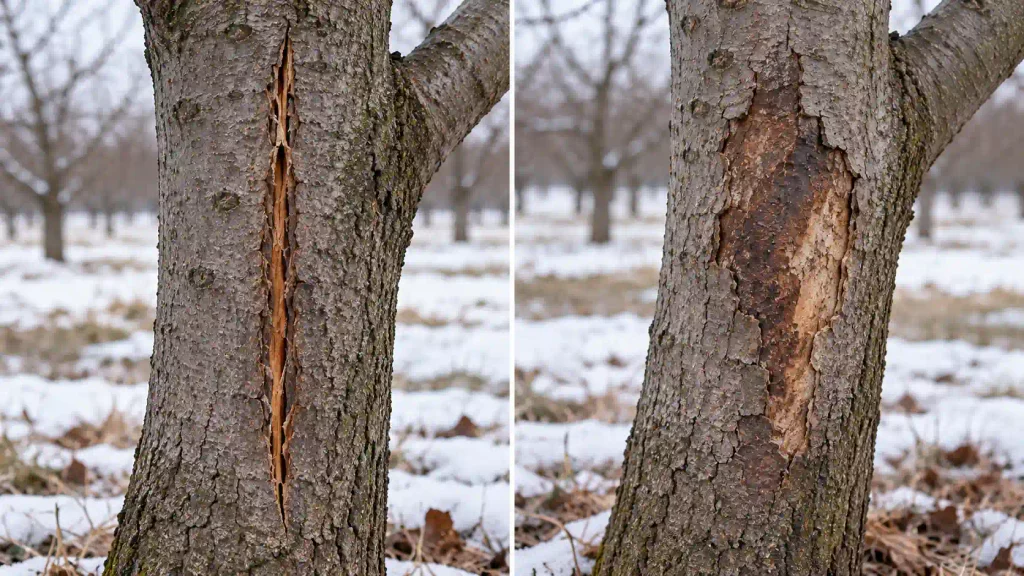
Start with the shape. A frost crack often runs up and down the trunk, sometimes in a fairly straight line. It can extend into the wood rather than staying in the outer bark. University of Maryland Extension explains that the wood may contract during intense cold, split, and partly close again when the weather warms. The same crack can reopen in a later winter.
Sunscald has a different appearance. You might find an elongated, flattened area where bark is darker, sunken, dry, or beginning to peel. The damaged patch is often on the south or southwest side of the trunk, where winter sun is strongest. Its full outline may take a while to show.
There’s a third possibility worth knowing about: normal growth cracking. As a trunk expands, older outer bark may develop fine fissures. If you see smoother, lighter developing bark underneath, with no exposed inner wood, decay, or oozing, the change may be part of normal growth. Maryland Extension describes this distinction in its guide to winter damage.
Why cold weather and winter sunshine damage bark
Tree bark doesn’t stay at the air temperature all day. Sunshine can warm one side of the trunk while the shaded side remains cold. A cloud passing overhead or nightfall can then cool the warmed tissue quickly. The result may be dead bark from sunscald, a frost crack in the wood, or both injuries in the same area.
Apple is among the trees susceptible to frost cracking. Recently planted trees also have thinner, more exposed bark, so a sunny position can create problems even when the variety is hardy enough for your USDA zone. Rootstock, recent pruning, older injuries, and local weather all affect the situation. A tree’s hardiness rating cannot tell you whether a particular wound is harmless.
The Utah State University Extension sunscald guide notes that bark injury may become obvious long after the weather event that caused it. That explains an awkward but common question: “Why is my apple tree peeling now when the severe freeze was weeks ago?”
Watch: This tree-wrapping demonstration is recommended in Colorado State University Extension’s Ask Extension guidance. It shows how to protect young trunks before winter. It is not a method for closing an existing split.
Check these clues before you call it frost damage
A crack tells you that the bark or wood has opened. It doesn’t identify the cause on its own. For apple tree bark splitting in winter, a quick look at the surrounding trunk is often more useful than staring into the fissure.
| What you find | What it may suggest | Next move |
|---|---|---|
| A long vertical opening; firm bark on both sides | Frost crack, particularly after severe temperature swings | Photograph it and check whether the wood is sound. |
| Dark, sunken, peeling patch on an exposed side | Sunscald | Leave the wound uncovered and plan protection for intact bark next fall. |
| Ragged missing bark low on the trunk, sometimes with tooth marks | Rabbit or vole feeding | See how far the damage extends around the trunk; consider an animal barrier. |
| Scrapes beside a support stake, tie, mower route, or string-trimmer path | Mechanical injury | Correct the rubbing or impact source. |
| Expanding sunken area, unusual swelling, oozing, or dieback above the wound | Possible canker or another problem | Ask your local extension diagnostic service for identification. |
| Shallow fissures with developing bark beneath and no exposed wood | Possibly normal growth cracking | Compare photos over time; avoid scraping the surface. |
Look at the graft union as well, especially on a dwarf apple tree. A crack at a constricting tie or a damaged lower trunk needs more attention than a small, stable mark higher up. And if bark is missing around much of the circumference, don’t judge the injury by its length alone. Trunk tissue must remain connected for the tree to function.
These clues are an editorial checklist, not a field diagnosis. North Carolina State Extension also lists mechanical damage, rapid growth, drought, heat, cold, and disease among possible causes of bark splitting. The extension’s bark-cracking alert advises an arborist’s inspection when large cracks may weaken a trunk.
6 steps for handling apple tree bark splitting in winter
If the tree is standing securely and the injury is limited, there is usually time to examine it carefully. Keep children and pets away from a trunk or large limb that appears unstable, and ask a professional to assess a possible structural failure.
1. Take two photos before touching the bark
Get one picture of the whole tree and one close-up with a ruler beside the split. Record the date and the direction the damaged side faces. If you remember a sudden freeze, note it, but don’t treat that memory as proof of the cause.
For apple tree bark splitting in winter, a photograph is particularly helpful because a crack may look wider on a bitterly cold day. Another photo at the same angle later can show whether the edges have moved or the surrounding bark has changed.
2. Check whether the injury is shallow or serious
Look without digging into the wound. Does the split seem confined to bark, or does it continue into the solid wood? Is the trunk firm? Are there holes, sawdust-like material, oozing, or dead branches above the opening? A deep split in a large trunk is a safety question, not a do-it-yourself repair project.
Pay attention to the amount of bark still connected around the stem. A short injury that removes bark around most of a young trunk can be more threatening to the tree’s health than a longer split on one side. If that is what you see, contact an arborist or your extension office.
3. Resist the urge to seal the crack
It is tempting to press loose bark back into place or fill the gap with something waterproof. Don’t. University of Minnesota Extension advises leaving sunscald wounds open instead of coating them with paint, tar, or commercial wound dressing. A coating cannot reconnect dead tissue to the trunk.
Leave firmly attached bark alone, too. Minnesota’s instructions describe removing dead bark with a disinfected knife in some circumstances, but cutting too far can injure the living margin. If you’re unsure which tissue is alive, let a qualified arborist make that call.
What the extension guidance agrees on: Protect vulnerable bark before winter, avoid sealing existing sunscald wounds, and support the tree’s normal growth while the injury is monitored. This summarizes University of Minnesota and Utah State University Extension guidance; it is not a quotation from an individual expert.
4. Give the root zone ordinary, steady care
The wound doesn’t call for a special fertilizer recipe. Check soil moisture when the ground is not frozen; water during genuinely dry periods and let excess water drain. Keep grass from competing right against the trunk, especially on a young tree.
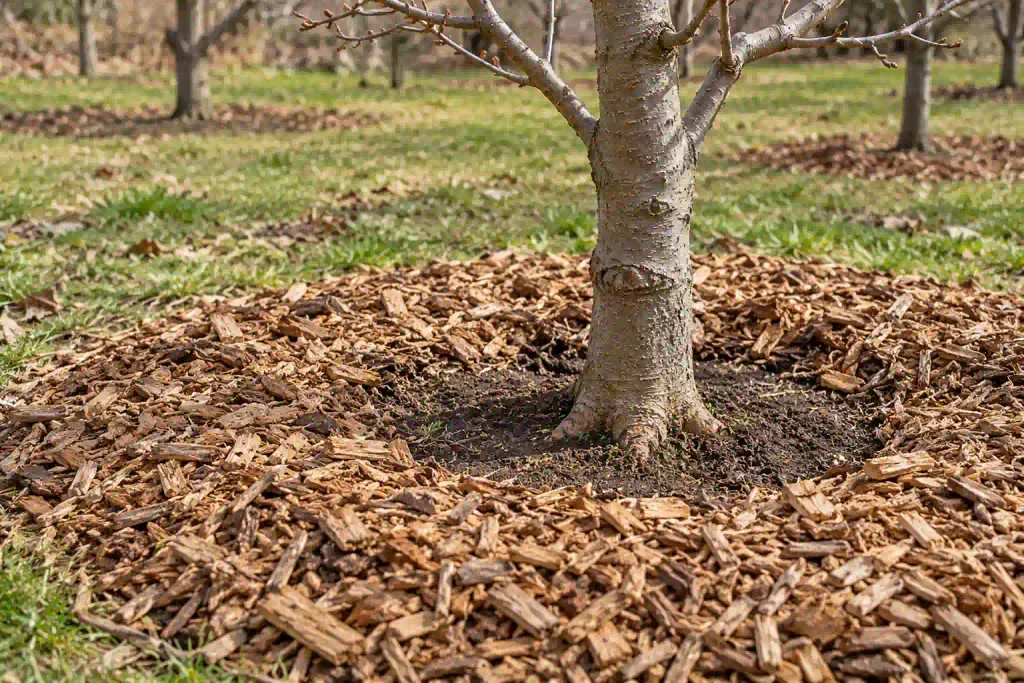
A broad, modest layer of organic mulch can help conserve moisture and moderate soil temperature. Leave a clear space around the trunk and graft union rather than building a mound against the bark. This is useful care after apple tree bark splitting in winter, although mulch does not heal a cracked trunk directly.
5. Decide what needs protection next autumn
Examine the healthy bark that still faces winter sun. A properly fitted white reflective guard can reduce temperature swings on young, thin-barked trees. Install seasonal protection in fall, following the product’s directions, and remove it after the main frost risk passes in spring.
Wrapping is a preventive measure. Don’t clamp a damp, tight covering over an open wound, and check that any guard doesn’t constrict a growing trunk. Where rabbits or voles are a problem, use an appropriate animal barrier as a separate measure. The University of Minnesota winter-protection guide explains the difference between white reflective materials and dark wraps that absorb sunlight.
6. Revisit the same spot when leaves emerge
Do not expect the old bark to stick itself back together. Trees can produce new protective tissue along living wound edges, a process that may take several growing seasons. A frost crack can remain visible and sometimes reopen in cold weather.
When the tree begins to leaf out, take another photograph from the same position. Check for normal shoot growth, new dieback, expanding discoloration, and changes around the wound. If the tree looks weaker or the injury is spreading, send the photo sequence to your local extension diagnostic service.
A simple observation log worth keeping
There is one easy way to make follow-up less uncertain: keep the same four notes each time you inspect the tree. This is a record-keeping suggestion for home growers, not a validated diagnostic test. It helps you compare changes instead of relying on memory.
| When | Record | Why it helps |
|---|---|---|
| When first noticed | Photo, ruler measurement, trunk side, nearby damage | Creates a reliable starting point. |
| After a major cold spell | New opening, loosened bark, or no visible change | Shows whether the split appears to reopen. |
| At budbreak and leaf-out | Leaf growth, branch dieback, wound-edge changes | Connects the trunk injury with the tree’s condition. |
| Before the next winter | Guard fit, exposed bark, mulch clearance, animal activity | Turns observations into a prevention plan. |
When someone asks whether apple tree bark splitting in winter is getting worse, this record gives an extension educator useful context. Include the tree’s approximate age and whether it was recently planted or heavily pruned. Those details matter more than guessing the date a hidden injury began.
What not to confuse with a repair
Two recommendations are easy to mix up. Extension services sometimes describe white latex trunk paint or light-colored wraps as prevention on intact bark, where they reflect winter sunlight. That is different from painting a fresh crack with wound dressing. The first aims to reduce heating; the second tries to cover an injury and is not recommended by Minnesota Extension.
Pruning is another area where timing matters. The University of Minnesota recommends most routine apple pruning in late winter or early spring, after the coldest weather has passed and before new growth begins. Don’t remove sound limbs solely because a crack appeared elsewhere on the trunk. If you need help choosing cuts, see our apple tree pruning in winter guide.
A late burst of soft growth can also leave trees less prepared for winter. Maryland Extension cautions against late-summer pruning or fertilizing that encourages tender shoots. On established trees, routine feeding should follow actual growth and soil needs, not the presence of a bark wound.
When to call an arborist instead of waiting
Minor winter injury and major trunk failure can begin with a similar-looking line in the bark. If the split extends deeply into the wood, a scaffold limb is separating, or the trunk has developed a pronounced lean, treat the area as unsafe until a qualified arborist evaluates it. Never attempt to bolt, bind, or pull together a load-bearing split yourself.
For apple tree bark splitting in winter accompanied by increasing sunken patches, oozing, insect galleries, or branch dieback, a diagnostic service may be the better first call. Sunscald can create an entry point for secondary problems, but the crack alone does not establish which organism, if any, is present.
How to reduce the chance of another winter crack
Begin with where the sun hits the trunk. Newly planted or thin-barked apples in exposed spots may benefit from a white guard. Keep it in place for the recommended cold-season window, then remove it rather than leaving the wrapping on through summer. An older tree with thicker bark may need less protection, depending on its history and exposure.
Try not to expose a previously shaded trunk all at once with heavy pruning. Protect it from mowers and trimmers, loosen tight support ties, and keep mulch off the bark. During an unusually dry fall, check soil moisture before the ground freezes. These measures follow extension guidance and are part of sensible apple tree winter care.
Our guide to protecting apple trees in winter covers guards and animal barriers in more detail. If the tree has injuries elsewhere, our apple tree frost damage article explains why a damaged bud or flower calls for a different assessment than a trunk crack.
FAQs
Can a young apple tree survive a winter bark split?
Yes, a tree can recover from a limited injury if enough living tissue remains and the trunk stays sound. Recovery is less certain when bark is lost around much of the stem, the crack runs deep into the wood, or dieback develops above it. Watch the tree through leaf-out rather than deciding from one winter photograph.
Does apple tree bark splitting in winter mean the tree has canker?
No. Frost cracks and sunscald are physical winter injuries; a canker may involve a pathogen and often changes as diseased tissue spreads. Because an injured area can later develop other problems, unusual swelling, oozing, or enlarging dead bark should be examined by your extension diagnostic service.
Should I put white paint into the open crack?
No. White trunk paint sometimes appears in extension advice as a way to reflect sunlight from intact bark before winter. It is not the same as wound paint, which should not be used to seal an existing sunscald wound. If you use any protective coating on a tree, follow the specific local extension guidance for that application.
Why did the bark split in spring instead of during winter?
The injury may have occurred earlier and only become visible when dead bark loosened. Utah State Extension notes that sunscald can remain unnoticed for a long time. A spring discovery is not proof that a spring freeze caused it.
Will the old crack disappear?
New woundwood can gradually develop at living edges, but an older frost crack may remain visible for years and reopen in later winters. The more useful signs are stable surrounding bark, continued growth, and the absence of spreading damage. Keep photographs so you can see those changes.
Related reading
Sources
- University of Maryland Extension. Winter Damage on Landscape Plants. Frost cracks, sunscald, growth cracks, and cultural care.
- University of Maryland Extension. Growing Apple and Pear Trees in a Home Garden. Apple-specific bark injury and orchard care.
- University of Minnesota Extension. Protecting Trees and Shrubs in Winter. Sunscald recognition, reflective guards, and wound care.
- Utah State University Extension. Sunscald. Delayed symptoms and seasonal protection.
- NC State Extension. Plant Health Alert: Splits and Cracks in Bark. Alternative causes and structural warning signs.
- University of Minnesota Extension. Pruning and Training Apple Trees. Routine dormant pruning timing.