Apple Scab: 5 Warning Signs and What to Do About Them
Apple scab is a fungal disease that causes olive-green or brown spots on apple leaves and corky lesions on fruit. Caused by Venturia inaequalis, it spreads during wet weather and can trigger early leaf drop. The best management combines accurate identification, fallen-leaf cleanup, resistant varieties, and preventive treatment when needed.
Table of Contents
Key Takeaways
- Apple scab commonly begins as olive-green, velvety leaf spots that darken with age.
- The fungus survives mainly in infected fallen leaves and produces new spores the following spring.
- Existing spots cannot be repaired with fungicides. Protective treatments work best before infection.
- Removing infected leaf litter and improving airflow can reduce future disease pressure.
- Resistant apple varieties offer one of the most practical long-term options for home orchards.
Finding spotted leaves on an apple tree can be unsettling, especially when the tree has already started losing foliage. However, a few damaged leaves do not necessarily mean the tree is dying or that an immediate spray is needed.
The right response depends on the symptoms, the time of year, the tree’s history, and whether you are growing apples for eating or ornamental purposes. This guide explains how to recognize the disease, what to do after infection, and how to reduce the chance of another outbreak.
If your tree has unusual symptoms beyond leaf spotting, our guide to apple tree diseases provides a broader starting point for comparing problems that affect leaves, branches, and fruit.
What Is Apple Scab?
Apple scab is caused by Venturia inaequalis, a fungal pathogen that infects susceptible apple and crabapple trees. The fungus affects developing leaves and fruit, particularly during periods when surfaces remain wet long enough for spores to establish infection.
According to Cornell Integrated Pest Management, the disease is favored by cool, wet weather and can complete repeated infection cycles within one growing season. As a result, a small early outbreak can become more noticeable following additional rainy periods.
Both fruit-bearing apples and ornamental crabapples may develop symptoms. Nearby susceptible crabapples can also contribute spores, so managing only one tree may not eliminate every possible source of infection.
The most important distinction is between protecting healthy growth and trying to reverse existing damage. A preventive program can reduce new infections, but established lesions remain visible until affected leaves fall or fruit is harvested.
University extension video: The University of Vermont Fruit Program explains how orchard managers evaluate weather-related scab risk and make preventive decisions using disease forecasting tools.
Video reference: VT Apple IPM: Apple scab, University of Vermont Fruit Program.
5 Signs of Apple Scab on Leaves and Fruit
Apple scab symptoms change as infections develop. Therefore, inspect several leaves and apples rather than relying on the color of a single spot.
1. Olive-Green, Velvety Spots on Young Leaves
One of the earliest recognizable signs of apple scab is a small olive-green lesion on an expanding leaf. The spot may have an indistinct or feathery edge and a slightly velvety appearance.
These lesions can develop on either leaf surface, although their appearance varies with leaf age and the apple cultivar. Check the leaves closest to areas where you first noticed unusual spotting, then compare them with healthy growth elsewhere in the canopy.
Early lesions can be easy to overlook because their color blends with green foliage. Good natural light and a close view of the leaf surface make the texture easier to assess.

2. Dark Brown or Black Lesions
As the infection develops, olive-colored areas often become darker brown or nearly black. Several lesions may also merge, producing larger patches that resemble damaged or dead tissue.
On susceptible trees, the spots may appear along leaf veins or spread across the leaf blade. However, dark spots alone are not enough to confirm a diagnosis because other fungal diseases and environmental injuries can produce similar discoloration.
If the pattern is unusual, compare the affected foliage with our apple tree disease identification guide before selecting a treatment.
3. Yellowing Leaves and Premature Leaf Drop
Severely affected leaves may turn yellow and drop during the growing season. Consequently, a heavily infected tree can appear unusually thin even when neighboring trees still have full canopies.
A single season of moderate leaf loss does not automatically mean the tree will die. Nevertheless, repeated severe defoliation can weaken growth, reduce future flowering, and increase vulnerability to additional stresses.
The University of Minnesota Extension emphasizes that the cumulative effect of early leaf loss is more concerning when it occurs across several growing seasons.
4. Corky, Rough Spots on Apple Fruit
Apple scab also affects developing apples. Early fruit lesions may look olive-green or brown, while older areas become rough and cork-like as the fruit grows.
Because healthy and affected tissue expand differently, infected areas may crack or become distorted. The damage is especially noticeable when infection occurs while the apple is young.
Look closely at the skin rather than assuming every rough patch is caused by the same organism. Insect feeding, russeting, and other fruit diseases can create blemishes that require a different management response.

5. Misshapen Apples and Reduced Fruit Quality
Severely affected fruit may develop uneven shapes, deep cracking, or extensive rough areas. Some infected fruit can drop prematurely, while fruit that remains on the tree may have reduced storage quality.
The condition of the apple matters more than the number of visible spots. Small superficial blemishes are different from fruit with exposed flesh, soft rot, mold, or extensive cracking.
For that reason, assess fruit quality individually and avoid assuming that cosmetic disease symptoms automatically explain every form of damage.
How to Tell Apple Scab From Similar Problems
Brown or black spots on apple foliage can have several causes. Therefore, look for a combination of lesion color, texture, distribution, and accompanying fruit symptoms.
| Problem | Typical appearance | Useful distinction |
|---|---|---|
| Apple scab | Olive-green to dark, sometimes velvety leaf spots; corky fruit lesions | Common after wet spring weather, with possible early leaf drop |
| Cedar apple rust | Yellow-orange spots, sometimes with distinctive structures beneath leaves | Rust typically produces brighter orange coloration and involves juniper hosts |
| Powdery mildew | Whitish fungal growth and distorted young foliage | Powdery growth differs from the darker scab lesions |
| Black rot and frogeye leaf spot | Leaf spots with contrasting centers and borders; possible fruit rot | Lesion pattern and associated fruit or wood symptoms help distinguish it |
| Environmental injury | Scorching, irregular discoloration, or widespread damage | Often follows weather stress or another noninfectious cause |
If you see bright orange lesions, our cedar apple rust guide explains the disease’s distinctive host cycle. When symptoms overlap or the tree has several problems at once, a diagnostic clinic can examine a suitable sample.
Apple scab is often recognizable from its characteristic lesions, but appearance alone cannot guarantee an accurate field diagnosis. Avoid making pesticide decisions from an unidentified photograph without considering other evidence.
What Causes Apple Scab to Return Every Year?
Understanding the fungus’s seasonal cycle explains why damaged leaves on the ground matter long after the harvest. Apple scab can return even when the tree appeared healthy at the beginning of spring.
Fall and Winter: The Fungus Survives in Leaf Litter
After infected leaves fall, the fungus can continue developing within that leaf material. During the colder months, reproductive structures form and prepare to release spores the following spring.
As a result, leaving substantial infected leaf litter beneath susceptible trees may increase the local supply of spores. Removing or thoroughly shredding that material reduces an important source of infection.
However, a perfectly clean yard cannot eliminate spores arriving from neighboring apple or crabapple trees. Sanitation reduces risk rather than creating a guarantee of complete protection.
Spring: Spores Infect New Growth
When spring conditions become favorable, spores from infected fallen leaves are released and carried to developing foliage. Infection is possible when susceptible tissue remains wet long enough at a suitable temperature.
Cornell identifies moisture duration and temperature as important factors in apple scab development. Consequently, a cool, rainy spring may create greater infection pressure than a spring with fewer prolonged wetting periods.
These early infections are particularly important because they establish lesions capable of producing additional spores. Protecting susceptible new growth during the primary infection period can therefore reduce problems later in the season.
Late Spring and Summer: New Lesions Produce More Spores
Once lesions develop, they can produce spores that infect other leaves and fruit during subsequent wet periods. Several cycles may occur during a season when weather remains favorable.
This is why apple scab can appear to spread after a series of rainy days. Some infections may have occurred earlier and only become visible as symptoms develop.
The practical lesson is to distinguish between infection that has already happened and new tissue that may still need protection. By summer, management decisions also depend on the amount of healthy foliage remaining and the importance of fruit appearance.
What to Do if You Find Apple Scab Today
Seeing disease symptoms does not automatically justify spraying the entire tree. Begin by assessing how widespread the infection is and what outcome you need from the rest of the growing season.
Step 1: Inspect the Tree Before Choosing a Treatment
Look at leaves from the lower, middle, and outer canopy. Also inspect developing apples for rough spots or cracks and note whether the tree has already lost a substantial amount of foliage.
- Are only a few leaves affected, or are symptoms widespread?
- Is the tree producing new, healthy foliage?
- Are the apples intended for fresh eating, cooking, or ornamental use?
- Did similar symptoms occur in previous years?
- Have recent conditions been consistently wet?
Photograph representative leaves and fruit, including healthy tissue for comparison. These observations will help if you later contact an extension educator or plant diagnostic clinic.
Step 2: Keep Healthy Foliage on the Tree
Do not strip an apple tree of every spotted leaf. Although infected foliage can produce additional spores, removing large amounts of functioning leaf area may increase stress on a tree that is already losing leaves.
Instead, prioritize fallen-leaf cleanup and routine monitoring. Remove isolated damaged material only when doing so is practical and will not substantially reduce the tree’s remaining foliage.
For a heavily affected tree, focus on preserving overall health rather than trying to make all visible symptoms disappear before autumn.
Step 3: Maintain Normal Care Without Overcorrecting
Continue appropriate watering during dry periods and avoid unnecessary fertilizer applications. Excessive corrective feeding is unlikely to repair fungal lesions and can encourage unwanted growth.
Also check for unrelated problems such as damaged bark, poor drainage, and insect activity. Multiple stresses can make the tree’s condition more difficult to interpret.
A soil test and a review of normal shoot growth can help identify whether nutrition needs attention. However, fertilizer should not be treated as a direct cure for apple scab.
Step 4: Decide Whether Future Protection Is Necessary
If symptoms appear after the main spring infection period, applying a fungicide will not erase damaged areas. For some home gardeners, sanitation and planning for the following season are the most practical response.
A different decision may be appropriate for a susceptible fruiting tree with a history of severe disease and a strong need for high-quality fresh fruit. In that situation, consult local extension guidance about whether protecting remaining susceptible growth is worthwhile.
Record when the first symptoms appeared and how severe they became. Those notes can make next year’s disease management more targeted.
Apple Scab Treatment Options Compared
No single treatment is appropriate for every home orchard. The choice depends on disease severity, cultivar susceptibility, weather, tree size, and whether the fruit will be eaten.
| Approach | Best use | Main limitation |
|---|---|---|
| Fallen-leaf sanitation | Reducing overwintering infection sources | Cannot stop spores arriving from elsewhere |
| Selective pruning | Improving airflow and leaf drying | Does not remove existing leaf lesions |
| Resistant varieties | Long-term disease reduction in new plantings | Resistance varies by cultivar and pathogen population |
| Organic-approved fungicides | Preventive protection where appropriate and labeled | May require careful timing and can cause plant injury |
| Conventional fungicides | Protecting susceptible edible apple crops when justified | Labels, timing, resistance management, and application safety are essential |
Can Fungicides Cure Existing Apple Scab?
Fungicides generally work best as protective tools. They cannot reverse the visible lesions or restore portions of fruit that have already become corky or cracked.
The University of Minnesota advises that sprays begin during early spring growth when they are necessary, with protection focused on susceptible new tissue. Once spots are established, spraying solely to remove those spots will not accomplish that goal.
For edible apples, product selection and timing must follow the current label for the specific crop and jurisdiction. Avoid transferring directions from ornamental crabapples or commercial orchard recommendations to a backyard food-producing tree without checking that the use is permitted.
Organic and Lower-Input Approaches
Some extension guidance discusses sulfur, copper-based materials, and certain biopesticides as possible options in integrated disease management. However, an organic label does not mean a product is harmless to foliage, beneficial organisms, or the applicator.
Sulfur and oil applications can be incompatible under some conditions, while copper products may cause plant injury and have environmental considerations. Never assume household mixtures, baking soda, or an unlabeled garden spray have proven effectiveness against apple scab.
For many backyard orchards, a lower-input plan starts with resistant cultivars, leaf sanitation, and an open canopy. The need for any additional fungicide protection can then be assessed with local extension advice.
Conventional Fungicides and Resistance Management
Depending on current registrations, extension resources may discuss materials containing captan or other fungicidal active ingredients for protective management. Their suitability depends on the specific product label, crop, location, and intended use.
Repeated use of the same fungicide mode of action can encourage resistant fungal populations. Therefore, where a multi-application program is warranted, follow regional extension recommendations and label directions concerning fungicide groups and resistance management.
Never substitute an insecticide for a fungicide. Combination fruit-tree sprays may contain unnecessary insecticides and can create additional risks to pollinators, particularly around bloom.
Extension research consensus: Long-term apple scab management combines reduced overwintering leaf litter, an open canopy, resistant cultivars, and preventive fungicide protection when warranted. Treatment decisions should reflect disease risk and the value of the fruit crop.
This summarizes the integrated management recommendations from Cornell IPM and the Oregon State University Extension home orchard guide. It is a synthesis of their published guidance, not a direct quotation from an individual researcher.
A Season-by-Season Apple Scab Prevention Calendar
The most manageable prevention plan follows the tree’s growth stage rather than a fixed calendar date. This matters because an apple tree in a warm region may begin spring growth considerably earlier than one in a cold northern orchard.
Fall: Reduce the Amount of Infected Leaf Litter
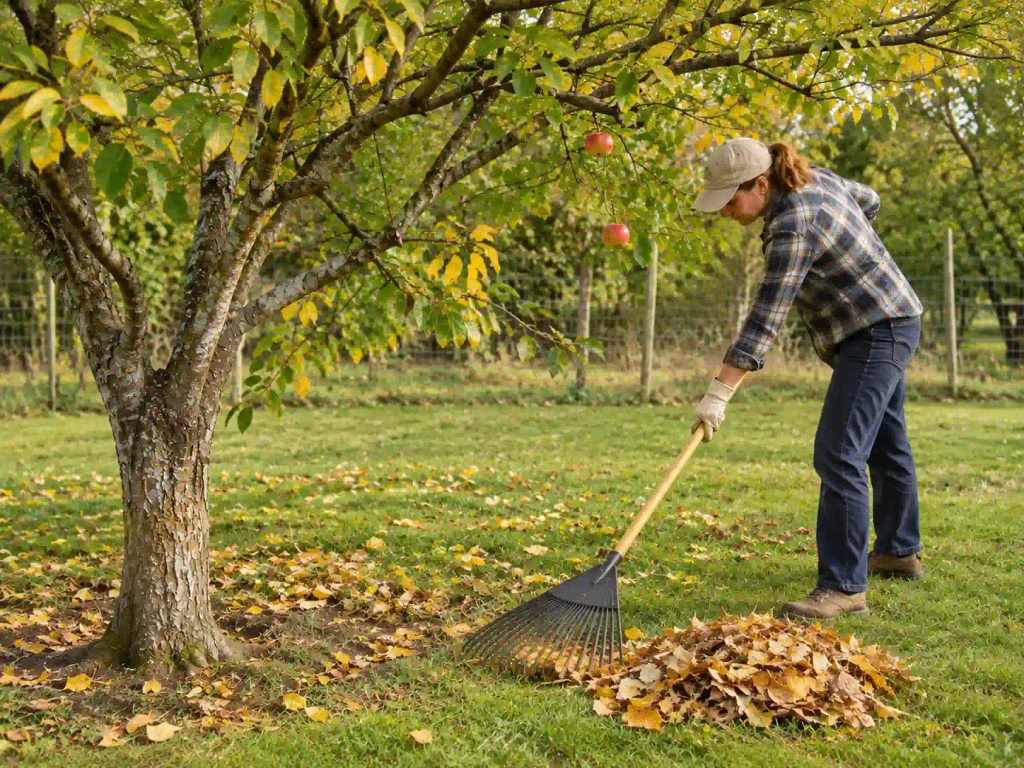
Rake fallen leaves beneath affected apple and crabapple trees and remove them from the immediate orchard area. Alternatively, thoroughly shred the leaves with a mower where the site allows safe access.
Proper composting can be suitable when material breaks down adequately, although simply piling infected leaves beneath the tree is not equivalent to effective composting. Follow local disposal rules and avoid using untreated infected leaves as orchard mulch.
During cleanup, note which trees lost leaves early and which retained healthy foliage. This provides useful information when reviewing cultivar susceptibility.
Winter: Improve Canopy Structure
Plan structural pruning during the appropriate dormant period for your climate, generally after the harshest winter cold and before active spring growth. Remove dead or damaged branches and selectively thin crowded areas to improve light penetration and air movement.
Young trees usually need careful training and relatively modest pruning. Mature, overgrown trees may require gradual correction over several seasons rather than extensive removal in one year.
Our apple tree pruning guide explains branch selection and pruning techniques. Use clean, sharp tools, and follow local extension advice when disease or winter injury complicates pruning decisions.
Early Spring: Monitor Conditions Before Infection
Begin checking susceptible trees as buds open and fresh green tissue becomes visible. Review the previous season’s disease severity and follow local extension alerts when persistent wet weather is expected.
If a preventive spray program is appropriate, early growth stages are particularly important. However, specific application intervals must come from the product label and regional recommendations rather than a universal calendar schedule.
For more advanced monitoring, Cornell’s NEWA apple scab forecast resource explains how weather and spore-development information can inform disease-risk decisions. Its models are valuable decision aids, but local interpretation is still necessary.
Summer: Monitor New Growth and Fruit Quality
Continue inspecting foliage after prolonged wet periods, particularly on susceptible cultivars. Note whether fresh lesions appear and whether fruit symptoms are becoming more extensive.
Maintain appropriate irrigation, but avoid repeatedly wetting the foliage when practical. Watering methods that supply the root zone directly can reduce unnecessary leaf wetness compared with overhead irrigation.
At harvest, inspect individual apples and set aside fruit showing cracks, soft decay, or other signs of deterioration. Keep records of disease severity so the next growing season’s approach is based on observations rather than guesswork.
Scab-Resistant Apple Varieties for Lower-Maintenance Orchards
Choosing a resistant cultivar can reduce the need for intensive disease management. However, resistance to apple scab does not necessarily mean resistance to fire blight, powdery mildew, cedar apple rust, or insect pests.
Cornell identifies Liberty, Enterprise, GoldRush, and several other cultivars as having useful scab resistance. Disease-resistance performance may vary by location and fungal population, so local recommendations remain important.
| Apple variety | Scab consideration | What to check before planting |
|---|---|---|
| Liberty | Widely recognized for strong scab resistance | Winter hardiness, fruit use, and pollination partner |
| Enterprise | Developed with scab resistance | Ripening season and local growing conditions |
| GoldRush | Recognized scab-resistant cultivar | Whether the growing season is long enough for proper ripening |
| Freedom | Listed as resistant in extension variety guidance | Local disease pressures and fruit preferences |
| Triumph | Newer University of Minnesota variety with strong scab resistance | Availability and suitability for the local climate |
Before ordering, compare USDA hardiness, expected tree size, rootstock characteristics, and pollination requirements. Rootstock influences growth and management needs, while the scion cultivar plays a major role in the fruit’s disease-resistance profile.
Our disease resistant apple trees guide covers additional choices. You can also compare climatic suitability in our apple tree varieties by zone guide.

For an existing susceptible tree, replacing it is rarely the first response to a modest outbreak. However, when planning new plantings or replacing a repeatedly troublesome tree, choosing a suitable resistant variety may simplify future maintenance.
Can You Eat Apples With Scab?
Apple scab can produce superficial blemishes as well as severe cracking and fruit distortion. Therefore, the presence of a scab lesion does not tell you everything about an apple’s condition.
Fruit with small, dry surface blemishes may still be usable after careful inspection and normal washing. However, apples with soft rot, visible mold, extensive cracking, or deterioration should be discarded rather than treated as harmless cosmetic damage.
University of Minnesota Extension notes that heavily scabbed fruit is often unsuitable for eating. Additionally, Cornell explains that severe lesions can reduce storage life and contribute to fruit deterioration.
Evaluate each apple individually and avoid storing damaged fruit with sound fruit for extended periods. If fruit quality is uncertain, discard it.
When to Ask an Extension Expert or Arborist
Most mild outbreaks can be managed through monitoring and routine orchard care. However, expert help is appropriate when severe defoliation repeats, symptoms do not match typical lesions, or several diseases appear to be affecting the same tree.
Seek diagnostic assistance when a tree shows extensive branch dieback, significant bark injury, rapidly worsening decline, or fruit damage that cannot be explained confidently. These symptoms may involve problems beyond apple scab.
Your county cooperative extension office or a university plant diagnostic clinic can advise on samples and local disease concerns. A certified arborist may also help evaluate the structural health of a large or declining tree.
FAQs
Can an apple tree recover from apple scab?
Yes, many affected trees continue growing and can recover their foliage in subsequent seasons. However, repeated severe leaf loss may weaken the tree, so sanitation, appropriate care, and prevention are important for long-term health.
Will apple scab go away without fungicide?
Symptoms on existing leaves will remain until those leaves fall, but an outbreak does not always require spraying. Mild disease may be managed through sanitation, canopy care, and resistant varieties, particularly when perfect-looking fruit is not essential.
Should I remove every leaf with apple scab?
No. Removing large amounts of attached foliage may unnecessarily reduce the tree’s functioning leaf area, especially when infection is widespread. Concentrate on fallen leaves, monitoring, and preserving healthy growth rather than stripping the canopy.
Does apple scab spread to other apple trees?
Yes. Spores can move by wind and water to susceptible apple and crabapple trees when conditions favor infection. Cleaning up one tree helps reduce local inoculum but cannot completely prevent exposure from nearby hosts.
When is the best time to prevent apple scab?
Prevention begins with fallen-leaf management and dormant-season canopy care. Where fungicides are justified, protection is focused on susceptible new growth during spring infection periods, following regional guidance and current product labels.
Can apple scab infect crabapple trees?
Yes. The disease affects both edible apples and many ornamental crabapples. Susceptible crabapples may develop dark leaf spots, yellowing foliage, premature leaf loss, and blemished fruit.
Is apple scab caused by insects or poor soil?
No. Apple scab is caused by the fungal pathogen Venturia inaequalis. Weather, susceptible cultivars, and infected leaf litter influence disease development, while unrelated growing stresses may affect the tree’s overall condition.
Related Articles
These published Apple Tree Guide resources provide more detailed information about related diagnosis and prevention decisions:
- Apple Tree Diseases: Identification and Treatment Guide
- Apple Tree Disease Identification: Visual Signs
- Cedar Apple Rust: Symptoms and Management
- Disease Resistant Apple Trees for Backyards
- Apple Tree Pruning: Timing and Techniques
- Apple Tree Varieties by USDA Zone
Sources
- Cornell Integrated Pest Management. Apple Scab Fruit Fact Sheet. https://cals.cornell.edu/integrated-pest-management/outreach-education/fact-sheets/apple-scab-fruit-fact-sheet
- University of Minnesota Extension. Apple Scab of Apples and Crabapples. https://extension.umn.edu/garden-and-home/yard-and-garden/gardening-in-minnesota/yard-and-garden-problems/apple-scab
- University of Maryland Extension. Apple Scab Disease. https://extension.umd.edu/resource/apple-scab-disease
- Oregon State University Extension. Managing Diseases and Insects in Home Orchards. https://extension.oregonstate.edu/catalog/ec-631-managing-diseases-insects-home-orchards
- Cornell Network for Environment and Weather Applications. Apple Scab Disease Forecasting. https://newa.cornell.edu/apple-scab
- University of Vermont Fruit Program. VT Apple IPM: Apple Scab. https://blog.uvm.edu/fruit/2024/04/24/vt-apple-ipm-apple-scab/
- University of Minnesota Extension. Apple Scab: About and Significance of Early Season Management. https://blog-fruit-vegetable-ipm.extension.umn.edu/2026/04/article-written-by-madeline-wimmer-umn_15.html
Important disease and pesticide disclaimer: This article provides general information based on university extension research. Field diagnosis can be difficult because several apple diseases and environmental problems produce similar symptoms. For uncertain or severe cases, consult a certified arborist, your local cooperative extension office, or a university plant diagnostic clinic.
Fungicide recommendations vary by crop, state, formulation, and current pesticide registration. Always read and follow the complete product label, including crop eligibility, application instructions, protective equipment requirements, pollinator precautions, and harvest restrictions. The label is the legal authority for pesticide use.