
Cedar Apple Rust: 6 Proven Symptoms, Lifecycle & Treatment
Cedar apple rust is a fungal disease caused by Gymnosporangium juniperi-virginianae that alternates between apples or crabapples and susceptible junipers. It produces yellow-orange leaf spots, sometimes damages fruit, and forms jellylike orange horns on juniper galls. Management centers on correct identification, resistant varieties, and protection before spring infection.
Table of Contents
Key Takeaways
- Cedar apple rust needs two different hosts to complete its lifecycle.
- Check both sides of spotted leaves and inspect nearby junipers for galls.
- Visible spots record an infection that has already happened; sprays cannot restore damaged tissue.
- Light spotting often needs observation, while repeated early leaf loss deserves a management plan.
- Choose varieties with rust-specific resistance and follow local guidance before considering pesticides.
Finding orange spots on an apple tree can raise several different questions: Is the tree dying, is the fruit usable, and should you spray today? Cedar apple rust becomes easier to manage when you separate identification from severity and treatment timing.
For example, a close-up photograph can make a few lesions look alarming while showing nothing about the rest of the canopy. Start by looking at the whole tree, then examine individual leaves and fruit.
This guide brings those observations together with university extension recommendations. For a wider comparison of problems affecting an orchard, use our guide to apple tree diseases.
What Is Cedar Apple Rust?
Two hosts, one disease
Cedar apple rust is an infection, rather than a nutrient deficiency or insect infestation. Its apple host develops leaf and sometimes fruit symptoms, while its juniper host develops woody galls that become conspicuous during wet spring weather.
The word “cedar” is confusing because eastern red cedar is actually a juniper, Juniperus virginiana. Therefore, identify the evergreen before making removal decisions; a common name alone does not establish that it is a host.
Why the same fungus looks so different
An orange-speckled apple leaf and an orange, tentacled juniper gall represent different stages of the disease. As Penn State’s guide to related rusts explains, the fungus changes spore stages while moving between its hosts.
Consequently, looking for identical symptoms on both trees leads to missed clues. Our juniper apple rust guide focuses on interpreting the evergreen side of that relationship.
6 Cedar Apple Rust Symptoms and Signs to Check
Use these six observations as a checklist, rather than expecting every affected plant to show all six. Technically, spots and leaf loss are symptoms, while fungal structures are signs of the pathogen itself.
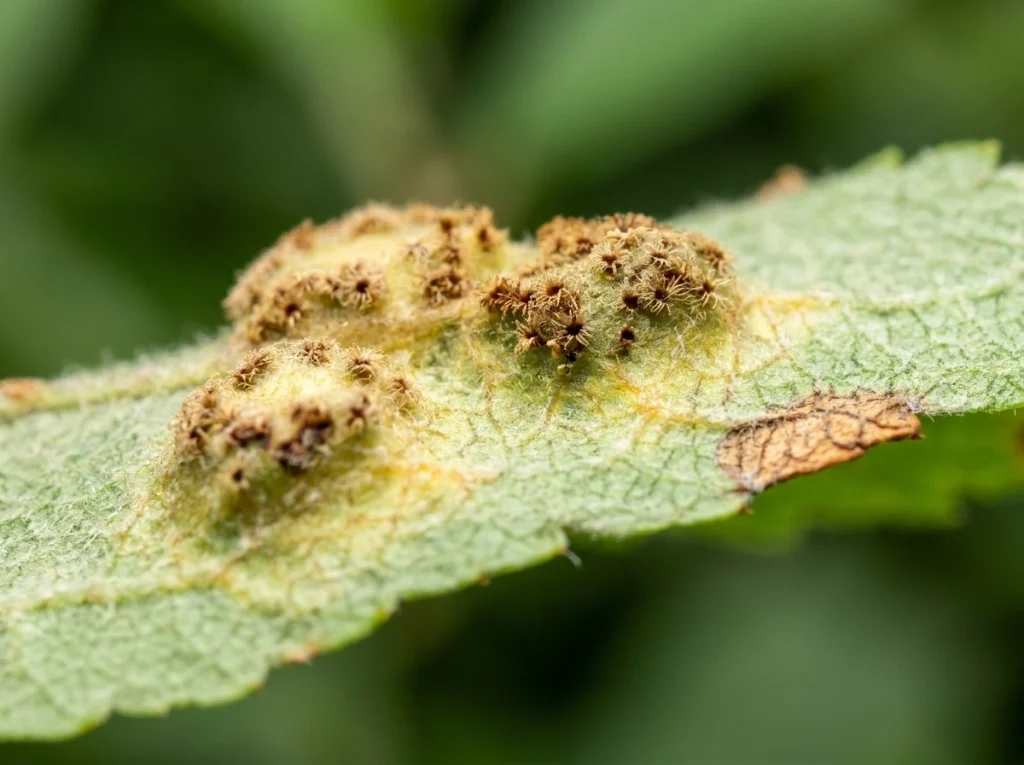
1. Yellow to orange spots on upper leaf surfaces
Early cedar apple rust lesions appear as small yellowish spots that become orange as they develop. However, orange color alone is not conclusive: record whether spots are scattered, roughly round, and accompanied by the features below.
For an apple-focused description with photographs, compare your leaves with NC State’s symptoms and signs. Photograph several affected leaves instead of relying on the most damaged example.
2. Tiny dark dots within mature spots
As lesions mature, small dark fungal structures can appear on the upper leaf surface. These dots belong to the developing rust lesion and should not automatically be treated as insect eggs.
For comparison, Penn State’s crabapple disease table describes dark structures above and fringed cups below rust spots. Use a hand lens or a sharp phone photograph to capture both surfaces.
3. Fringed tubes beneath the leaf
Later, small protruding structures called aecia develop underneath affected areas. Consequently, turning a leaf over can provide more useful evidence than another photograph of its orange upper surface.
These structures release spores associated with the return trip to the juniper host. The cedar rust factsheet hosted by Utah State Extension describes this distinctive underside stage.
4. Yellowing and premature leaf drop
Severe infections can cause leaves to yellow and fall before their normal autumn drop. However, leaf loss is a measure of damage, not a rust-specific identification feature.
Maryland Extension’s rust guidance connects heavy defoliation with reduced vigor and yield. Record whether the tree is retaining most of its canopy or losing leaves across several branches.
5. Raised or rough lesions on apples
Fruit may develop raised orange lesions that later become brown or cracked, and some affected fruit may drop. Nevertheless, rusty-looking apple skin is not always cedar apple rust.
For example, russeting produces rough, corky skin through several possible causes, including weather-related injury. Maryland’s explanation of apple russet helps distinguish a skin disorder from a diagnosis based on leaf and fruit symptoms together.
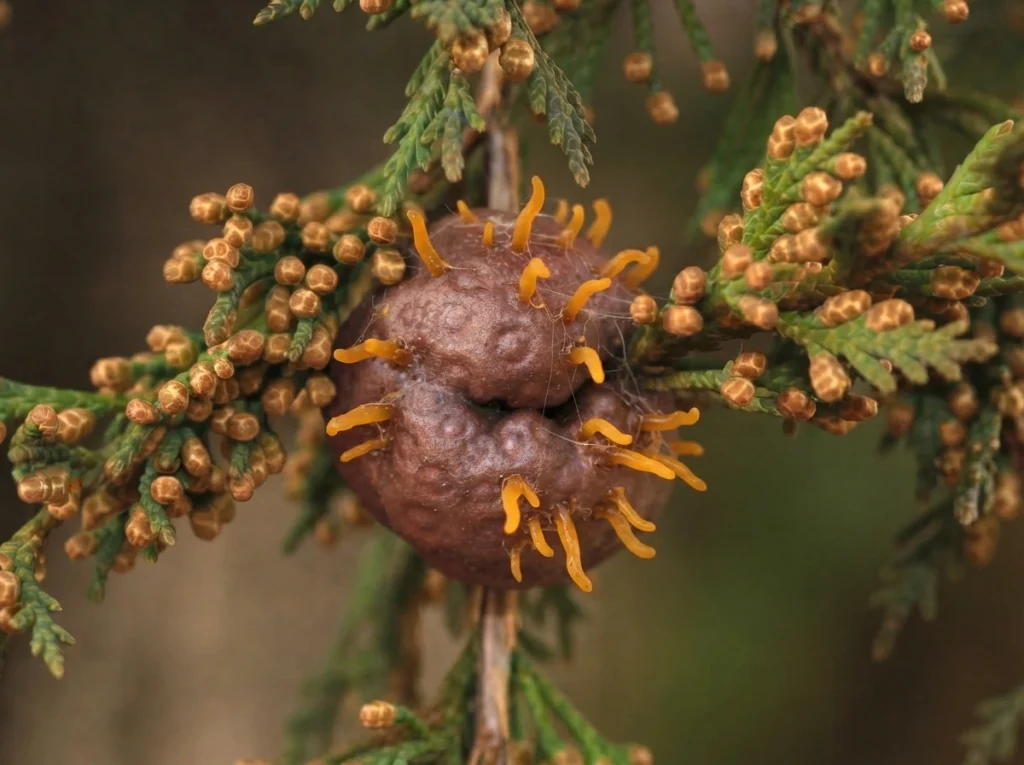
6. Brown juniper galls with orange jellylike horns
On susceptible junipers, look for rounded, dimpled woody galls on twigs. During spring wetting, orange gelatinous horns emerge, producing the striking appearance often compared with tentacles.
Penn State’s juniper disease guide identifies these galls as characteristic signs. However, orange growth along an elongated swelling may indicate another rust, so photograph the supporting twig as well.
How to Distinguish Rust From Similar Problems
Compare the pattern, not just the color
Cedar apple rust overlaps visually with related rust diseases. Therefore, combine host identity, leaf surfaces, fruit injury, and evergreen symptoms before deciding which disease name fits.
| Problem | Useful clue | Next check |
|---|---|---|
| Cedar apple rust | Orange leaf lesions and underside fungal tubes; rounded juniper galls | Inspect both hosts and note spring conditions |
| Cedar hawthorn rust | Similar leaf spotting on apples and other susceptible hosts | Compare the juniper stage or request a diagnosis |
| Cedar quince rust | Fruit and twig damage can be prominent; apple leaves may be unaffected | Check fruit injury and elongated evergreen swellings |
| Apple scab | Olive-brown, velvety lesions and later corky fruit patches | Compare lesion texture with verified scab photographs |
| Fruit russeting | Rough or netted corky skin without the matching rust leaf pattern | Review cultivar, weather, and spray history |
The rust comparisons follow Minnesota Extension’s identification guide; the scab distinction is described in Missouri’s disease-resistant apple guide. Read our cedar hawthorn rust guide or apple scab guide when those patterns fit better.
When bark symptoms change the investigation
Apple trunk decay, extensive peeling bark, or collapsing branches should not be explained away by a few rust spots. Likewise, a juniper with persistent swollen stems needs closer identification than “orange fungus.”
Photograph those symptoms separately and include them in a diagnostic request. This prevents a correct leaf diagnosis from becoming an unsupported explanation for every problem on the tree.
The Cedar Apple Rust Lifecycle, Step by Step
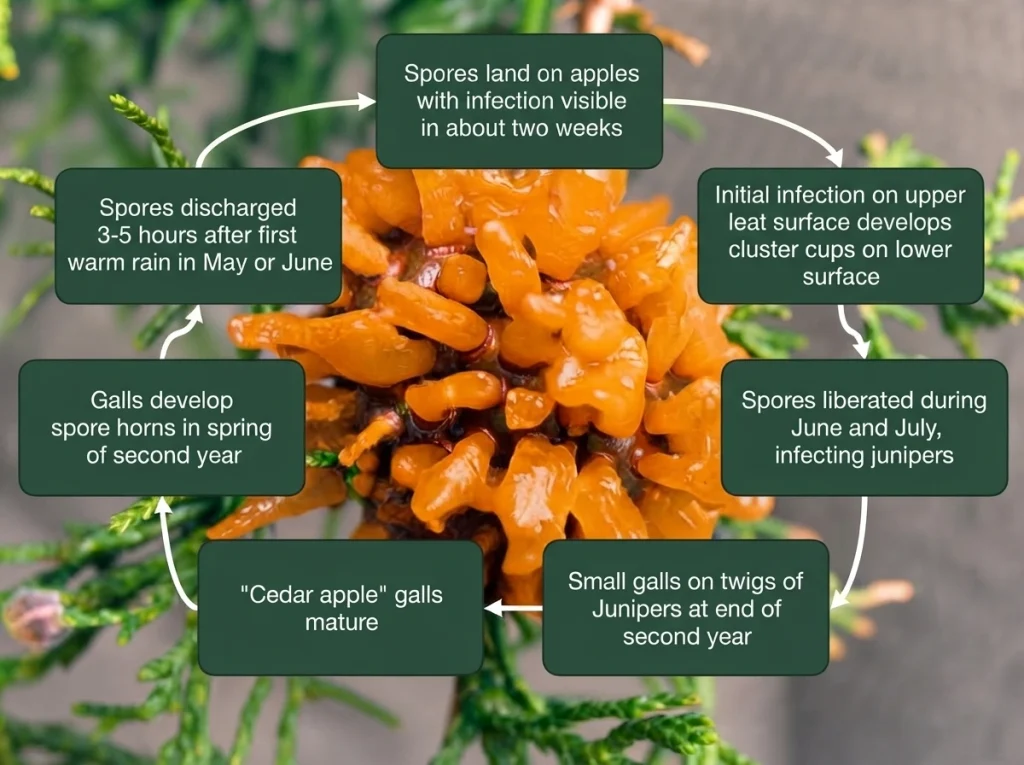
Winter: the fungus remains in the juniper
The fungus survives in living gall tissue on the evergreen host. Gall development extends across seasons, so a newly infected juniper does not immediately produce the familiar orange horns.
In particular, the long juniper stage does not mean an apple needs two years to show symptoms. Those are two different intervals within the same lifecycle.
Spring: spores reach susceptible apple tissue
During suitable wet spring conditions, mature galls produce horns and release the spore stage that infects apples. Leaves and developing fruit become exposed when susceptible tissue and favorable weather coincide.
Penn State’s pome fruit rust guide reports that leaf lesions can appear about 10 to 14 days after infection. Therefore, the date you discover spots is not necessarily the date the infection happened.
Summer: spores return to junipers
Structures on infected apple tissue eventually produce spores that infect susceptible junipers. Crucially, this stage does not generate repeating apple-to-apple infections.
Consequently, a spotted apple is not continually infecting neighboring apples with cedar apple rust throughout summer. Several apples can still develop symptoms because they received spores from the same spring source.
Why the disease can appear every year
Juniper infections from different years can overlap in a landscape. As a result, a lifecycle extending across seasons does not create a dependable alternate-year break for your orchard.
Use that distinction when evaluating treatment claims: fewer symptoms one summer do not establish that a particular spray ended the lifecycle. Weather, host susceptibility, and exposure also need consideration.
What Causes an Outbreak in a Backyard Orchard?
Susceptible trees and favorable spring weather
The fungus causes cedar apple rust, while wet spring conditions create opportunities for infection. For example, Maryland’s 2024 orchard observations reported increased rust during a rainy spring.
Keep rainfall notes alongside photographs and cultivar names. That record is more useful than assuming every disappointing season has the same cause.
No cedar in your yard does not rule it out.
Wind can carry infectious spores beyond property boundaries, and Minnesota Extension notes that infection can occur more than a mile from the source. Therefore, a short search around your fence is not enough to exclude cedar apple rust.
Equally, finding one gall does not prove it caused every lesion. Consider it evidence of local exposure, rather than a precise tracing of where each infection originated.
How Serious Is Cedar Apple Rust?
Judge canopy loss and repeated damage
Light spotting often has limited consequences, especially when leaves remain attached. However, repeated heavy infection and early defoliation on a susceptible apple can reduce growth and fruit performance.
Separate your observations into three practical descriptions: spots with a mostly intact canopy, substantial early leaf loss, or recurring leaf and crop damage. These are recording categories, not scientific treatment thresholds.
Match the response to your goal
A wildlife planting, a decorative crabapple, and a small eating-apple orchard may justify different responses to similar-looking spots. Before purchasing anything, decide whether your main concern is appearance, tree vigor, or usable fruit.
Maryland’s fruit care guidance recommends planning prevention after a current disease problem. Bring your actual leaf-loss and harvest records to that planning conversation.
Cedar Apple Rust Treatment: What Helps Now?
If spots have already appeared
Cedar apple rust treatment cannot make existing lesions turn healthy again. Start by confirming the diagnosis and determining whether the local spring infection period is still active.
Do not make repeated summer applications simply because old spots remain visible. Our cedar apple rust treatment guide develops this timing decision in more detail.
Extension guidance, paraphrased: Rust management should focus on preventing infection; visible lesions indicate damage that a later treatment cannot reverse. This principle underlies the NC State and Penn State recommendations cited here.
If spring infection risk is still present
Protecting uninfected tissue is different from curing a spotted leaf. NC State places rust protection around apple bud and bloom development, but published schedules vary with region and production setting.
Therefore, ask your extension service whether additional protection is justified for your cultivar and current conditions. Avoid converting one state’s recommendation into a fixed nationwide calendar date.
How to evaluate a fungicide recommendation
NC State’s home orchard guide discusses myclobutanil where rust protection is needed. However, an active ingredient mentioned in an extension article does not establish that every formulation is suitable for edible apples.
- Confirm that the actual product label permits use on the intended crop and site.
- Check that rust is included in its disease directions.
- Follow the rate, application interval, maximum use limits, and required protective equipment.
- Observe harvest restrictions and all environmental precautions.
Registration and available formulations can change, so verify the container label and local guidance before purchase. Our guide to the best fungicide for cedar apple rust addresses that comparison separately.
What about organic products and home remedies?
Organic management starts with resistant planting choices and reducing exposure. However, “organic” does not guarantee that a spray controls this disease or repairs existing damage.
Penn State’s orchard guidance cautions that effective organic rust control options are lacking. Use our organic treatment for cedar apple rust guide to assess limitations, rather than relying on a homemade recipe with no demonstrated rust-control evidence.
Preventing Cedar Apple Rust Next Season
Choose resistance to this particular disease.
Check the rust rating itself when buying an apple tree. For example, Missouri Extension’s cultivar table rates Liberty very resistant to cedar apple rust and Redfree resistant, while Goldrush is scab resistant but rust susceptible.
Therefore, a nursery’s broad “disease resistant” description is not enough. Our cedar apple rust resistant varieties guide helps narrow the choices before you check local suitability.
Consider climate, rootstock, and pollination too.
Rust resistance is one part of selecting a productive backyard tree. Missouri’s home apple production guide explains how cultivar and rootstock choices affect orchard performance.
Ask the nursery to confirm climate suitability, mature size, and a compatible pollination arrangement. A rust-resistant cultivar still needs to fit the space and growing conditions you can provide.
Remove accessible juniper galls before spring activity
Where practical, remove identified galls before their orange horns develop. Penn State’s home fruit guidance includes this approach when nearby red cedars remain in place.
However, gall removal reduces a local source without guaranteeing freedom from windborne infection. Avoid treating removal of every neighborhood evergreen as a realistic requirement for growing apples.
Keep routine care focused on tree health.
Pruning apples to admit light and air can help reduce leaf wetness, according to the University of Vermont Extension. Combine appropriate pruning with ordinary care, rather than stripping spotted leaves to make the tree look clean.
For next year’s records, note the cultivar, first orange gall activity, first leaf spots, and any early leaf loss. If you use a labeled treatment, record the product and application date so its timing can be reviewed.
When to Call a Professional
Get help when the diagnosis or response is uncertain
Contact an extension plant diagnostic clinic when symptoms do not fit, a young tree loses much of its canopy, or major damage returns year after year. Also seek help when fruit injury occurs alongside cankers, wilt, or branch death.
Send whole-tree photographs, both sides of affected leaves, close-ups of fruit, your location, and the cultivar if known. Include previous sprays and their dates, since a treatment history helps the adviser interpret what happened.
FAQs
Will cedar apple rust kill my apple tree?
Cedar apple rust rarely kills either host, but repeated serious defoliation deserves attention. As Vermont Extension explains, the leaf-spot stage can affect apple vigor even when the disease is not fatal.
Can you eat apples with cedar apple rust?
Vermont Extension says apples showing cedar apple rust symptoms are edible, with blemished areas removed if desired. However, that advice does not clear fruit with additional decay or override a pesticide label’s harvest restrictions.
What is the best fungicide to prevent cedar rust on apples?
There is no single cedar apple rust product recommendation suitable for every location and tree use. Start with local extension guidance, then verify that the current product label covers edible apples, the disease, and the intended application.
Is it too late to treat cedar apple rust in summer?
It is too late to erase cedar apple rust lesions once they are visible. If the local spring infection period has ended, additional spraying for those old lesions provides no preventive benefit against that completed infection period.
How can I prevent it without removing nearby cedars?
Choose cedar apple rust resistant varieties and remove accessible, identified juniper galls before spring spore activity where feasible. Then use the tree’s actual damage history to decide with your extension adviser whether further protection is warranted.
Sources
- NC State Extension: Cedar Apple Rust
- Penn State Extension: Cedar Apple and Related Rusts on Ornamentals
- Penn State Extension: Crabapple Diseases
- Utah State Extension hosted factsheet: Ornamental Tree Disease, Cedar Rust
- University of Maryland Extension: Rust Diseases of Trees
- Penn State Extension: Juniper Diseases
- University of Maryland Extension: Russet on Apples
- University of Minnesota Extension: Cedar-Apple Rust and Related Rust Diseases
- University of Missouri Extension: Disease-Resistant Apple Cultivars
- Penn State Extension: Pome Fruit Disease, Rust
- University of Maryland Extension: Looking Back at Spring and Ahead to Harvest
- University of Maryland Extension: Fruit Plant Care
- NC State Extension: Disease and Insect Management in the Home Orchard
- University of Missouri Extension: Apple Cultivars and Their Uses
- University of Missouri Extension: Home Fruit Production, Apples
- Penn State Extension: Pest Management in Apples in Home Fruit Plantings
- University of Vermont Extension: Cedar Apple Rust Disease
Disclaimer: This article provides general information, not a confirmed diagnosis for an individual tree. For identification and locally appropriate management, contact your university cooperative extension plant diagnostic clinic or a qualified arborist.
Always read and follow the pesticide label before applying any product. Confirm permitted crops, application directions, precautions, and harvest restrictions for the exact formulation you use.
