
Roundheaded Apple Tree Borer: Proven ID & 4 Control Steps
Roundheaded apple tree borer is a longhorn beetle whose larvae tunnel into the lower trunk of apple trees, leaving reddish-brown frass, dark or sunken bark, sap stains, and later round exit holes. Control starts with confirming active tunneling, removing reachable larvae, protecting the trunk from new egg laying, and reducing tree stress while monitoring for fresh damage.
Table of Contents
Key Takeaways
- Roundheaded apple tree borer larvae feed inside bark and sapwood, so early detection matters most.
- Fresh reddish-brown frass near the lower trunk is a stronger clue than a clean old exit hole.
- Young trees can be badly weakened when tunneling interrupts water movement or removes too much sound wood.
- Mechanical removal can help when a larva is still shallow enough to reach without excessive bark removal.
- Prevention depends on regular trunk inspection, careful watering, open trunk visibility, and only label-compliant pesticide use when justified.
Finding sawdust at the base of a young apple tree can be unsettling, especially when the canopy still looks normal. A roundheaded apple tree borer problem is easiest to manage before trunk damage becomes extensive. The roundheaded apple tree borer can spend a long time hidden in the trunk, so the first visible clue may be frass, a sap-stained patch, loose bark, or a weakened section near the soil line.
The pest is Saperda candida, a longhorn beetle in the family Cerambycidae. University of Minnesota Extension describes adults as brown-and-white striped beetles with long antennae, while the larvae are cream colored, legless grubs that tunnel through woody tissue. If you are not sure that the damage is from this species, start with our apple tree borer guide and compare the location and type of injury before cutting bark or applying any product.
How to identify roundheaded apple tree borer damage
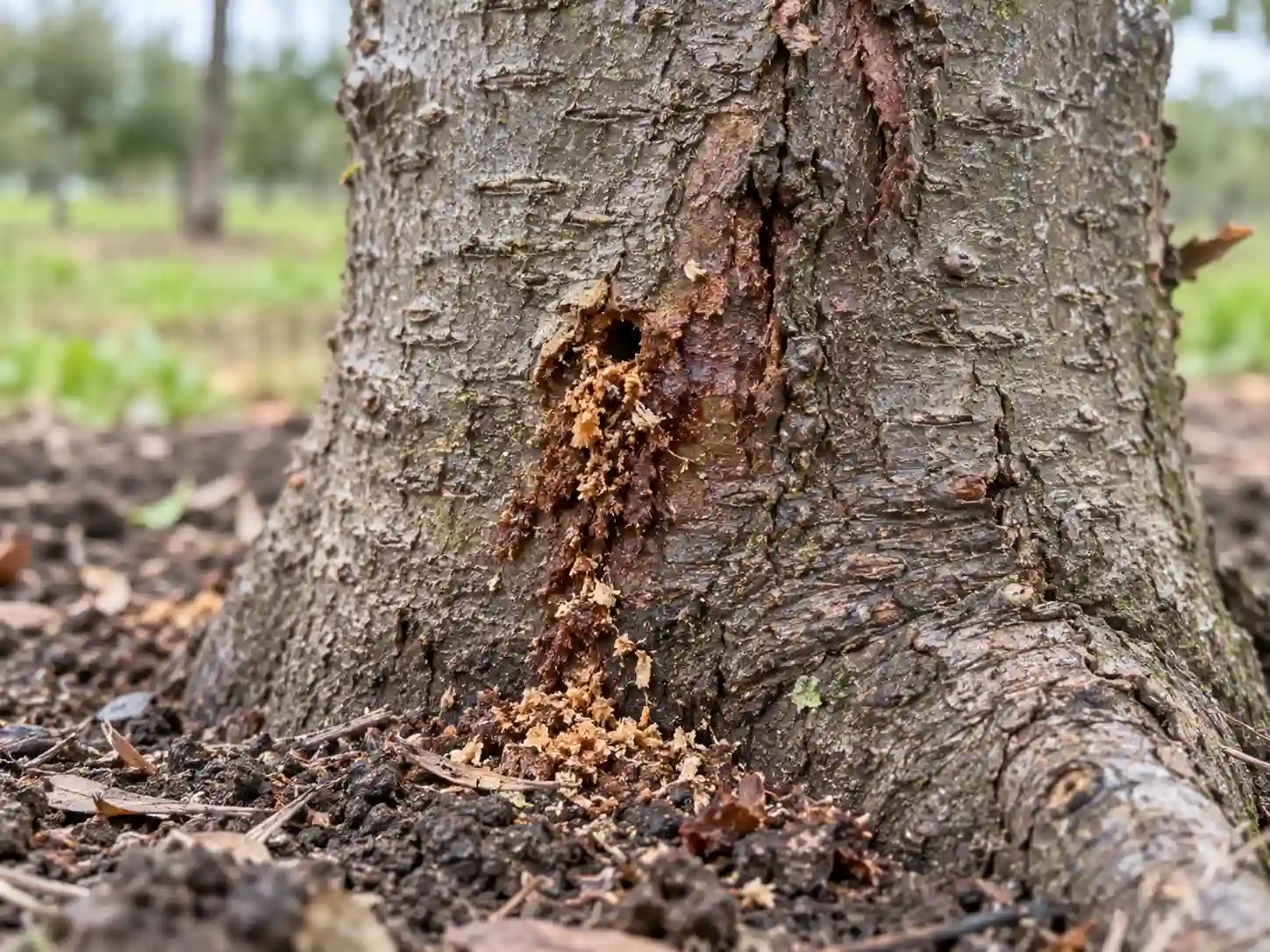
The most useful inspection area is the lower trunk, including the root flare and the first several inches above the soil. University of Minnesota Extension lists reddish-brown frass near the base, sparse or pale foliage, branch dieback, round trunk holes, and large tunnels in the sapwood among the key signs of roundheaded apple tree borer activity.
Roundheaded apple tree borer signs to check first
- Fresh frass: sawdust-like or pigtail-shaped material pushed from a feeding site.
- Dark or wet-looking bark: sap flow can stain the bark around an active entrance area.
- Soft or loose bark: shallow larval feeding may separate damaged bark from sound tissue.
- Round exit holes: a clean round hole can indicate that an adult beetle has already emerged.
- Canopy decline: sparse leaves, yellowing, dieback, or reduced vigor can appear as internal damage accumulates.
A single hole does not prove that a larva is still inside. Therefore, look for fresh frass, moist sap staining, soft tissue, or new material that reappears after you gently brush the trunk clean. Our apple tree pests identification guide can help when the symptoms could also fit another insect, a canker, physical bark injury, or woodpecker activity.
| Clue | What it suggests | Best next check |
|---|---|---|
| Reddish-brown frass at lower trunk | Active wood-boring larva is possible | Clean the area and watch for fresh frass |
| Round hole with no new frass | Old exit hole is possible | Inspect surrounding bark for active sites |
| Chewed leaves with no trunk injury | Leaf-feeding insect is more likely | Compare with caterpillars on apple trees |
| Sunken or dead bark without frass | Canker, sun injury, or another cause is possible | Use local Extension or an arborist for diagnosis |
Why this borer can seriously weaken an apple tree
Roundheaded apple tree borer larvae do the damaging work inside the trunk. Missouri Extension reports a two-year life cycle and notes that the borer can attack apple as well as pear, quince, mountain ash, hawthorn, and serviceberry. The larva feeds beneath the bark and into woody tissue before eventually pupating and emerging as an adult.
That hidden feeding matters because a young trunk has limited sound tissue to spare. On a young tree, roundheaded apple tree borer tunnels can occupy a meaningful share of the trunk cross-section. Tunnels can interrupt the tissues that move water and nutrients, while larger galleries reduce structural strength. Missouri Extension notes that badly affected young trees can die and that previously damaged trees may later break near the ground.
Extension guidance is consistent on one point: borer management works best when it starts with identification, monitoring, and prevention, because larvae already deep inside wood are difficult to reach safely.
Do not assume that a vigorous-looking tree is automatically safe. Missouri Extension specifically notes that roundheaded apple tree borer does not appear to distinguish reliably between weak and healthy trees. However, good tree care still matters because a well-watered, correctly planted tree has more capacity to tolerate limited injury and recover from bark damage.
4 proven control steps for roundheaded apple tree borer
1. Confirm whether the roundheaded apple tree borer is still active
Start by brushing away loose frass and inspecting the trunk in good light. Mark suspicious spots with a removable tag or take a close photograph, then recheck for new frass. Fresh material, sap staining, or soft bark is more useful than an old clean hole when deciding whether a larva may still be feeding.
Check the entire lower trunk and root flare, not just the first obvious spot. Also inspect nearby young apple trees because more than one tree can be exposed during the same adult activity period. If the pattern is unclear, use the broader apple tree pest control guide before choosing a treatment.
2. Remove a reachable larva without stripping healthy bark
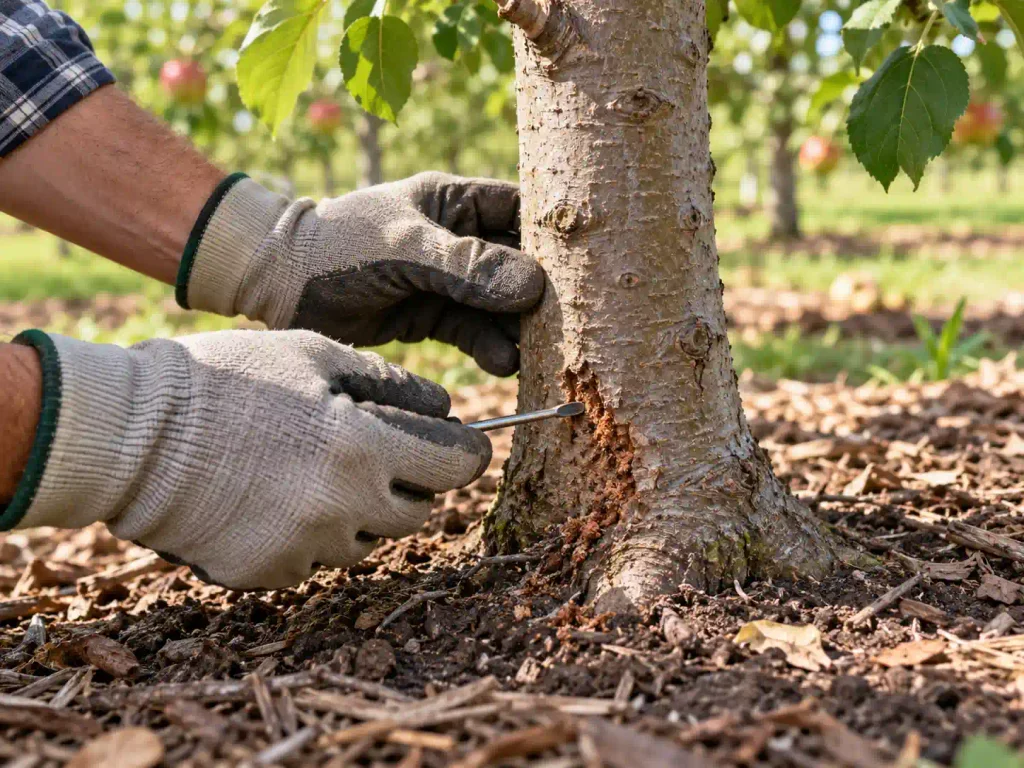
Missouri Extension describes a traditional mechanical approach for young larvae near the bark surface. A shallow slice at a fresh sap-stained area may expose or kill a larva. If a tunnel is visible, a stiff wire may sometimes reach farther into the gallery.
This method requires restraint. Do not carve widely around the trunk, peel sound bark, or chase a deep tunnel through healthy cambium. If the damaged area is large, circles much of the trunk, or feels structurally weak, stop and ask a certified arborist or local Extension office to assess whether the tree can be retained safely.
3. Prevent new egg laying and keep the trunk visible
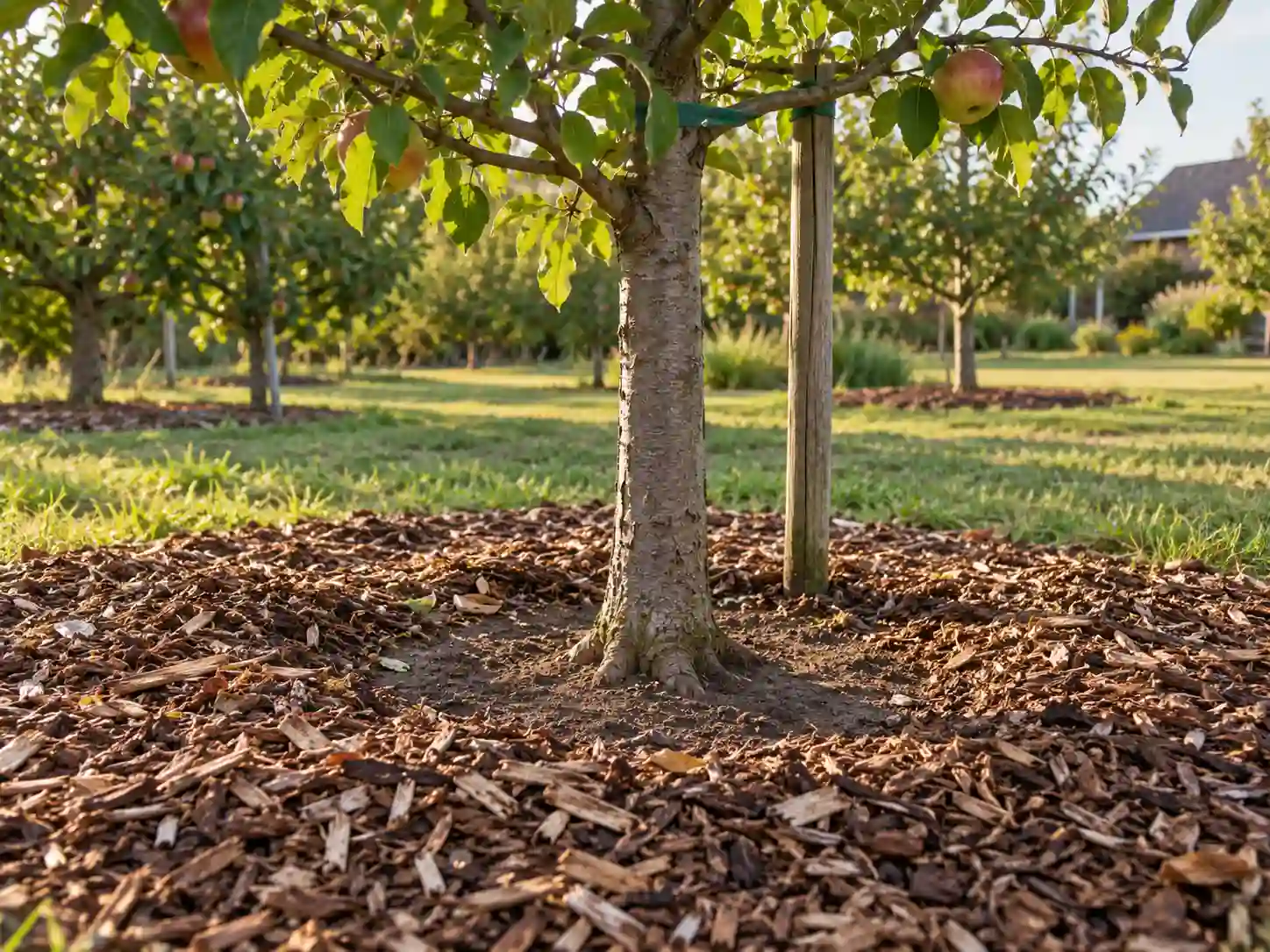
Prevention is easier when the lower trunk can be inspected quickly. Roundheaded apple tree borer prevention starts with keeping that inspection zone visible and undamaged. Keep mulch from touching the bark, control dense weeds at the base, and remove guards that hide the trunk when they are no longer needed for animal protection. If you use a guard, check it regularly so it does not trap moisture or girdle the tree.
For general trunk care, our apple tree mulching guide explains how to keep organic material away from the root flare. If the tree is drought-stressed, use the apple tree watering guide to restore consistent root-zone moisture without keeping the trunk wet.
Some Extension programs describe physical barriers or trunk whitewashing as part of borer prevention. Because materials and recommendations vary by region, use your local Extension guidance before applying a coating or installing a barrier, and make sure any wrap remains loose enough for trunk growth and ventilation.
4. Use pesticides only when the label and local timing fit
Insecticides cannot reliably reach a roundheaded apple tree borer larva once it is deep inside wood. Missouri Extension explains that sprays are most useful when timed against adults during the egg-laying period, before larvae are protected inside the trunk. Therefore, calendar spraying without confirming local adult activity is a poor substitute for scouting.
If you are considering a pesticide, verify that the current product label lists apple and the target use in your state. Follow every label direction for application site, timing, protective equipment, harvest restrictions, and pollinator protection. The organic apple tree pest control guide covers lower-input decision-making, but “organic” does not mean risk-free or automatically effective against a larva already inside the trunk.
Roundheaded vs. flatheaded apple tree borer
These pests are easy to confuse because both can injure trunks and produce frass. The important practical difference is that they are different beetles with different behavior, so a product or timing recommendation for one should not automatically be transferred to the other. Use our dedicated flatheaded apple tree borer guide when the adult, exit hole, or injury pattern does not match the roundheaded species.
For roundheaded apple tree borer, the combination of lower-trunk tunneling, reddish-brown frass, darkened bark or sap staining, and a brown-and-white longhorn beetle is especially useful. Minnesota Extension reports adults active from June through August, but local weather shifts insect development. That is why regional Extension timing should take priority over a fixed national spray date.
Can an infested apple tree be saved?
Sometimes, especially when the damage is localized and a shallow larva is found early. A roundheaded apple tree borer infestation is not automatically a reason to remove the tree. A tree with most of its trunk circumference intact, a stable trunk, and a functioning canopy may continue growing after the active borer is removed. However, hidden galleries can be more extensive than the surface injury suggests.
Replacement becomes more reasonable when the trunk is badly girdled, multiple large galleries weaken the base, the tree has major dieback, or the trunk can no longer support the canopy safely. A young replacement tree may establish faster than a severely damaged tree can recover. Do not base that decision on one exit hole alone.
Prevention checklist for young apple trees
- Inspect the lower trunk several times through the growing season and again after leaf fall.
- Keep the root flare visible and mulch off the bark.
- Prevent mower and string-trimmer wounds.
- Water young trees deeply enough to prevent repeated drought stress, while avoiding saturated soil.
- Check stakes, ties, wraps, and guards so they do not rub or girdle the trunk.
- Remove severely infested wood from the orchard area according to local guidance.
- Confirm the pest before using any insecticide.
This routine also improves detection of other trunk problems. If you see a different boring pattern, start with apple tree borer identification rather than assuming every hole is caused by roundheaded apple tree borer.
FAQs
What does roundheaded apple tree borer frass look like?
It is commonly described as reddish-brown, sawdust-like material that can collect on the bark or at the base of the tree. Missouri Extension also describes pigtail-shaped frass and wood cuttings. Fresh material that returns after cleaning is more suggestive of active feeding than old debris.
Where should I look for roundheaded apple tree borer damage?
Start at the lower trunk and root flare. Look for frass, darkened bark, sap staining, soft bark, and round holes. Then inspect upward for dieback or a sparse, pale canopy that could indicate more advanced disruption of the trunk.
Can I kill a roundheaded apple tree borer with a wire?
A stiff wire can sometimes kill a larva in an accessible tunnel, and Missouri Extension describes this as a mechanical option. However, do not force a wire blindly through healthy tissue or enlarge the wound unnecessarily. Serious or extensive damage is a good reason to involve an arborist or Extension diagnostician.
Will spraying the leaves kill larvae already inside the trunk?
Not reliably. Larvae deep in wood are physically protected from many contact sprays. Chemical management, when warranted and label-compliant, is generally aimed at adults before or during egg laying rather than at mature larvae deep inside galleries.
When are adult roundheaded apple tree borers active?
University of Minnesota Extension lists adult activity from June through August. Local timing varies with climate and season, so use regional Extension monitoring information before making a pesticide decision.
Related Articles
- Apple Tree Borer: identification and control
- Flatheaded Apple Tree Borer
- Caterpillars on Apple Trees
- Apple Tree Pests Identification
- Apple Tree Pest Control
- Organic Apple Tree Pest Control
Sources
- Missouri Extension: Insect Borers of Fruit Trees
- University of Minnesota Extension: Roundheaded Apple Tree Borer diagnostic guide
- Penn State Extension: Urban Tree Pests
- Oregon State University Extension: Fruit Tree Integrated Pest Management
