
Apple Tree Pests Identification: Proven Practical Guide
Apple tree pests identification is easiest when you match the damage pattern to the tree part affected, then confirm it with the insect, residue, or life stage you can find. This guide covers the common clues linked with codling moths, apple maggots, aphids, mites, borers, scale, and leaf-chewing pests.
Table of Contents
Key Takeaways
- Apple tree pests identification depends on where the damage appears: leaves, fruit, bark, shoots, or roots.
- Small holes, frass, sticky honeydew, webbing, cottony colonies, and tunnels point to different pest groups.
- Monitor before treating, protect beneficial insects, and use only products whose labels allow the intended crop, pest, and application.
Finding a damaged apple can be frustrating, especially when the culprit is no longer visible. However, a close inspection usually narrows the possibilities. Start by photographing the injury, checking several leaves and fruits, and recording when the symptoms appeared.
Good apple tree pests identification also prevents unnecessary spraying. Oregon State University Extension explains that some pests are difficult to see and that traps can help monitor codling moths, leafrollers, and fruit flies before control decisions are made.[1]
Apple Tree Pests Identification Starts With the Damage Pattern
The first step in apple tree pests identification is to locate the main injury. Chewed leaf edges suggest a different group from a fruit entry hole, while bark tunnels point toward a borer. In contrast, curled leaves with sticky residue often indicate sap-feeding insects. This symptom-first approach makes apple tree pest identification more useful than guessing from color alone.
Check the tree part affected
- Leaves: Look for holes, skeletonized tissue, stippling, blisters, curling, or a shiny coating.
- Fruit: Look for dimples, tunnels, frass, misshapen skin, rot around a hole, or brown trails below the surface.
- Bark and shoots: Look for cottony colonies, armored bumps, cracks, loose bark, sawdust-like frass, or exit holes.
- Roots and crown: Look for galls, weakened growth, or injury near the soil line, especially on young or stressed trees.
Look for the confirming clue
Next, inspect the underside of leaves, fruit clusters, pruning cuts, and branch unions. Use a hand lens if possible. A pest may be present as an egg, crawler, larva, nymph, adult, or shed skin, so one inspection does not always provide a complete answer. Careful apple tree pest identification therefore uses more than one clue.
| Damage pattern | Likely pest group | Useful confirming clue |
|---|---|---|
| Entry hole with crumbly material and a tunnel toward the core | Codling moth | Pinkish larva or golden-brown frass |
| Small dimples, pitting, and brown winding trails in the flesh | Apple maggot | Small fly with dark wing markings or red sticky trap catches |
| Curled, sticky leaves or deformed young fruit | Aphids | Clusters of soft-bodied insects, honeydew, or sooty mold |
| Fine stippling, bronzing, or webbing | Spider mites | Very small moving dots and silk, often in hot, dry weather |
| Frass, loose bark, dead limbs, or oval holes | Borers | Larval galleries beneath bark or adult exit holes |
| Small fixed bumps on bark or red halos on fruit | Scale | Armored scales or mobile crawlers |
| Irregular holes, skeletonized leaves, or rolled leaves | Caterpillars or sawflies | Chewing larvae, webbing, or folded leaves |
7 Common Apple Tree Pests and Their Identification Signs
Selected video: University of Wisconsin Extension, “Apple Pest Management for Home Gardeners.”
1. Codling moth: holes, frass, and a damaged core
Codling moth larvae are the familiar “worms” that feed inside apples. Look for a small entry hole, crumbly golden-brown frass near the opening, and a tunnel leading toward the seeds. The larva is pinkish with a brown head and can grow to about one-half inch, according to the University of Minnesota Extension.[2]
For apple tree pests identification, codling moth damage is more likely when the fruit is bored from the outside toward the core. This is one of the clearest apple tree pest identification clues in a damaged apple. Remove infested and fallen fruit, inspect storage areas for cocoons, and use a pheromone trap to learn whether adults are present. Treatment timing varies by local pest activity, so use regional extension recommendations rather than a fixed calendar.
2. Apple maggot: dimples, pitting, and brown trails
Apple maggot injury begins when the female makes a small sting in the skin and lays an egg. As the larva feeds, the apple develops pits, distortion, brown winding trails, and internal breakdown. The adult is a small fly with dark markings on clear wings and a conspicuous white spot near the thorax and abdomen.[3]
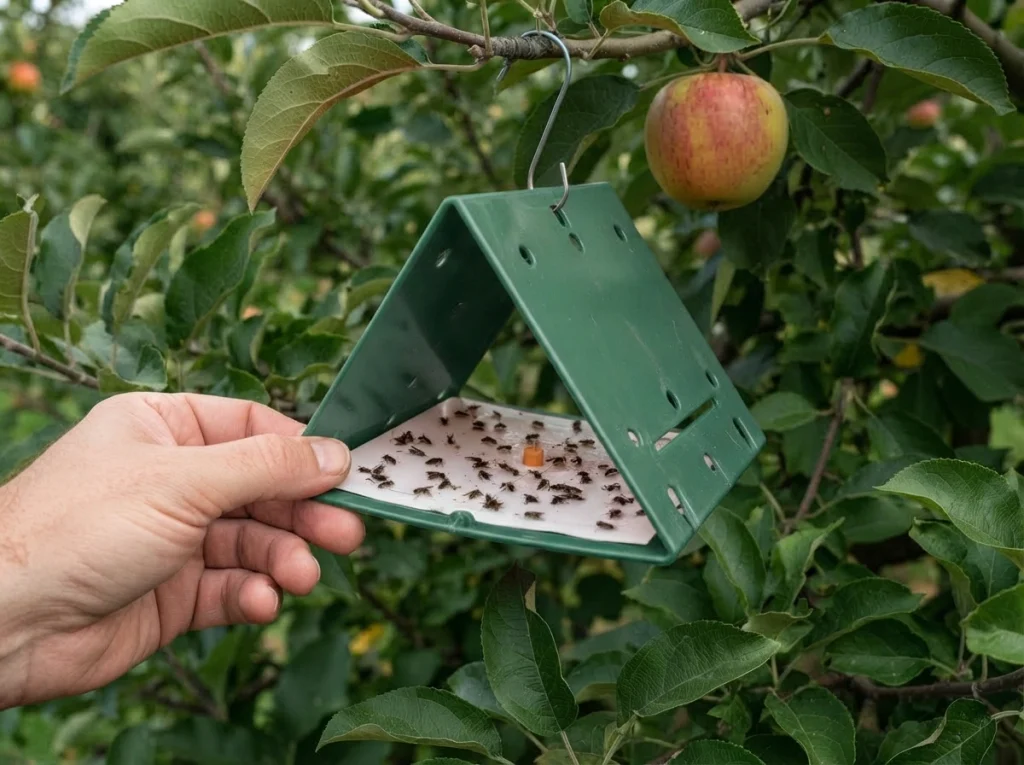
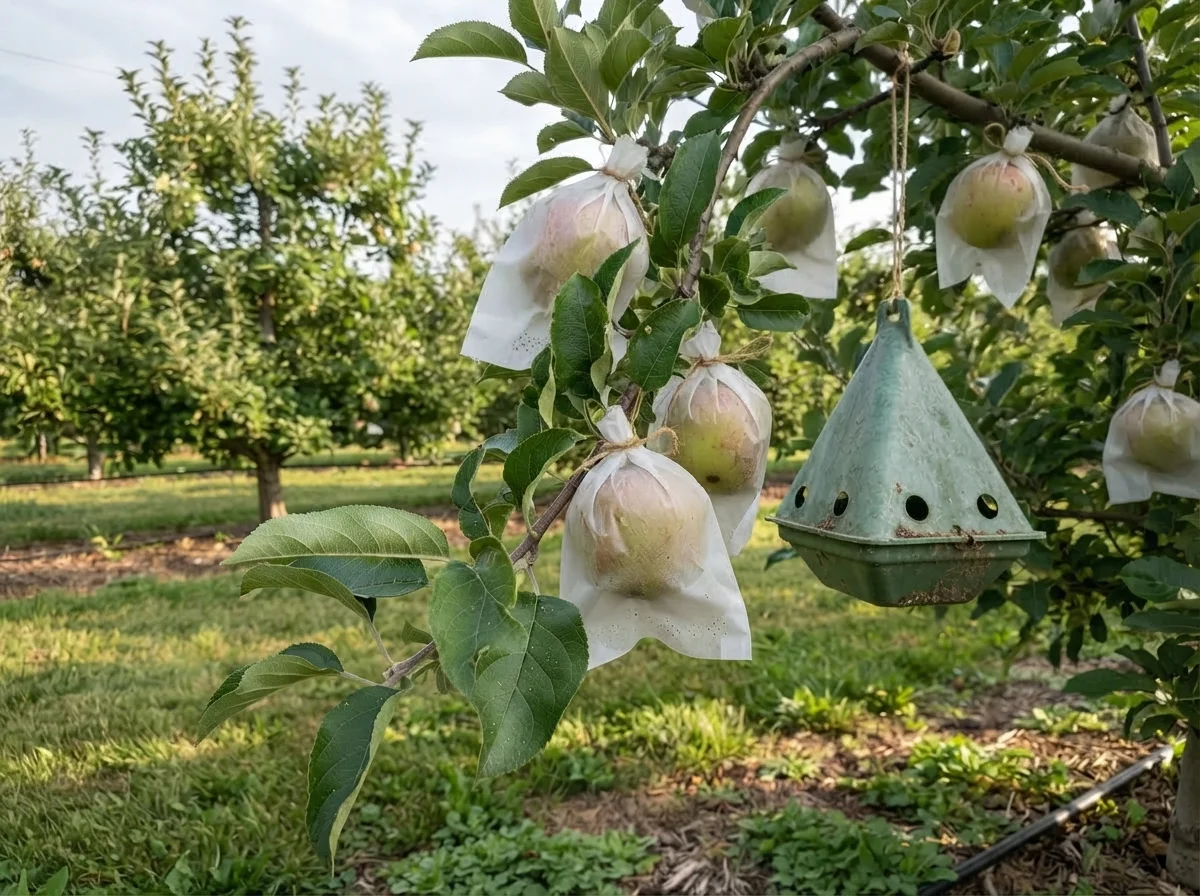
In practical apple tree pests identification, apple maggot is more consistent with fine internal trails and surface dimples than with one large entry hole and frass. These details make apple tree pest identification more precise when the adult fly is absent. Remove dropped apples, consider red sticky traps on the outer canopy, and use fruit bags or exclusion methods where appropriate for small trees.
3. Aphids and woolly apple aphids: curling, honeydew, and cottony colonies
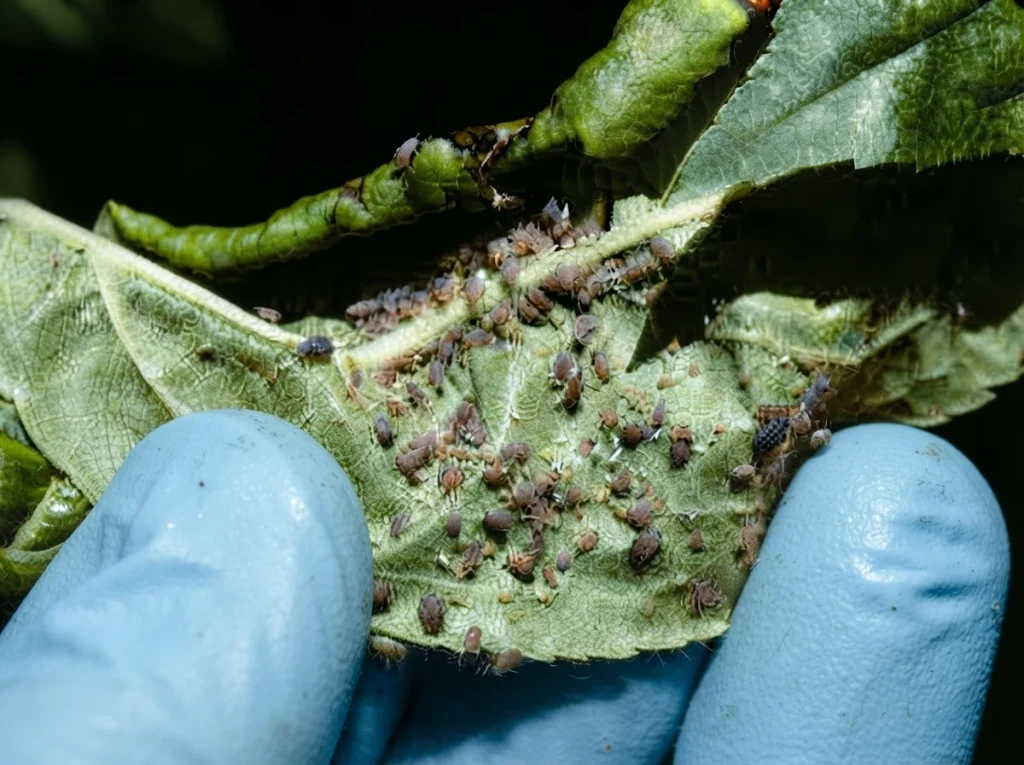
Aphids are soft-bodied sap feeders that gather on tender shoots and leaf undersides. Their feeding may cause curled leaves, sticky honeydew, black sooty mold, weak new growth, or distorted young fruit. Woolly apple aphids add a distinctive cottony appearance and may form colonies at pruning wounds, cracks, twigs, or roots.[4]
When apple tree pests identification points to aphids, first check whether lady beetles, lacewings, or syrphid larvae are already suppressing the colony. For apple tree pest identification, the presence of beneficial insects is an important part of the diagnosis and decision. A small population may not require treatment. A strong water spray or a labeled insecticidal soap or horticultural oil can be considered when appropriate, but avoid harming beneficial insects and follow the product label.
4. Spider mites and blister mites: stippling or raised leaf blisters
Spider mites remove sap and chlorophyll, leaving fine pale stippling that can progress to bronzing, scorch, and webbing. They are favored by hot, dry conditions, while broad pesticide disruption can reduce predatory mites and allow outbreaks to expand.[4]
Blister mites are microscopic and produce small blisters that may begin green and turn brown. Therefore, apple tree pests identification should distinguish a fine, sandpaper-like stipple and webbing from discrete raised blisters. This distinction improves apple tree pest identification when symptoms overlap. Check several leaves and use a hand lens before deciding that a miticide is needed.
5. Borers: frass, galleries, loose bark, and exit holes
Borer larvae tunnel beneath the bark and can girdle limbs or trunks. Common clues include sawdust-like frass, loose or flaking bark, oval exit holes, sunken areas, and declining or dead limbs. Utah State University Extension notes that flatheaded borers are more likely to trouble drought-stressed apples or trees under high pest pressure.[4]
For apple tree pests identification, inspect the trunk from the soil line upward, especially where bark is injured or growth is weak. The bark inspection is a key apple tree pest identification step because larvae may be hidden. Improve basic tree care, remove severely infested wood when appropriate, and ask a certified arborist or local extension diagnostic clinic to assess extensive trunk damage.
6. Scale insects: armored bumps and red halos
San Jose scale can appear as small circular dark or gray scales encrusting limbs. On fruit, feeding can create small red halos with pale centers. The crawler stage is mobile, while the settled insect is protected under an armored covering, which makes casual spraying unreliable.[4]
In apple tree pests identification, scale is more likely when the bumps remain fixed on bark and appear in clusters. A close bark check makes apple tree pest identification more reliable than a glance at the canopy. Examine dormant branches closely and seek local extension timing for any oil or other treatment. Always confirm that a product is labeled for apple trees and the target scale species.
7. Caterpillars and sawflies: chewing, skeletonizing, or rolled leaves
Leaf-chewing larvae may create irregular holes, strip tissue between veins, roll leaves, or leave webbing around a cluster. Sawfly larvae can resemble caterpillars, but the number and arrangement of prolegs differ, so a close photograph or diagnostic service may be needed for a confident identification.
For apple tree pests identification, look for the larva itself and note whether the injury is fresh or old. This direct observation can resolve apple tree pest identification when leaf damage alone is ambiguous. Hand removal, pruning of heavily infested rolled leaves, and protection of predatory insects may be enough for a small backyard infestation. Avoid treating unidentified insects automatically, because many insects on apple trees are predators, pollinators, or decomposers.
A Practical Identification and Monitoring Workflow
- Photograph the whole tree and close-up symptoms. Include the leaf surface, fruit, bark, and surrounding ground.
- Inspect several locations. Check leaf undersides, fruit clusters, pruning wounds, trunk bark, and fallen fruit.
- Record timing and conditions. Note whether symptoms followed bloom, hot, dry weather, rain, drought, or a recent spray.
- Use the least disruptive monitor. Pheromone traps can help with codling moth, while red sticky traps can help monitor apple maggot flies. Traps are monitoring tools, not automatic proof that treatment is needed.
- Separate pests from diseases. Spots, cankers, and dieback may have a non-insect cause. If the pattern is unclear, send clear photos or a sample to a local extension diagnostic clinic.
Accurate apple tree pests identification becomes easier when notes are kept from one season to the next. A simple record of pest, symptom, date, weather, and response is more useful than a broad product list. It also gives future apple tree pests identification decisions a local history.
Control Choices After You Identify the Pest
Start with cultural and physical measures. Remove fallen or infested fruit, prune out badly affected dead material when appropriate, protect young trunks from injury, manage drought stress, and use exclusion bags or netting where they fit the tree and pest.
Next, conserve beneficial organisms. Aphids, mites, and other pests may be held below damaging levels by predators and parasites. Oregon State University Extension recommends combining cultural, biological, and chemical methods, using the least toxic suitable materials and following label directions and protective-equipment requirements.[1]
For a broader treatment decision tree, read apple tree pest control. If your priority is reducing conventional inputs, see organic apple tree pest control. Both resources should be used after the pest has been identified as accurately as possible.
Do not spray during bloom unless the label and local guidance specifically allow the use and protect pollinators. Even organic products can injure beneficial insects or cause plant damage when misapplied. Always read and follow the current label.
FAQs
What are the most common pests found on apple trees?
Common backyard problems include codling moth, apple maggot, aphids, woolly apple aphid, spider mites, scale, borers, and leaf-chewing larvae. However, the most common pest varies with region, weather, nearby hosts, tree stress, and orchard history. Apple tree pests identification should therefore begin with the observed damage, not a universal spray schedule. That is why apple tree pests identification guides work best when they compare symptoms.
How can I tell codling moth from apple maggot?
Codling moth usually leaves a larger entry hole, frass, and a tunnel toward the apple core. Apple maggot typically causes small stings or dimples, winding brown trails, and softened internal flesh. Because damage can overlap, combine fruit inspection with the appropriate trap and regional extension guidance.
Why are my apple tree leaves curled and sticky?
Curled, sticky leaves often indicate aphids, especially when clusters of small soft-bodied insects are visible underneath. Woolly apple aphids may look cottony, while honeydew can support black sooty mold. Check for beneficial insects before treating, and confirm the diagnosis if the symptoms also include spots, scorch, or dieback.
Related Articles
- Apple tree pests: overview of the main pest groups affecting backyard apple trees.
- Apple tree pest control: monitoring and control options after identification.
- Organic apple tree pest control: lower-input approaches for home growers.
Sources
- Oregon State University Extension, Fruit tree pest management.
- University of Minnesota Extension, Codling moths in home orchards.
- University of Minnesota Extension, Apple maggot.
- Utah State University Extension, The Backyard Orchard: Apple Pests.
Disclaimer: This article is for informational purposes only. Apple tree disease and pest identification in the field can be challenging. For a confirmed diagnosis, consult a certified arborist or contact your local university cooperative extension plant diagnostic clinic. Always read and follow pesticide label directions before applying any product.
