
Apple Tree Watering: How Much, How Often, and When
Apple tree watering works best when moisture reaches the active root zone deeply and consistently, while the soil is allowed to drain between applications. Newly planted trees need more frequent attention than established trees. Adjust the routine for tree age, soil texture, rainfall, heat, wind, mulch, and drainage.
Table of Contents
Key Takeaways
- Apple tree watering should moisten the root zone, not just the soil beside the trunk.
- New trees need a consistent establishment routine, while established trees usually need supplemental water during extended dry weather.
- Use soil moisture, rainfall, and tree condition together instead of following a rigid calendar.
- Deep, slow applications are generally more useful than frequent light sprinkling.
- Good drainage and a moderate mulch layer help prevent both drought stress and waterlogging.
Water is involved in photosynthesis, nutrient movement, cell expansion, cooling, and new growth. Meeting these needs without keeping the root zone saturated is the real goal of a good watering routine. A tree can look green on the surface while hidden water stress has already affected shoot growth, fruit size, or next season’s crop potential. University of Minnesota Extension notes that extended dry weather in June and July can reduce the next year’s apple crop load, while Washington State University Tree Fruit connects irrigation management with growth, nutrient uptake, fruit size, and fruit quality.
The central question isn’t simply how many gallons to apply — effective watering starts with the condition of the soil around the roots. Ask whether the soil in the tree’s root zone is moist enough, whether water can infiltrate without pooling, and whether the interval matches the weather and the tree’s stage of establishment. This guide applies that framework to young, second-season, and established apple trees in backyard landscapes across the United States.
Apple tree watering basics: roots, soil, and water demand
Why moisture consistency matters
Apple trees need access to water while roots, shoots, leaves, flowers, and fruit are developing. More water isn’t automatically better, though. Excess irrigation can displace air from pore spaces, leach nutrients, encourage root disease, and create conditions that look similar to drought stress above ground.
Newly planted trees are particularly vulnerable because their root systems are still concentrated near the original root ball and planting hole. Watering should be more deliberate during this establishment period. UMN Extension recommends regular, consistent watering while roots are establishing, then expanding the watered area as roots grow. A young apple tree shouldn’t be managed the same way as a mature tree just because both happen to be planted in the same yard.
Root-zone moisture is more useful than a calendar
A calendar can provide a starting point, but rainfall and soil texture quickly change the result — watering has to respond to conditions, not just dates. Sandy soil drains and dries faster than heavier soil, while compacted clay can stay saturated near the root ball even when the surface looks dry. Check the soil before adding more water, particularly after a storm or when the tree sits in a low spot.
Use a hand trowel or narrow soil probe to inspect several locations across the root zone. This simple check is more reliable than judging by the surface alone — the top inch can be dry while the soil below stays adequately moist, and mulch can make surface inspection even less useful. If the soil is wet, sticky, or slow to drain, don’t respond to wilting by automatically adding more water.
Soil pH, drainage, and mulch
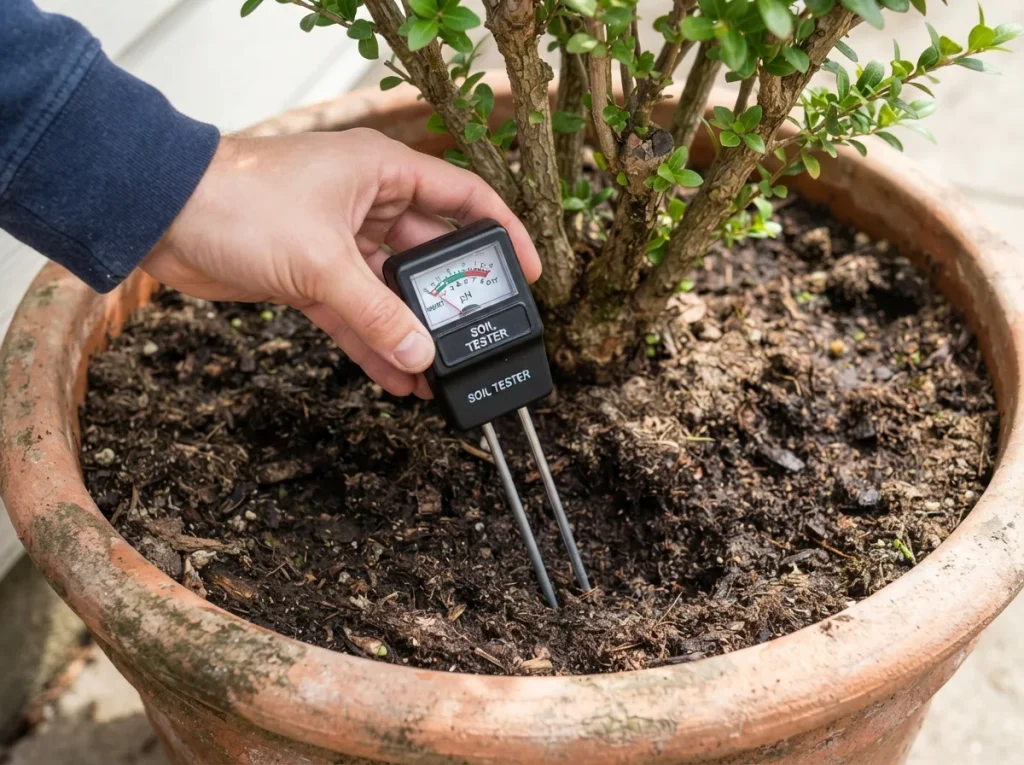
Soil condition affects how water moves as much as how much you apply. UMN’s home-apple guidance places apples in a pH range of roughly 6 to 7 and flags standing water as a problem — a sign that drainage, not just pH, deserves attention before adjusting a watering routine. A soil test is the most reliable way to confirm where your soil actually stands.
Mulch reduces evaporation and competition from turf, which helps conserve soil moisture — but it doesn’t replace a moisture check. Apply a moderate layer of organic mulch over the root-zone area, keep the root flare visible, and leave space around the trunk. UMN warns that mulch deeper than about 3 inches can block water movement, reduce oxygen, and keep poorly drained soil too wet.
Extension Guidance Summary: These extension sources generally favor root-zone irrigation that is deep enough to wet the active soil profile, slow enough to infiltrate, and adjusted for soil, weather, tree age, and drainage. A fixed schedule without a soil check is less reliable than observing both the tree and its root-zone conditions.Synthesized from University of Minnesota Extension, Utah State University Extension, and Washington State University Tree Fruit guidance.
How much water does an apple tree need?
Selected video: How To Water Fruit Trees from Kansas City Community Gardens. The video is a supplementary demonstration, not a substitute for local extension recommendations or a soil assessment.
Apple tree watering by tree age
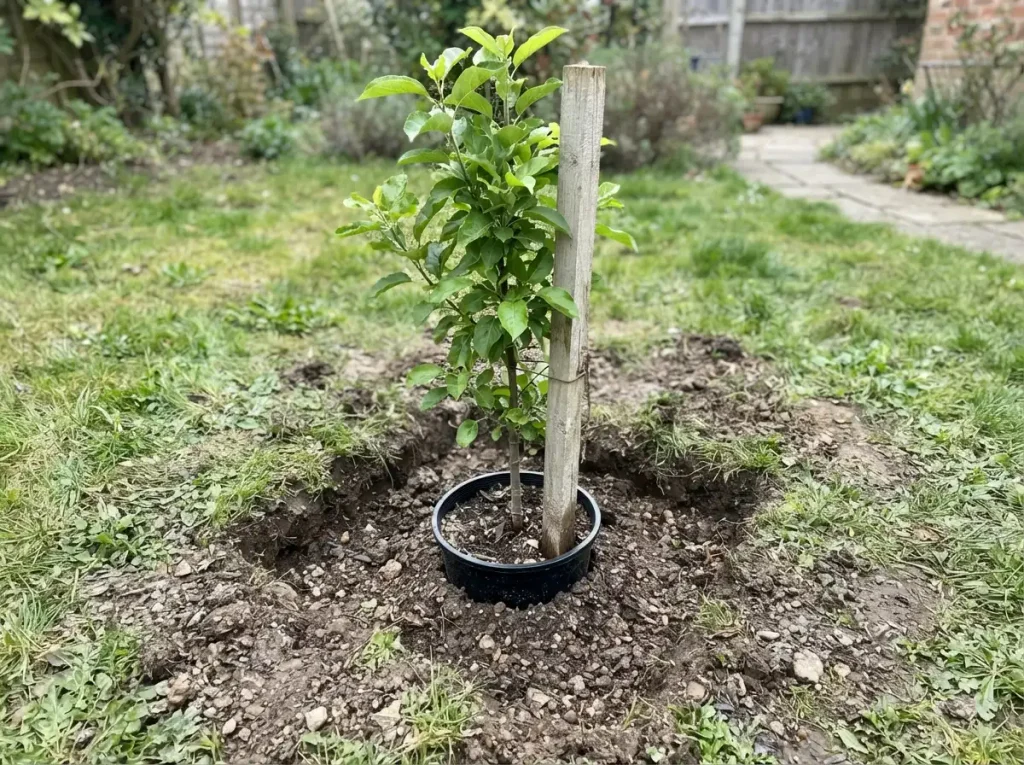
Newly planted trees need a predictable establishment routine because roots haven’t yet occupied the surrounding soil. UMN Extension’s general tree guidance recommends watering daily for the first 1 to 2 weeks, every 2 to 3 days from weeks 3 through 12, and weekly after 12 weeks until roots are established. Treat this as a starting framework, then shorten or lengthen the interval for rainfall, soil, heat, wind, and drainage. For a deeper breakdown of frequency by establishment stage, see how often to water apple trees.
In the second season, the tree may need less frequent watering than it did during planting, but it may not be fully independent yet. Continue checking the wider root zone during dry weather, especially when the canopy is expanding or fruit is developing. A small tree in turf or compacted soil can need more help than a similar-sized tree growing in a mulched, well-drained bed.
Established trees generally draw from a larger soil volume and may need little supplemental water during regular rainfall. But an extended dry period, unusually hot and windy weather, drought, root competition, or shallow soil can increase demand. UMN recommends deep watering over the entire root zone until the top 6 to 9 inches are moist, rather than relying on light surface applications.
A practical volume framework for new trees
For newly planted trees, UMN Extension gives a useful stem-caliper framework: apply about 1 to 1.5 gallons of water per inch of stem caliper at each watering. This is a practical starting point, not a fixed rule for every tree. Measure caliper according to the extension guidance, and treat the figure as an establishment benchmark rather than a universal volume for every mature apple tree.
As roots spread, increase the wetted area instead of concentrating larger and larger amounts beside the trunk. Broad coverage matters more than volume alone. A shallow basin or low soil berm at the edge of the root zone can hold water long enough for infiltration, but it shouldn’t create a permanently saturated bowl in heavy clay or a low site.
How to adjust for soil, weather, and rainfall
UMN Extension describes roughly 1 inch of water per week as a general rule for many fruit crops, then advises adjusting for soil type. Sandy soil usually needs smaller or more frequent applications because it holds less water. Heavier clay soil may hold more water, but compacted or poorly drained clay can also become oxygen-poor, so the correct response isn’t simply to apply more.
Rainfall should count toward the weekly total, but don’t assume a light shower wet the root zone. Watering should fill the gap left by inadequate rain, not duplicate a thorough soaking. Check the soil after rain. Likewise, increase observation during heat, wind, drought, or active fruit development, and reduce irrigation when cool weather and substantial rain keep the soil moist.
How to water an apple tree correctly
Direct water to the root zone
Place water over the soil where roots are active, not only at the trunk. That placement is what separates efficient watering from wasted water. For a young tree, begin over and just beyond the original root ball. For an established tree, distribute water across the area beneath the canopy and gradually farther outward as the root system extends.
Keep the trunk and root flare dry when possible. Constantly wet bark, a buried root flare, deep mulch, and standing water can increase the risk of trunk or root problems. The goal is to replenish soil moisture without turning the planting hole into a reservoir that never drains.
Apply slowly and check infiltration
A slow hose trickle, soaker hose, correctly designed drip system, or sprinkler can work. Choose whichever method keeps the application slow, observable, and broad enough to cover the root zone. Pause if water runs off the surface, pools, or moves away from the root zone. On sloped or clay sites, several shorter application cycles may allow water to infiltrate more effectively than one fast burst.
After watering, inspect the soil in more than one location. This confirms whether the water reached the intended depth. The top 6 to 9 inches should be moist for a deep application to an established tree, but the soil shouldn’t remain saturated. If the surface is crusted or water runs off, address compaction, turf competition, grading, or organic-matter management rather than only increasing run time.
Use a basin, hose, sprinkler, or drip line appropriately
A temporary soil basin is useful for a newly planted tree because it holds water over the root zone while it soaks in. This makes the early establishment routine easier to control. A hose can be effective when someone monitors the flow. A sprinkler may wet a broad area, but consider avoiding unnecessary foliage wetting where disease pressure is a concern. University of Maryland Extension advises watering in the morning and keeping foliage dry to help discourage disease problems — a consideration that mainly applies to sprinkler or overhead watering, since soaker hoses and drip lines already keep foliage dry.
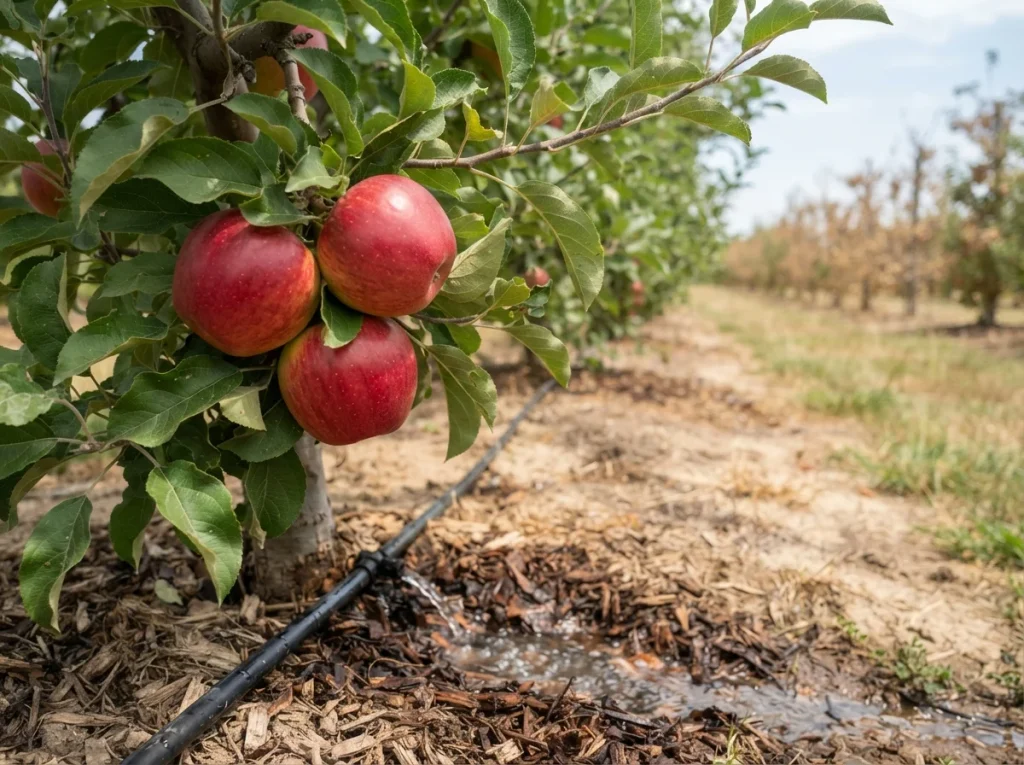
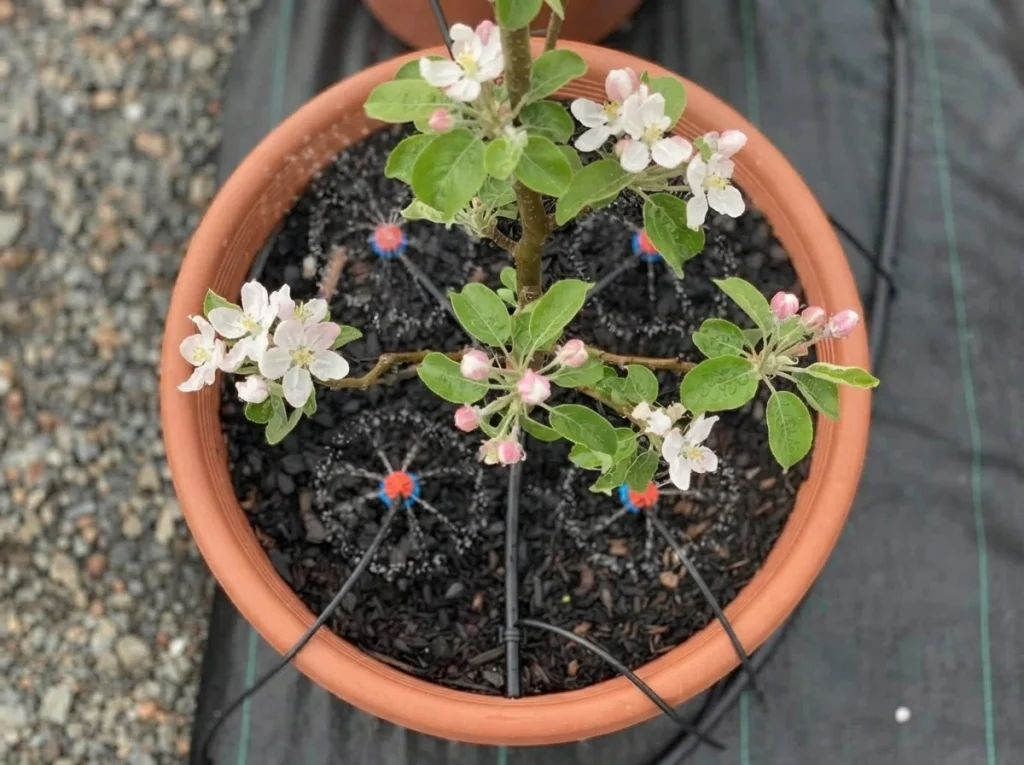
Drip irrigation can reduce evaporation and deliver water directly to soil, but it isn’t automatically correct just because the system is labeled “drip.” Emitter coverage and soil response still determine whether it actually works. Utah State University Extension advises designing the system to wet at least 50% of the root area, with 60% or more preferred, and spacing emitters according to soil texture. A single emitter next to the trunk is rarely a complete long-term root-zone strategy.
Seasonal apple tree watering schedule
Spring
Begin by checking soil moisture as growth resumes and rainfall becomes variable. In spring, let the root-zone check set the timing rather than a fixed start date. Newly planted trees may still follow an establishment routine, while established trees may need little supplemental water if spring soil is consistently moist.
As leaves, flowers, and shoots develop, avoid swinging between severe dryness and saturation. Keep mulch moderate, remove competing turf from the immediate root zone, and confirm that irrigation reaches the soil rather than running off the surface.
Summer and fruit development
Summer is the season when heat, wind, long daylight, and active transpiration can expose weak watering practices. Watering becomes especially important when dry weather coincides with fruit development. Water stress during and after bloom can reduce growth and affect fruit development. WSU Tree Fruit notes that the month after full bloom is an important period for rapid fruit cell division, so moisture monitoring matters during that window.
Don’t convert that principle into a fixed gallons-per-day claim for every backyard tree. Instead, check soil depth, rainfall, canopy condition, and the site’s drainage. During a dry spell, apply a slow, deep watering across the root zone, then reassess rather than repeatedly wetting only the trunk base.
Fall
Continue monitoring while leaves remain active, especially after a hot or dry summer. In fall, aim to support healthy late-season condition without leaving the soil saturated. Adequate moisture supports late-season growth and helps the tree enter dormancy without severe stress, but fall watering should still be reduced when rain keeps the soil moist.
Rake fallen leaves and fruit as part of normal orchard sanitation, but don’t disturb major roots while checking soil or applying mulch. A final pre-freeze watering can be useful for a dry site when the soil isn’t frozen and drainage is good, yet it’s not a substitute for fixing poor site drainage.
Winter
Winter watering needs depend on temperature, soil condition, precipitation, and tree age. The same winter routine won’t fit every USDA zone or site. Newly planted or young trees in mild, dry climates may need attention during a rain-free period when the ground is workable and temperatures are above freezing. In cold climates, frozen soil prevents normal infiltration, so avoid applying water that will freeze around the trunk or create ice injury.
Established trees in regions with regular winter precipitation usually need little supplemental water. But wind exposure, shallow soil, drought, or an unusually dry winter can change that assessment. Check local extension guidance for regional conditions rather than copying a winter schedule from a different climate.
Signs of underwatering and overwatering
Why symptoms overlap
Wilting, curling, browning edges, yellowing, leaf drop, weak growth, and small fruit can occur for more than one reason. Waterlogged roots can fail to supply the canopy, making an overwatered tree appear drought-stressed. Conversely, dry soil, high heat, wind, root damage, and salt buildup can produce similar symptoms.
Community growers often describe “crispy leaves” or browning leaf tips when asking whether a tree needs more water. Their questions show why these judgments need more context than a single symptom can provide. Before changing the routine, inspect the soil, drainage, root flare, mulch depth, irrigation output, and recent rainfall.
What to check before watering again
| Observation | What it may suggest | Next check |
|---|---|---|
| Dry soil several inches down, wilt during heat, and no meaningful rain | Underwatering or drought stress is possible | Apply a slow root-zone watering and recheck moisture after infiltration |
| Wet soil that stays saturated, pooling, or sour-smelling planting hole | Poor drainage or overwatering is possible | Pause irrigation and assess grading, compaction, mulch, and root health |
| Browning tips with either wet or dry soil | Water stress is possible, but the symptom is not specific | Check soil, roots, salts, heat, wind, pests, and disease before concluding |
| Weak growth in turf or compacted ground | Root competition or poor infiltration may limit water uptake | Check the root-zone area and reduce turf competition with appropriate mulch |
For a focused symptom guide, see overwatered apple tree symptoms. If the tree is exposed to a prolonged dry period, compare the symptoms with apple tree drought stress symptoms. These cluster guides should complement, not replace, a local diagnosis when the tree is declining rapidly.
Recovery priorities
If soil is dry, restore moisture gradually across the root zone rather than flooding the planting hole. If soil is saturated, stop adding water, improve drainage where feasible, and avoid piling mulch against the trunk. Don’t fertilize a severely stressed tree simply because growth is weak; first determine whether the roots can access air and moisture.
Persistent yellowing, dieback, cracking, fungal growth, root decay, or a rapidly declining canopy warrants professional assessment. Watering changes alone won’t correct a disease, girdling root, damaged trunk, or structural drainage problem.
Drip irrigation, hoses, and sprinklers compared
| Method | Strength | Risk or limitation | Best use |
|---|---|---|---|
| Hand-held hose | Flexible and inexpensive for a few trees | Flow rate is easy to underestimate, and runoff can occur | Small yards when the grower monitors the application |
| Soaker hose | Slow delivery over a continuous line | Coverage can be uneven if placement and pressure are poor | Young trees and beds where the hose can follow the root zone |
| Sprinkler | Can cover a broad root-zone area | Evaporation, wind drift, and wet foliage can reduce efficiency | Established trees when broad, deep watering is needed |
| Drip irrigation | Directs water to soil and can be automated | Emitters can cover too little area or clog without inspection | Regularly managed systems designed for adequate root-zone coverage |
For setup details, read drip irrigation for apple trees. This works well when the system is sized and maintained for the full root zone. The right method is the one that wets enough of the root zone, infiltrates without runoff, and can be inspected regularly. A sophisticated system can still under-water a tree if the emitters remain beside the trunk or the schedule ignores soil texture.
Common watering mistakes to avoid
- Following a rigid calendar without checking soil. Rainfall, wind, heat, soil texture, and drainage vary too much for one schedule to fit every yard.
- Watering only at the trunk. Roots need a broader wetted area as the tree grows, particularly for established trees.
- Applying water too quickly. Fast flow can run off compacted soil before the root zone is wet.
- Keeping soil continuously saturated. Roots need air as well as water, and excess water can increase root-disease risk.
- Assuming mulch eliminates the need to check moisture. Mulch slows evaporation, but it doesn’t guarantee that the underlying soil is wet.
- Using one drip emitter forever. As roots spread, the system must wet a sufficient portion of the active root area.
- Reading one leaf symptom as a diagnosis. Browning, curling, or yellowing can have multiple causes.
- Letting turf dominate the root zone. Grass can compete for water and space, especially around young trees.
When to call a professional
Contact a certified arborist or local university extension diagnostic clinic when a tree declines quickly, develops extensive dieback, shows root or trunk decay, remains wilted in wet soil, or fails to recover after a reasonable correction in watering. A professional can separate a watering problem from a root, trunk, pest, or disease problem. Professional help is also appropriate when grading, buried utilities, irrigation design, or large structural roots make drainage changes risky.
Bring useful observations: tree age, rootstock if known, planting date, recent rainfall, irrigation method, soil texture, mulch depth, symptoms, and photographs of the whole tree and affected tissues. This information is more useful than reporting only that the tree was “overwatered” or “underwatered.”
FAQs
How often should I water a newly planted apple tree?
For a newly planted tree, start with consistent establishment watering. Watering is most frequent while the root system is still confined to the planting area. UMN Extension recommends daily watering for the first 1 to 2 weeks, every 2 to 3 days from weeks 3 to 12, and weekly afterward until roots establish. Adjust that framework when substantial rain wets the root zone, when soil drains slowly, or when heat and wind increase drying.
How much water does an apple tree need in summer?
There is no single summer volume for every apple tree. The right amount depends on canopy size, soil, rainfall, and drainage. As a general fruit-crop rule, UMN describes about 1 inch of water per week, adjusted for soil type, rainfall, and conditions. For new trees, its caliper-based guidance is about 1 to 1.5 gallons per inch of stem caliper per watering. Mature trees need a broader root-zone assessment.
Should I water an established apple tree during a drought?
Yes, an established tree may need supplemental water during an extended dry period, especially in shallow, sandy, compacted, or heavily competing sites. For established trees, watering is usually event-driven rather than scheduled daily. Water deeply across the root zone until the top 6 to 9 inches are moist, then allow the soil to drain. During regular rainfall, a well-sited established tree may need little additional water.
How can I tell if an apple tree is overwatered or underwatered?
Check the soil and drainage before interpreting leaves. Dry soil, wilt during a rain-free hot period, and rapid recovery after appropriate watering suggest water stress, while persistent saturation, pooling, and poor drainage suggest excess moisture. Because browning tips, yellowing, and wilt can overlap, a local diagnostic assessment may be needed.
Is drip irrigation better than a hose or sprinkler for apple trees?
Drip irrigation can be efficient, but it’s only an advantage when it’s designed and maintained correctly. Utah State University Extension recommends wetting at least 50% of the root area, with 60% or more preferred. A hose or sprinkler can work well when it wets the root zone slowly and broadly and the grower verifies infiltration.
What is the best time of day to water apple trees?
Morning is generally the preferred time. University of Maryland Extension advises watering in the morning and avoiding wetting the foliage, since this helps discourage disease problems. This mainly matters for sprinkler or overhead watering — soaker hoses and drip lines already keep foliage dry regardless of when you run them. There’s no single correct hour beyond that; the priority is giving the soil time to absorb water rather than hitting an exact time on the clock.
Related Articles
- How often to water apple trees
- Drip irrigation for apple trees
- Overwatered apple tree symptoms
- Apple tree drought stress symptoms
Sources
- University of Minnesota Extension, Watering newly planted trees and shrubs
- University of Minnesota Extension, Watering fruit crops during dry spells
- University of Minnesota Extension, Watering established trees and shrubs
- University of Minnesota Extension, Growing apples in the home garden
- University of Maryland Extension, Fruit Plant Care
- Utah State University Extension, Drip Irrigation for Trees
- Washington State University Tree Fruit, Irrigation
Disclaimer: This article provides general growing guidance based on university extension research. Soil conditions, climate zone, and variety affect results. Contact your local cooperative extension service for region-specific recommendations.
