
Espalier Apple Tree: 5 Proven Shapes & How to Train One
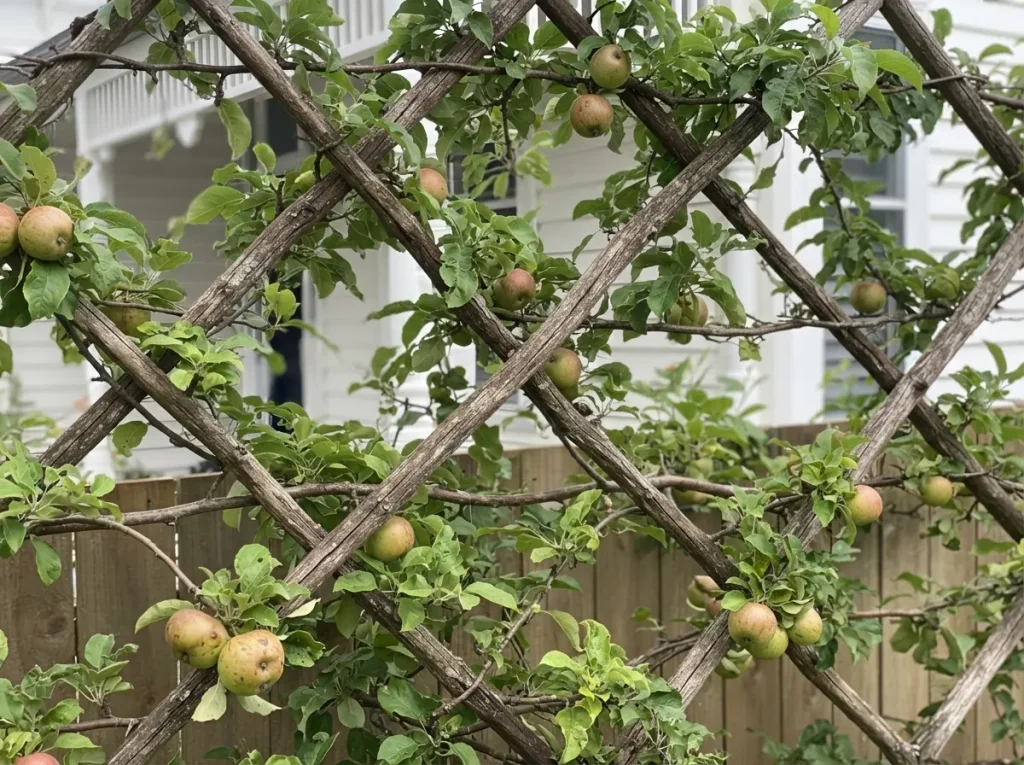
An espalier apple tree is trained flat against a wall, fence, or wire trellis in a two-dimensional form, making it one of the most space-efficient and productive methods available to home growers. An espalier apple tree produces fruit from well-exposed spur systems, improves air circulation to reduce disease pressure, and gives any garden a striking structural feature year-round.
Table of Contents
Key Takeaways
- An espalier apple tree grows flat in a two-dimensional plane and suits small backyards, fences, and south-facing walls with limited space.
- The horizontal cordon (tiered) shape is the easiest for beginners and produces reliable fruiting spurs within three to four years.
- Choose a spur-bearing variety on MM.106 rootstock for the most manageable home espalier.
What Is an Espalier Apple Tree?
An espalier apple tree is any apple tree that has been pruned and tied to grow in a single flat plane, typically against a south-facing wall, wood fence, or freestanding wire trellis. Many trace the technique to ancient Rome, and it was refined in medieval Europe as a way to grow fruit in confined courtyard spaces. According to the University of Wisconsin Extension, espaliered apple trees can live and produce fruit for well over 150 years when properly maintained.
The core advantage for home growers is space efficiency. The open structure of an espalier also puts every fruiting spur in direct sunlight, which can improve fruit color and yields compared to many standard free-standing trees. Disease and pest management tends to be simpler too, since spray coverage and air movement are better across a flat, open canopy.
The 5 Proven Espalier Shapes for Apple Trees
Before planting, choose a shape that matches your available wall or trellis width, your patience level, and the years you want to invest. The five patterns below cover most backyard situations, from the absolute beginner to the experienced pruner looking for a formal garden statement.
| Shape | Difficulty | Wall Width Needed | Best For |
|---|---|---|---|
| Horizontal Cordon (Tiered) | Beginner | 8 to 12 feet | First espalier, reliable fruiting |
| Fan | Beginner to Intermediate | 10 to 15 feet | Warm climates, decorative focal points |
| Belgian Fence | Intermediate | 10 to 20 feet | Screens and living fences with multiple trees |
| Palmette Verrier (Candelabra) | Advanced | 8 to 12 feet | Formal gardens, high visual impact |
| Informal (Freestyle) | Beginner | Flexible | Irregular walls, creative landscapes |
Wall widths above are general planning ranges, not fixed rules. Actual space needs vary with rootstock vigor, cultivar, and how many tiers you train.
Which Espalier Shape Is Easiest for Beginners?
For most home growers, the horizontal cordon is the best starting espalier apple tree shape. It consists of one vertical central leader with paired horizontal branches trained along wire tiers. Each tier takes roughly one growing season to establish, so a three-tier espalier apple tree generally frames out in about three years from a bare-root whip.
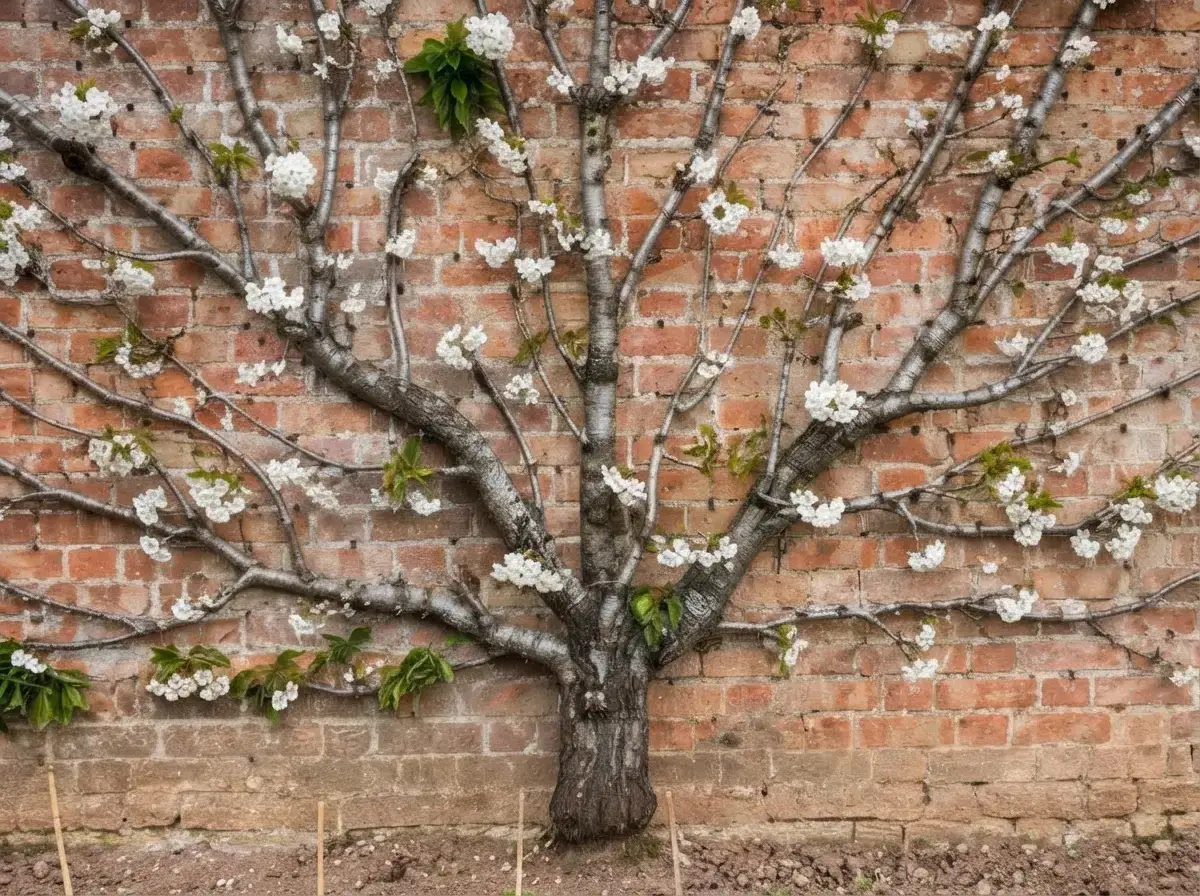
The fan, by contrast, requires managing more branch angles without the grid-like wire discipline of a cordon, making it less predictable for new espalier growers. It does suit warm walls and climates, though, where the radiant heat helps ripen fruit faster.
How to Choose the Right Rootstock for an Espalier Apple Tree
Rootstock determines the ultimate size and vigor of any espalier apple tree. Semi-dwarfing rootstocks such as MM.106 are common choices for home espalier because their root systems anchor well enough that permanent staking usually isn’t needed, while still keeping the tree’s mature size manageable against a wall or trellis.
The three rootstocks most commonly used for home espalier work are compared below. Choose a spur-bearing variety rather than a tip-bearing one: tip-bearing varieties fruit mainly near the branch tips, which get removed during training, so yields suffer unless you adjust your pruning approach. Also confirm that your selected variety needs a cross-pollinator in range, since most apple trees need a second variety nearby to set fruit.
| Rootstock | Mature Tree Size | Staking Required | Notes |
|---|---|---|---|
| MM.106 | 60 to 70% of standard | First 2 to 3 years only | Best all-around for home espalier; tolerates variable soils |
| M.26 | 40 to 50% of standard | Permanent | Fruits early; highly susceptible to fire blight; needs support for life |
| M.9 | 30 to 40% of standard | Permanent | Very early fruiting; poor natural anchorage; highly susceptible to fire blight |
How to Build Your Espalier Support Structure
The support structure must be in place before you plant. For a wall-mounted espalier, attach sturdy horizontal galvanized wire to the wall, leaving at least 6 inches of clearance between the wall and the wire for air circulation. This matches University of Missouri Extension guidance for espalier trellising. For a freestanding trellis, set posts at each end of the row and run wires spaced roughly 14 to 18 inches apart vertically, with the first wire starting about 16 inches above ground level.
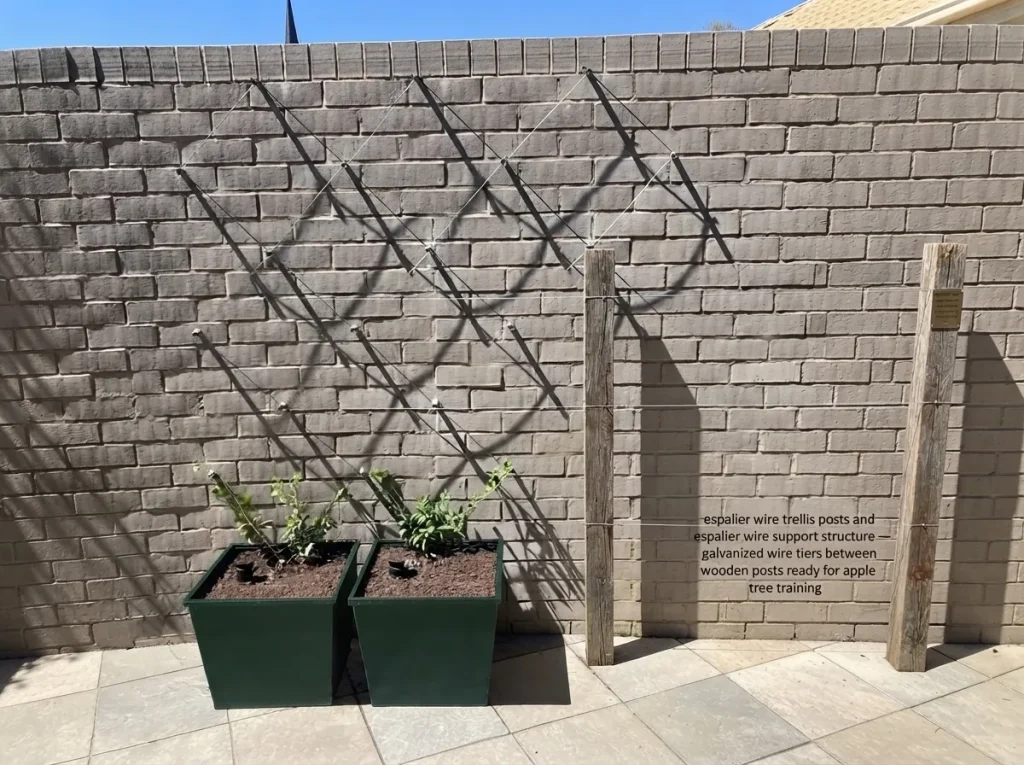
University of Missouri Extension guidance also specifies that the support frame material should be rot-resistant and non-degradable, since you’ll be relying on it for the full productive life of the tree. Plan for three to four wire tiers: a standard-height espalier typically reaches about 6 feet tall and 10 to 14.5 feet wide.
How to Train an Espalier Apple Tree Step by Step
Training an espalier apple tree is a multi-year process. Understanding what to do in each season prevents the most common errors that set beginners back by an entire growing season.
Year One: Planting and the First Cut
Plant a one-year-old bare-root whip (unbranched) in front of the lowest wire, centered on your support structure. Immediately cut the central leader back to just above the height of the first wire, typically 15 to 18 inches from the ground. This heading cut forces buds below the cut to break into vigorous new shoots. That initial hard cut is what gives you the material to form the first tier, so don’t skip it even though it feels severe.
Summer Training: Tying and Selecting Branches
As new shoots develop through early summer, select the strongest shoot pointing upward as the new central leader. Select one strong shoot to the left and one to the right to become the first pair of horizontal arms. Tie these at roughly a 40-degree upward angle initially, rather than horizontal right away, since this preserves enough vigor for the shoots to develop properly. Then, in late summer (typically mid to late August for apple trees, per RHS guidance), lower them gently to horizontal and secure them to the first wire tier. Remove all other shoots at their base.
Year Two and Beyond: Adding Tiers
In late winter of year two, cut the central leader back to just above the second wire. This stimulates a new pair of shoots for the second tier. Repeat the same summer-lowering process. Training one new tier per year keeps you on the three-to-four-year timeline for a simple design that University of Missouri Extension describes, without asking the young tree to support too much new growth at once.
Established Tree Maintenance
Once your espalier reaches its desired number of tiers, remove the central leader at the top wire. Each summer on established trees, once the lower third of new growth has hardened (per RHS timing), cut upright-growing shoots on the horizontal arms back to three or four leaf buds to encourage fruiting spur production. In late winter, remove dead, crossing, or out-of-plane branches during the dormant pruning window. Wipe down cutting tools between trees if disease is present on the property, since pruning cuts are easy entry points for pathogens.
Common Mistakes to Avoid When Training an Espalier Apple Tree
The most frequent error for new espalier growers is waiting too long to lower branches from their angled position to horizontal. Young shoots lower easily in late summer when they are still semi-flexible. Branches that have fully hardened into wood will snap rather than bend, losing an entire year of progress on that tier.
A second major mistake is skipping summer pruning entirely and relying only on the dormant winter cut. Per RHS guidance, summer pruning converts leafy shoot growth into fruiting spurs and keeps the canopy within the flat plane; skip it for long enough and growth reverts toward the tree’s natural, spreading form as untrained shoots outcompete the framework. Choosing a strongly tip-bearing apple variety for espalier training is also a common mismatch: most tip-bearing varieties need an adjusted summer-pruning approach (leaving some shorter shoots unpruned) to fruit well in a trained form, so check a variety’s bearing habit before committing it to a wall.
Espalier’s appeal is partly its flexibility: with several traditional patterns and endless variations, University of Missouri Extension horticulture specialist Marlin Bates has noted there’s a design suited to nearly any gardener, whether you want a low-maintenance accent or a formally trained showpiece.
FAQs
How long does it take to fully train an espalier apple tree?
A four-tier espalier apple tree generally takes about four years to frame from a bare-root whip, adding roughly one tier per growing season. You can expect to see meaningful fruit production on established lower tiers within the second or third year, depending on rootstock and variety.
Can I espalier an existing apple tree, or do I have to start from a whip?
Starting from a one-year bare-root whip is the most reliable method and produces the cleanest structure. Retrofitting an established free-standing apple tree to espalier form is possible but difficult, as mature wood is less flexible and the branch structure rarely lines up with a horizontal tier system without severe remedial pruning.
What tools do I need to train an espalier apple tree?
You will need sharp bypass pruners for clean cuts on live wood, flexible soft tying twine or horticultural tape to secure branches without girdling, galvanized wire for the trellis, and a wire tensioner to maintain firm, even horizontal support. For full guidance on selecting and maintaining cutting tools, see our apple tree pruning tools guide.
Related Articles
- Apple Tree Pruning: Complete Guide for Home Growers
- When to Prune Apple Trees for Best Results
- How to Prune Apple Trees: Cuts, Timing, and Tools
- Open Center Apple Tree Pruning Explained
Sources
- West Virginia University Extension — Rootstocks for Apples
- University of Missouri Extension — Espalier in Your Landscape
- University of Wisconsin Extension Horticulture — Espalier
- Royal Horticultural Society — Apples and Pears: Espalier Pruning and Training
Disclaimer: This article provides general pruning guidance based on university extension research. Pruning requirements vary by variety, rootstock, tree age, and regional climate. When in doubt, consult a certified arborist or your local cooperative extension service.
