
Apple Tree Borer: 5 Proven Signs, ID & How to Kill It
Apple tree borer is a common name for insects whose larvae tunnel into an apple tree’s bark or wood. To control them, first identify the likely borer and check whether feeding is still active. Accessible larvae can sometimes be removed or killed mechanically, but larvae deep inside a trunk are difficult to reach. Preventing new attacks and assessing existing damage are both part of saving the tree.
Table of Contents
Start at the lower trunk, especially if you have found reddish sawdust, a wet patch, or a hole near the soil line. A tree can still carry green leaves while its trunk is being damaged. Conversely, an old hole does not establish that a larva is inside it today.
This guide covers wood- and bark-boring insects affecting US home apple trees. If the damage is mainly chewed leaves or tunnels inside apples, use the broader apple tree pests guide to follow the right identification path.
Five signs of apple tree borer damage
These signs justify a closer inspection. None identifies every borer species on its own, and you do not need to find all five before seeking help. Record where each sign occurs and whether it changes between inspections.
1. Sawdust-like frass at the trunk or graft union
Frass is insect waste, often mixed with bits of chewed bark or wood. Roundheaded borer activity can leave reddish-brown material at the tree’s base. The University of Minnesota’s apple diagnostic guide lists this material alongside round trunk holes and large sapwood tunnels.
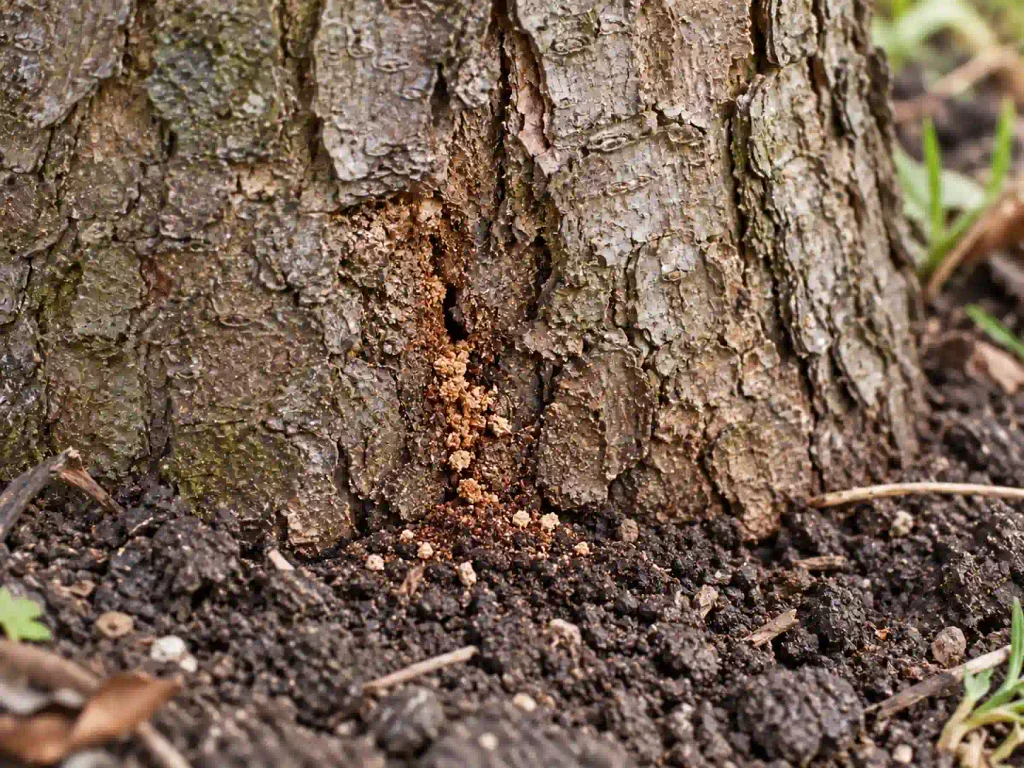
Photograph the deposit before gently brushing away loose material. Note the exact opening it appears to come from. A later deposit at the same location supports continued activity, although wind and rain can remove evidence. Loose mulch or soil dust resting against the bark is less informative than material emerging from a specific opening.
2. Wet, dark, or sunken bark
Sap staining and darkened bark can accompany tunneling. Look at the edge of the affected patch and any nearby crack. A wet area containing wood particles deserves attention, but sap alone is not a diagnosis. Photograph it before applying anything that changes its appearance.
Flatheaded borers can attack tissue beneath a damaged patch. NC State’s identification factsheet explains that feeding beneath the bark can kill the bark above the tunnels. Avoid peeling healthy bark away to see whether a suspected gallery continues.
3. Holes in the bark
Measure a hole across its widest point and record its shape. Minnesota describes roundheaded borer holes as around one-quarter inch across. That is a useful comparison, not a rule for naming every round hole.
Small openings associated with fresh frass and clean adult emergence holes tell different stories. An emergence hole records an insect leaving. It does not show that the same insect remains available for treatment. Photograph multiple holes separately if their sizes or locations differ.
4. Cracked or loose bark over a tunnel
Where bark has already loosened, galleries may be visible beneath it. Utah State’s flatheaded borer guide describes packed frass in galleries, splitting bark, and oval exit holes. A tunnel is much stronger evidence of boring activity than a crack by itself.
Check whether the crack follows a tie, a mower injury, or another obvious wound. Record that history for the person identifying the pest. An insect found around damaged tissue may be using an injury that began for a different reason.
5. Sparse foliage, branch dieback, or a weakened trunk
Roundheaded borer infestations can accompany pale, thinning foliage and branch dieback. Those canopy symptoms also occur with other problems. Give them more diagnostic weight when they occur together with trunk frass or galleries.
A split, leaning, or badly hollowed trunk needs prompt professional assessment. Keep people away from a tree that appears likely to break. Do not test its strength by rocking it or climbing it to inspect the canopy.
Which borer is attacking your apple tree?
The name on the treatment plan matters. Beetle larvae, clearwing moth caterpillars, and tiny bark beetles can all damage woody tissue, but they differ in where they feed and how they are monitored. Use the combination of insect appearance, feeding site, and damage pattern.
| Likely group | Useful clues | Next step |
|---|---|---|
| Roundheaded apple tree borer | Cream-colored beetle larva, lower-trunk tunneling, reddish frass; striped adult with long antennae. | Inspect the trunk base and document fresh activity. |
| Flatheaded appletree borers | Pale larva with a broad, flattened area behind its small head; galleries beneath injured bark. | Check for sun injury, drought stress, and mechanical wounds. |
| Dogwood borer | Caterpillar associated with burr knots or injured graft-area tissue; reddish frass. | Inspect the exposed rootstock and beneath removable guards. |
| Bark or ambrosia beetles | Numerous tiny openings; some ambrosia beetles produce fragile, toothpick-like dust projections. | Request species identification before choosing a treatment. |
| Fruit or leaf caterpillars | Damage centered on apples, chewed foliage, or silk-bound leaves. | Follow a fruit- or leaf-pest identification guide. |
Roundheaded appletree borer
The roundheaded appletree borer, Saperda candida, can attack healthy apple trees as well as neglected ones. Missouri Extension warns that even a small number of larvae can kill a young tree. Good watering therefore cannot replace trunk inspection.
Its larvae may remain inside a tree for multiple growing seasons. The University of Maine’s home-garden guidance describes prolonged tunneling that can weaken a small trunk enough for it to break in wind. If you find one active site, inspect the rest of the trunk and the other young apples in your yard.
Flatheaded appletree borer and Pacific flatheaded borer
Chrysobothris femorata and Chrysobothris mali are related beetles. Their pale larvae have a broad enlargement immediately behind the head. A larva’s appearance can identify the flatheaded group more readily than the exact species.
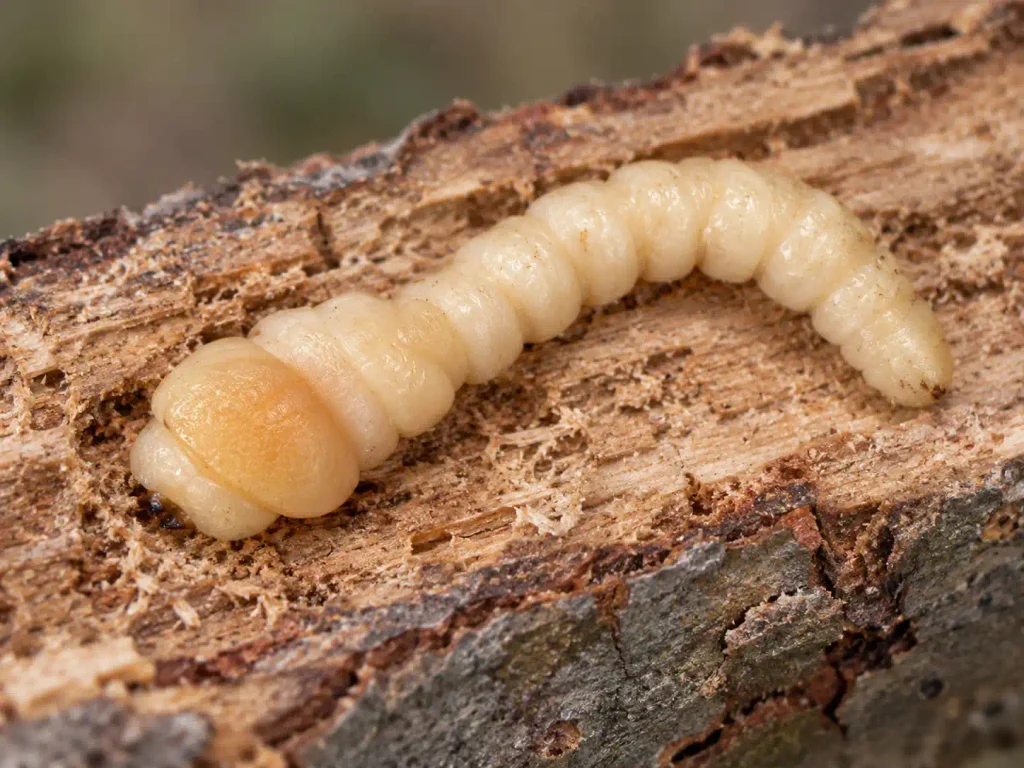
The UC IPM identification page notes that the Pacific species occurs in western states. These borers commonly use stressed or injured trees, so document establishment problems and bark injuries as well as the insect. Do not assume that every D-shaped opening identifies one particular species.
Dogwood borer around burr knots
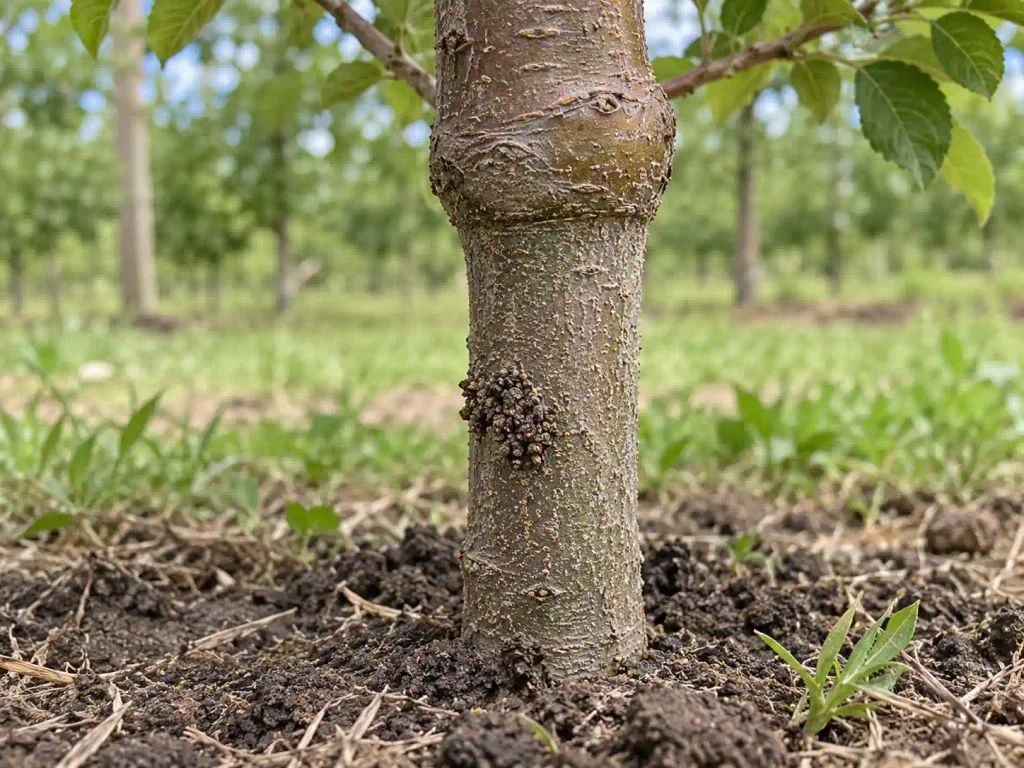
Burr knots are clusters of developing root initials on above-ground trunk tissue. They are especially relevant on some dwarfing rootstocks. Dogwood borer, Synanthedon scitula, is a moth whose caterpillars can feed in these areas and extend into surrounding tissue.
A 2026 Minnesota orchard report also discusses damaged rootstock and graft-union areas as vulnerable sites. Knowing your apple tree’s rootstock helps provide context, but a rootstock name cannot confirm the insect. Photograph the graft area and any burr knots without cutting them away.
Tiny beetles and caterpillars that need a different diagnosis
The New England Tree Fruit Management Guide describes black stem borer producing very small holes and toothpick-like projections of boring dust. Their fragile shape can disappear before your next visit. Take a close photograph when you first notice one.
For an exposed larva, Virginia Tech’s apple borer key uses abdominal prolegs to separate caterpillars from beetle larvae, then other body features to narrow the identification. A clear side-view photograph helps a diagnostic service assess those features.
If the tunnel leads through an apple toward the core, compare codling moth damage. Fruit tunneling calls for a different control plan from an active gallery in a living trunk.
How to inspect a suspected infestation
Bring a flashlight, phone camera, ruler, and soft brush. Begin with observation. Cutting into the tree before documenting the original damage can make identification harder and create another wound.
- Take a whole-tree photograph showing the canopy and trunk. Note which branches have declined.
- Move loose mulch away from the bark and locate the soil line and graft union. Avoid digging through roots.
- Check every side of the lower trunk, then check visible injuries on larger branches. Safely open removable guards for inspection.
- Photograph each hole, wet patch, or frass deposit with a ruler beside it. Include an unzoomed photograph showing its position.
- Brush away only loose frass after taking photographs. Record the date and return to the same location to check for new material.
- If a larva is already exposed, photograph its head end and side. Ask your diagnostic service how it wants any specimen collected.
This sequence is a practical way to organize evidence, not a test that guarantees a diagnosis. A quiet opening may be old, temporarily inactive, or hiding a gallery that retains its frass. Absence of a fresh deposit during one inspection does not settle the question.
Send your county extension office the photographs together with your state, planting year, known cultivar and rootstock, watering history, and any recent injury. Describe prior treatments by product name and date. Those details help an adviser distinguish a current attack from old damage or another cause of decline.
Check common lookalikes
Sun injury, mower damage, and constricting ties can leave damaged bark without establishing a borer infestation. Minnesota’s winter tree guidance describes sunscald and stresses that open wounds should not receive paint, tar, or wound dressing. Trunk protection applied to intact bark is a separate practice.
Fire blight and root problems also deserve consideration when the canopy is declining. Compare the pattern using the apple disease identification guide. Borers and other injuries can occur together; finding an insect does not establish that it caused every symptom.
How to kill borers and prevent further damage
There are two separate jobs: deal with an existing infestation where feasible, and prevent new larvae from entering. An option that protects the bark during egg laying may have little value against a mature larva deep in wood.
| Situation | Reasonable action | Limit |
|---|---|---|
| Accessible larva in a small infestation | Ask about careful mechanical removal or probing an existing gallery. | Further bark injury is possible; success may be hard to confirm. |
| Infestation restricted to a removable limb | Get pruning guidance and dispose of infested wood appropriately. | Removing the limb does not treat separate trunk infestations. |
| Confirmed risk during adult activity | Discuss species-specific monitoring and a labeled protective treatment. | Timing, edible-crop permission, and coverage all matter. |
| Old hole without confirmed current activity | Document the damage and assess the tree before treatment. | A hole alone cannot show what a pesticide would target. |
| Severely damaged or unstable trunk | Arrange professional assessment and possible removal. | Killing an insect cannot restore lost trunk strength. |
Mechanical removal has a narrow role.
Missouri Extension describes locating accessible roundheaded larvae and using a wire in an existing tunnel. This is most plausible when the gallery can be followed without extensive excavation. It is not a reason to cut exploratory holes around the trunk.
UC IPM’s flatheaded borer guidance similarly describes wire probing for small infestations but notes that knowing whether the wire reached a larva can be difficult. Ask an extension adviser or arborist to assess accessibility first. Stop if the work requires cutting into sound tissue or forcing a tool through an uncertain path.
After an attempted removal, record what was actually recovered or seen. Finding one larva does not demonstrate that every gallery is empty. Retain the photographs and continue checking the original sites.
Prune localized infestations and manage the removed wood
Where a confirmed flatheaded infestation is limited to a few limbs, removal can take infested tissue out of the tree. UC IPM’s apple-specific Pacific flatheaded borer guidance recommends removing badly infested wood before the growing season.
Discuss the cut location and timing locally, especially on a major scaffold limb. Do not leave removed material stacked beside your apples while insects can continue developing inside it. Ask about permitted disposal options; burning restrictions and available green-waste services vary by location.
When insecticides may help
Protective treatments generally depend on reaching a vulnerable stage before it is sheltered inside the tree. Utah State’s backyard apple guidance discusses trunk protection during flatheaded adult activity. However, California’s apple-specific Pacific flatheaded borer guide does not recommend spraying for that insect. Those regional recommendations should not become one national spray calendar.
Ask your extension office what is appropriate for the identified species on bearing home apple trees in your state. Some systemic options are used for certain borers, but treatment instructions for ornamental trees cannot be transferred to edible apples.
Before purchasing, find the exact formulation’s current label and check:
- Permission for the intended edible-apple site and application method.
- The target pest and the timing relevant to its vulnerable stage.
- Rates, repeat intervals, seasonal limits, and any harvest restrictions.
- Protective equipment, reentry instructions, and restrictions around bees and water.
Do not apply insecticides to open apple blossoms unless the label expressly permits the use and its pollinator restrictions can be met. Also check flowering groundcover and drift exposure. The Pacific Northwest apple borer guidance flags bee hazards for several control options.
Use the apple tree pest control guide to fit a confirmed borer problem into your wider monitoring plan. Keep a treatment record so a later adviser can assess what was applied and when.
Avoid unsupported rescue treatments.
No general home remedy can be recommended here for every insect described as an apple borer. Neem formulations appear in some regional flatheaded guidance, but that does not establish that spraying neem will kill a roundheaded larva deep inside a trunk.
Do not pour fuel, household cleaners, or an unlabeled pesticide mixture into galleries. Do not fill openings with caulk or cement as a pest treatment. If a proposed method does not identify the insect, explain how it reaches that insect, and have an appropriate permitted use, it is a poor basis for treating a food-producing tree.
Can you save an apple tree with borers?
Some trees can survive localized injury when further attack is controlled. A badly girdled or weakened trunk has a different outlook. Girdling means the injury extends around the stem and interrupts living tissues that connect the canopy and roots.
Ask the assessor to answer two questions separately: is there ongoing insect activity, and is enough sound structure and living tissue left to keep the tree? A treatment recommendation answers only part of that decision.
For a hypothetical example, a young tree with one documented active site and a stable trunk may justify targeted intervention and close follow-up. Another tree with a splitting base and widespread dieback may need removal even if no live larva can be found. These examples illustrate the decision process; they are not survival predictions or a percentage-based threshold.
Replacing a tree also calls for reviewing why the attack occurred. If the likely borer favors injured trees, correct the exposure or maintenance problem before planting again. If roundheaded borer is the concern, retain an inspection plan even for a well-established replacement.
Prevent new attacks without hiding the trunk
Reduce avoidable stress and bark injury
Maintain suitable root-zone moisture and keep mowing equipment away from the trunk. Follow soil-based apple watering checks instead of adding water whenever leaves look poor. Check the newly planted root ball as well as surrounding soil.
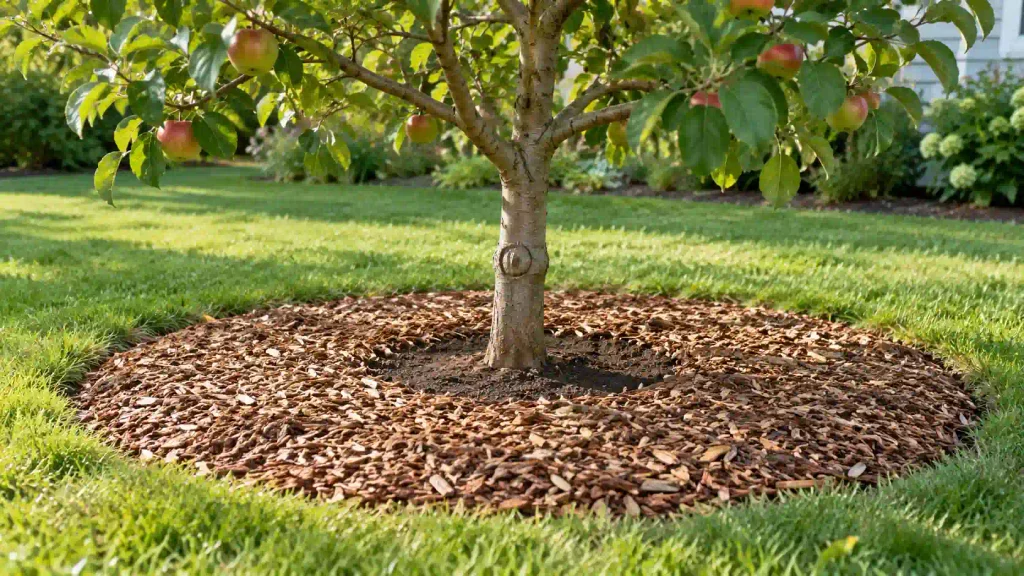
A maintained mulch ring can separate bark from string trimmers. Keep the material clear of the trunk so you can inspect it. The apple tree mulching guide explains placement and maintenance. Inspect support ties at the same visit and adjust any that are pressing into bark.
Choose trunk protection for the problem and season
Light-colored protection or an appropriate whitewash can reduce sun injury on young trees. Maine also describes whitewash and screening as preventive options for roundheaded borer. These measures require maintenance and cannot guarantee exclusion.
Ask locally which protection fits your climate and pest. Michigan State guidance warns against leaving tree wrap in place for extended periods. Check beneath guards and replace constricting protection as the trunk grows. Avoid converting a seasonal guard into a permanent concealed space.
Check burr knots and nearby sources.
Keep rootstock tissue visible for inspection. Purdue’s dogwood borer guidance discusses frass around burr knots and the value of checking beneath guards. Do not shave off living burr knots or bury the graft union as a routine pest remedy; discuss the actual tree with an adviser.
Inspect nearby susceptible trees if attacks recur. Removing confirmed infested wood can reduce a source of emerging insects, but wholesale removal of healthy neighboring trees is not a sensible first step. Identify the pest and likely source before changing the landscape.
A seasonal monitoring plan
Use local pest activity to set timing. The following is an inspection framework for a home grower, not a spraying schedule.
- During late winter or early spring, review old damage photographs and inspect protection, ties, and the graft area when conditions allow.
- Before locally expected adult activity, ask extension about previous infestations and the monitoring appropriate to that species.
- During the growing season, include the lower trunk in your regular tree inspection. Photograph fresh frass or sap staining before it disappears.
- After harvest, compare marked sites, note canopy changes, and plan any locally advised wood removal.
Maine recommends checking for roundheaded borer signs in September and again in late May. Elsewhere, adjust those dates to local guidance. Dogwood borer monitoring can include species-specific pheromone traps, as described in Cornell’s dogwood borer factsheet. A trap intended for another insect cannot serve as a general borer detector.
Keep a short log with the tree’s identity, date, damage location, fresh-frass observations, photographs, and action taken. At the next inspection, compare the same site. That record is more useful for follow-up than a note saying only that the tree was sprayed.
FAQs
What does an apple tree borer look like?
It depends on the species and stage. Roundheaded and flatheaded beetle larvae are pale grubs; flatheaded larvae have a broad enlargement behind the small head. Dogwood borer is a caterpillar. Photograph an exposed insect and its feeding site before assigning a species.
How do you get rid of borers already inside the tree?
You can sometimes remove or kill accessible larvae in an existing gallery. Localized infested limbs may be pruned out. Deep trunk infestations are harder to treat, and substantial damage may require removal. Have the insect and tree condition assessed before choosing a method.
What is the best insecticide for apple tree borers?
There is no single choice for all borer species and situations. Ask for a locally appropriate option whose exact label permits the intended edible-apple use. Preventive timing and established-infestation treatment are different decisions.
Will neem oil kill apple tree borers?
Some regional flatheaded borer guidance lists certain neem-based options. That is not evidence of a dependable cure for all trunk borers or mature larvae deep in wood. Confirm the species, formulation, permitted use, and intended life stage.
Does a hole mean the tree needs to be removed?
No. A hole alone does not reveal the amount of damage or current activity. Removal decisions depend on the remaining living tissue, structural condition, and extent of decline. An unstable trunk needs prompt professional assessment.
When should I spray an apple tree for borers?
Only when an identified pest and an appropriate labeled treatment justify it. Protective timing follows local adult activity or egg hatch. Avoid using another state’s calendar, and observe the product’s bloom, bee, and harvest restrictions.
Are worms inside apples the same as trunk borers?
Usually, they lead to a different diagnosis. Codling moth larvae and other fruit pests damage apples, while the borers covered here attack woody tissue. Start with the plant part affected so you do not apply a fruit-pest treatment to an unrelated trunk problem.
Sources
- Missouri Extension: Insect borers of fruit trees
- University of Maine: Roundheaded apple tree borer
- UC IPM: Flatheaded borers
- UC IPM: Pacific flatheaded borer in apples
- UMass Amherst: New England tree fruit borer guidance
- Pacific Northwest handbook: Apple flatheaded borers
