
Codling Moth Apple Tree: 7 Signs & Best Control
A codling moth apple tree infestation shows up as pink-white caterpillars tunneling to the core, with brown frass plugging the entry hole. Protect the crop by tracking moth flight with a pheromone trap, removing infested fruit, bagging or netting apples, and timing any spray to egg hatch instead of the calendar.
Table of Contents
Key Takeaways
- Codling moth apple tree damage comes from larvae that enter fruit within about a day of hatching and feed on seeds at the core.
- Brown frass at the blossom end, pinprick stings, and early-summer fruit drop are the clearest field signs.
- Pheromone traps show when moths are flying, so they work as a timing tool and not as a cure.
- Bagging, exclusion netting, sanitation, and trunk bands protect fruit without sprays, although each one takes steady work.
- Sprays only help when they land before larvae bore in, which makes timing more important than frequency.
What a Codling Moth Apple Tree Problem Means for Your Harvest
Codling moth (Cydia pomonella) causes most of the wormy apples found at harvest. Utah State University (USU) Extension ranks it as the most serious apple and pear pest worldwide, and Oregon State University (OSU) Extension calls it often the most damaging insect in home orchards.
A codling moth apple tree problem is mainly a fruit problem. Larvae hatch on or near developing apples, bore inside, and feed around the seeds. Penn State Extension notes that this pest and two close relatives have infested most fruit in untreated orchards.
This guide covers codling moth apple tree identification, the life cycle, seven field signs, monitoring, control, and a seasonal plan. See also our apple tree pests overview.
Which Trees and Fruit Are at Risk
USU lists apple, pear, crabapple, and English walnut as the main hosts, while quince, apricot, plum, and peach are attacked only rarely. Therefore, a neglected crabapple or pear near your apples can keep a codling moth apple tree infestation going in the neighborhood.
How to Recognize the Adult, Egg, and Larva
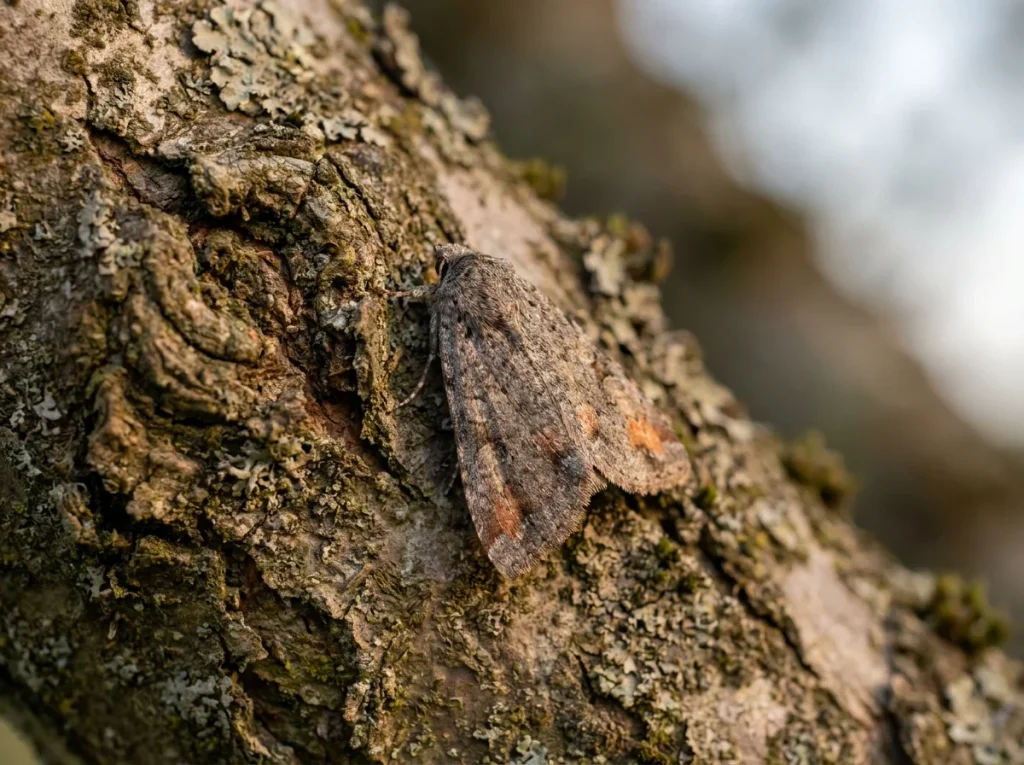
The adult is a mottled gray-brown moth with a copper patch near each wing tip. It holds its wings tent-like, blends into bark, and measures roughly 3/8 to 1/2 inch depending on the source (USU, Penn State).
Eggs are flat, pinhead-sized, and translucent, and females lay them singly on fruit or nearby leaves. The larva starts near 1/10 inch with a black head. When fully grown, it reaches 1/2 to 3/4 inch and looks cream to pink with a brown head.
Codling Moth Life Cycle and Generations Per Year
Control works only when it matches the insect’s calendar. Because timing drives every codling moth apple tree decision, it helps to learn the seasonal sequence first.
Overwintering and Spring Emergence
Mature larvae spend winter in silken cocoons under loose bark, at the base of the tree, or in debris and fruit bins. Pupation begins when spring temperatures pass 50°F, and moths become active once evening temperatures top 55°F (USU).
In practice, the first flight lands close to bloom. OSU says adults begin to emerge as apples bloom.
Egg Hatch and Feeding
USU reports that a mated female lays 30 to 70 eggs, while University of Minnesota (UMN) Extension reports up to 100. Eggs hatch in 6 to 20 days depending on temperature.
Newly hatched larvae enter fruit within 24 hours and tunnel toward the seeds. They feed for 3 to 5 weeks, then leave the fruit to find a sheltered spot for cocooning.
Second and Third Generations
Two to three generations occur per year depending on location (OSU, USU), and Penn State describes a partial third generation that cannot survive winter but can still add late-season fruit injury. In contrast, UMN Extension says the second flight in Minnesota, which starts in late July or early August, matters little in home orchards.
Your local extension office can tell you which generation does the most harm where you live.
7 Signs of Codling Moth Apple Tree Damage
Extension guides describe several clues of a codling moth apple tree infestation, and no single one proves the diagnosis. However, finding two or three together is far more convincing.
Sign 1: Brown Frass at the Entry Hole
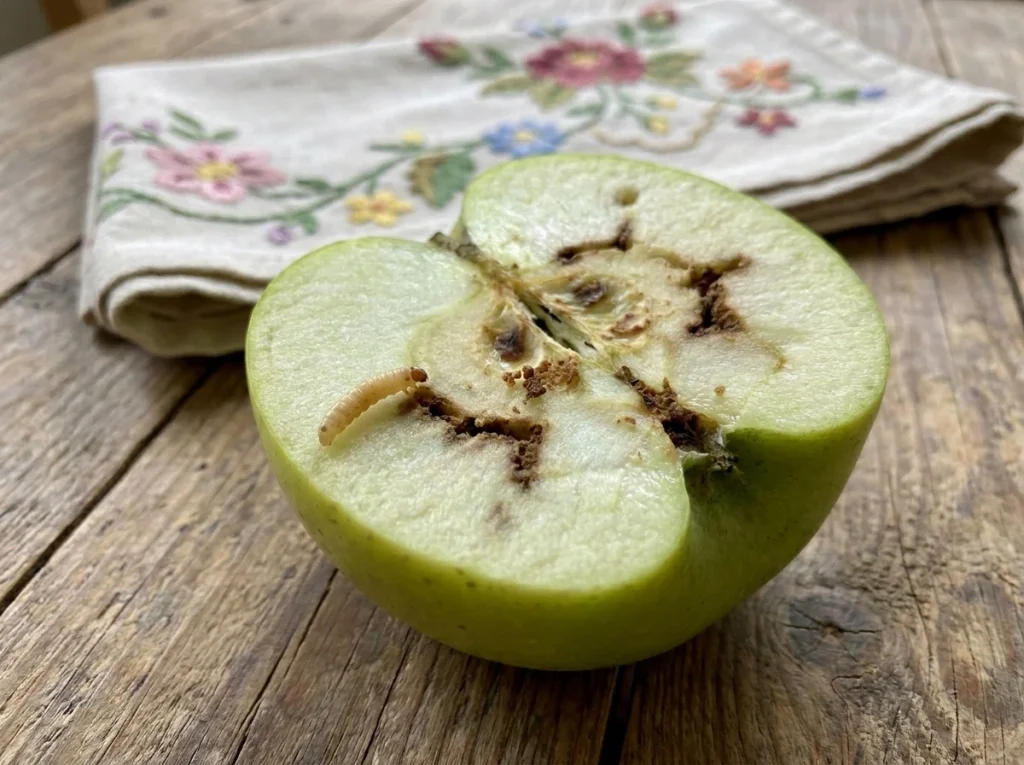
Larvae push crumbly brown excrement, called frass, out of their tunnel. USU notes that it appears at entry and exit holes, and entries often sit at the calyx (blossom) end of the apple. Therefore, check the bottom of the fruit first.
Sign 2: A Tunnel That Runs to the Core
Cut the suspect fruit open. A codling moth tunnel runs from the surface toward the core, where the larva eats the developing seeds (USU, UMN). For example, a tunnel with a frass plug at the blossom end points strongly to this pest.
Sign 3: Stings on the Skin
Stings are small, shallow, pinprick-sized marks. USU explains that they are healed or aborted entries left when a larva died or gave up. As a result, stung fruit can look bad even though the larva never reached the core.
Sign 4: Fruit That Drops in June or July
Apples attacked by the first generation drop early, and in Utah this usually happens in June or July (USU). Penn State recommends checking fruit for frass in mid to late June. However, natural thinning also drops apples, so cut a few open before deciding.
Sign 5: A Cream-to-Pink Larva With a Brown Head
Fully grown codling moth larvae are cream to pink with a brown head, and Penn State points to dark speckles on the collar behind the head. In contrast, the UMN apple maggot page says the larvae are much smaller. Size and head color therefore help separate the two.
Sign 6: Silken Cocoons in Bark and Debris
Larvae that leave the fruit spin cocoons in loose bark, at the trunk base, and in bins, brush, and woodpiles (USU). Cardboard bands wrapped around the trunk give wandering larvae a place to hide, so they also help you find and remove cocoons.
Sign 7: Male Moths in a Pheromone Trap
A baited trap catches male moths before you ever see codling moth apple tree damage. USU defines the start of consistent flight as one moth per night on consecutive nights. Additionally, OSU ties spray timing to that first consistent catch.
Codling Moth or Another Worm in Apples?
Several insects leave wormy fruit, and each one needs different timing. Penn State stresses that correct identification comes before treating a codling moth apple tree problem.
| Pest | Feeding pattern | Field clue |
|---|---|---|
| Codling moth | Tunnels to the core, eats seeds | Frass at entry, often blossom end |
| Apple maggot | Tunnels through flesh, pulp breaks down | Much smaller larva |
| Oriental fruit moth | Less likely to eat seeds | Smaller, similar-looking larva |
| Lesser appleworm | Feeds just under the skin | Smaller larva, shallow feeding |
For deeper comparisons, read our guides on worms in apples and apple maggot fly.
Monitoring a Codling Moth Apple Tree With Pheromone Traps
Choosing and Hanging a Trap
OSU describes delta or wing traps baited with a synthetic pheromone lure and a sticky insert. USU recommends orange traps because white ones attract bees, and UMN suggests hanging a trap near eye level on the outside of the canopy in early May.
Hang it by bloom and check it weekly. Our codling moth trap comparison covers lure and trap options.
Reading the First Catch
USU advises checking traps every day or two until the first moth appears, then weekly. A zero catch does not prove the tree is clean, because old lures can also produce empty traps. Therefore, replace lures on the schedule the manufacturer gives.
OSU says to time sprays to the start of egg hatch, which comes shortly after the first consistent male catch. UMN adds that if you catch no moths, you might not need to spray.
What Traps Can and Cannot Do
USU’s homeowner fact sheet says pheromone traps are not an effective control because they capture only males, and cutting male numbers barely reduces mating. OSU takes a middle view: in small backyards traps remove many males, but their main job is showing when fruit needs protection. As a result, treat the trap as a timing tool for your codling moth apple tree plan and pair it with the controls below.
When Moths Start Flying by Region
Codling moth apple tree flight timing shifts with climate and weather, so use these reports as examples and confirm dates with your local extension office.
| Region | Reported first flight | Source |
|---|---|---|
| Western Oregon | Late April to May | OSU |
| Southern Oregon | Mid-April in warm springs | OSU |
| Central Oregon | Late May into June | OSU |
| Pennsylvania | About the first week of May | Penn State |
| Minnesota | Just before bloom | UMN |
Non-Chemical Codling Moth Apple Tree Control
Many gardeners start with repeated sprays. However, the methods below cut codling moth apple tree damage with fewer chemicals, and they work best when combined.
According to Oregon State University Extension, “several less-toxic methods can significantly reduce damage.”
Control Methods at a Glance
| Method | What it does | Main limit |
|---|---|---|
| Sanitation | Removes larvae and cocoon sites | Must continue all season |
| Trunk bands | Catch larvae seeking pupation sites | Best on smooth bark |
| Bagging | Blocks egg laying and entry | Labor-intensive |
| Netting | Encloses the whole tree | Best on smaller trees |
| Traps | Show when moths fly | Not a cure alone |
Sanitation and Dropped Fruit
Scout regularly and remove infested fruit. OSU warns that larvae keep feeding inside dropped apples, and UMN adds that fallen apples belong in the trash, away from stored fruit.
USU also advises clearing bins, brush, and woodpiles that shelter cocoons. Additionally, OSU suggests keeping weeds and thick leaf litter from building up under the tree.
Trunk Bands
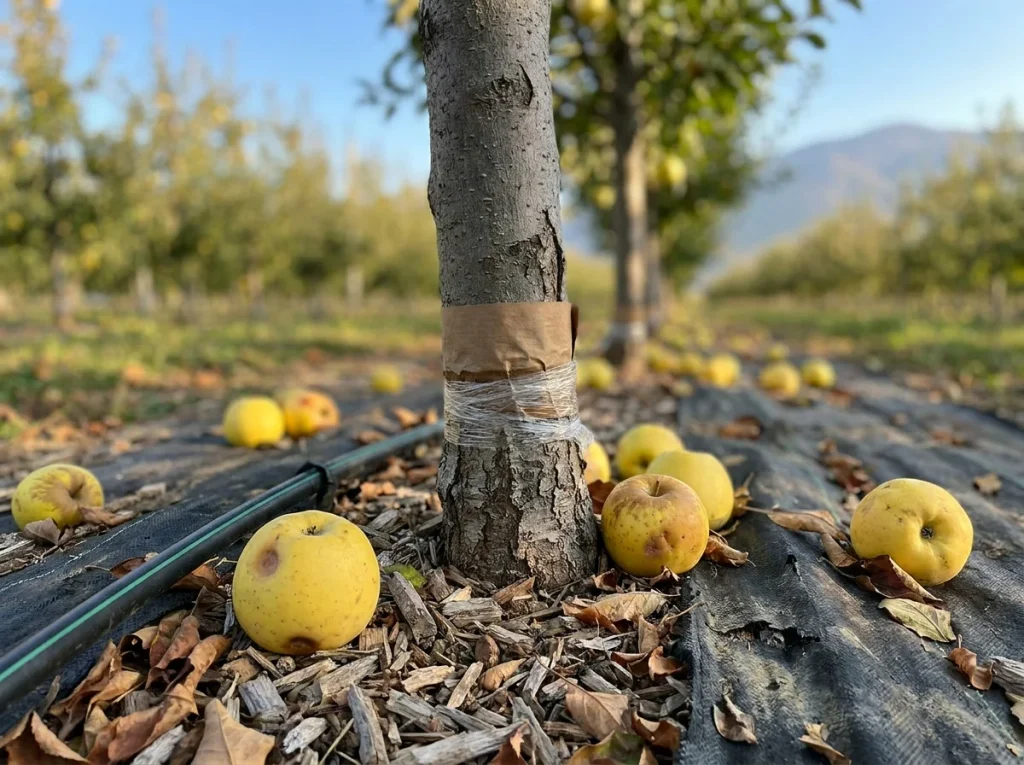
Wrap corrugated cardboard around the trunk so migrating larvae pupate in it. USU suggests bands 2 to 3 inches wide, placed in May and again in August in Utah, then destroyed before moths emerge. Penn State suggests September placement and December removal.
Bands work best on smooth bark (USU), and Penn State recommends removing loose bark from old trees as part of sanitation. Regional timing differs, so confirm dates locally.
Fruit Thinning
Thin fruit to one apple per cluster. USU explains that newly hatched larvae favor protected entry sites, such as spots where two fruits touch. In addition, thinning improves spray coverage on each apple.
Bagging Fruit
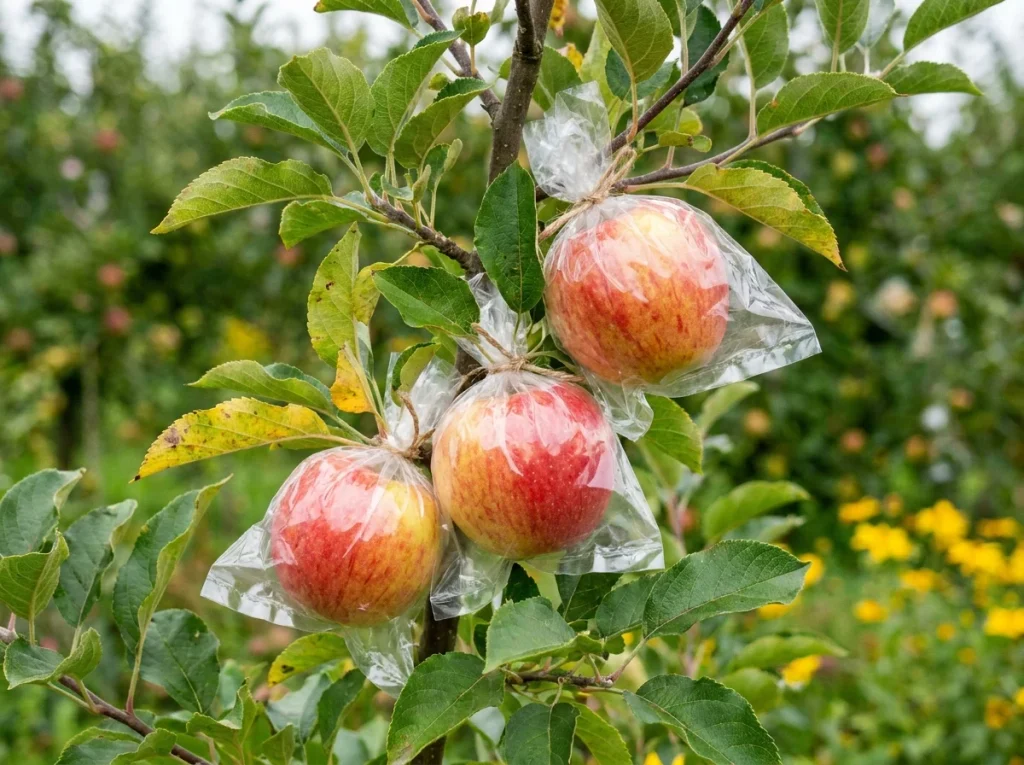
USU calls bagging labor-intensive but completely effective. Wait until fruit reaches 1/2 to 3/4 inch, slip a paper bag over each apple with a small slit for the stem, and close the top with a twist-tie. OSU describes mesh bags placed soon after petal fall.
Remove paper bags 1 to 2 weeks before the fruit matures so it can color. USU adds that an early spray may be needed before bagging to prevent infestation.
Exclusion Netting
UMN Extension reports research on hail netting as a barrier against apple maggot and codling moth. The whole tree must be enclosed, netting goes on after bloom and thinning, and it comes off right before harvest. For example, UMN measured an average 96% exclusion of apple maggots in a commercial orchard.
Netting suits smaller trees best. See our fruit tree netting roundup for options.
Natural Enemies and Mating Disruption
Native predators and parasitic wasps give limited help because larvae hide inside fruit (USU). The wasp Trichogramma shows promise mainly alongside other tools.
Mating disruption also falls short in small spaces. USU says it is not effective in home yards or orchards under 10 acres.
Choosing a Method for Your Yard
Based on the extension guidance above, our research team reads codling moth apple tree control as a matter of scale. One or two small trees suit bagging or netting, while several large trees usually call for sanitation, traps, and timed sprays.
Sprays for a Codling Moth Apple Tree: Options and Timing
Sprays are the last layer of codling moth apple tree protection, and they only work at a narrow moment. Use the guidance below together with advice from your local extension office.
When Spraying Makes Sense
OSU suggests spraying only if trap counts show sustained moth activity, because need-based timing beats calendar spraying. UMN adds that an orchard with no history of codling moth apple tree trouble probably has low numbers.
Match the Spray to Egg Hatch
Larvae bore into fruit within a day of hatching, and sprays applied afterward cannot reach them. Penn State says applications should start at late petal fall, and UMN recommends a second spray 7 to 10 days later. Neither source supports spraying during bloom.
Because exact dates depend on climate, see our codling moth spray timing guide for the degree-day method.
Common Home-Orchard Product Types
OSU lists spinosad, codling moth granulosis virus, and kaolin clay as options sold to homeowners. USU adds horticultural oil, applied once before egg hatch to smother eggs, and notes that pyrethrin protects for only 3 to 5 days while spinosad lasts about 7.
Rotate modes of action and confirm that the label lists apples in your state. Our best insecticide for apple trees and organic apple tree pest control guides go deeper.
Protect Bees and Stay Safe
Never spray during bloom, and apply in the evening when bees are inactive (OSU). Read the entire label, wear the protective gear it lists, and observe the waiting period between the last spray and harvest. For pesticide questions, contact your local extension office or a licensed applicator.
A Season-by-Season Codling Moth Apple Tree Prevention Plan
This codling moth apple tree plan folds the steps above into one calendar. Dates shift with climate, so anchor them to bloom and petal fall.
Late Winter to Bloom
- Clear bins, brush, and debris, and scrape loose bark from old trees.
- Hang a pheromone trap by first bloom.
- Skip sprays until petals have fallen.
Petal Fall to Early Summer
- Thin fruit, then bag or net the apples you can reach.
- Place trunk bands.
- Spray only if trap counts and egg hatch timing justify it.
Midsummer to Harvest
- Check fruit for frass in mid to late June.
- Empty bands on schedule and remove infested fruit promptly.
- Remove paper bags 1 to 2 weeks before the fruit matures.
After Harvest
- Strip leftover fruit and pick up windfalls.
- Destroy bands and the cocoons inside them.
- Clear culled fruit piles.
Common Codling Moth Apple Tree Control Mistakes
- Hanging the trap after bloom, which can miss the first flight.
- Spraying during bloom, which harms pollinators.
- Spraying after larvae are already inside the fruit.
- Letting windfalls sit under the tree.
- Relying on sanitation alone, which USU says rarely gives satisfactory control.
- Ignoring untended host trees nearby.
Moths From Outside Your Yard
UMN says adults can fly as far as a mile to find mating sites, so a tidy yard does not always stop a codling moth apple tree infestation. USU recommends removing abandoned orchards and wild hosts within a quarter mile where possible.
Consequently, talk with neighbors who have unmanaged apple, crabapple, or pear trees. When the source is off your property, bagging or netting your own fruit may be the most reliable answer.
When to Call a Professional
Call your local university extension office if you cannot confirm a codling moth apple tree problem, if damage keeps returning despite good sanitation, or if you need spray dates for your climate. A certified arborist can help with large trees that are too tall to bag, band, or spray safely. In addition, use a licensed applicator when a product requires one.
FAQs
What does codling moth apple tree damage look like?
Look for a small hole with brown frass, often at the blossom end, and a tunnel leading to the core. Stings, which are shallow pinprick marks, also count as codling moth apple tree damage.
When should I spray for codling moth?
Spray when eggs are hatching and before larvae enter fruit, which usually means shortly after petal fall and the first consistent trap catch. Codling moth apple tree spray dates vary by climate, so confirm them locally.
Do pheromone traps get rid of codling moths?
Traps mainly show when moths fly. USU says they are not an effective control alone because they catch only males, so use them to time other controls.
Are all worms in apples codling moth?
No. Apple maggot, oriental fruit moth, and lesser appleworm can also cause wormy fruit. Check where the larva feeds and how big it is before choosing a codling moth apple tree treatment.
Can I stop codling moth without spraying?
Often you can reduce damage, and USU describes bagging as complete control. Sanitation, bands, and netting add protection to any codling moth apple tree plan, although each takes regular effort.
Related Articles
- Apple tree pests
- Codling moth trap
- Codling moth spray timing
- Worms in apples
- Apple maggot fly
- Fruit tree netting
- Apple tree pest control
- Apple tree pests identification
Sources
- Utah State University Extension: Codling Moth in Utah Orchards
- Oregon State University Extension: Softer, smarter codling moth control for home orchards
- Penn State Extension: Codling Moth in the Home Fruit Planting
- University of Minnesota Extension: Codling moths in home orchards
- University of Minnesota Extension: Apple maggots
- Utah State University Extension: Apple and Pear Insect Control for Homeowners (Codling Moth)
