
M9 Rootstock Apple Tree: Proven Best Size & Spacing Guide
An M9 rootstock apple tree is a highly dwarfing grafted tree suited to small yards, intensive rows, and easy harvesting. It usually needs permanent support because its roots anchor poorly. Size and spacing vary with the scion, soil, climate, and training system, so plan the tree and its support together.
Table of Contents
Key Takeaways
- An M9 rootstock apple tree stays much smaller than a seedling tree and commonly fruits early.
- Permanent staking or a trellis is usually part of the planting design because M9 has weak anchorage.
- Start with about 6 to 8 feet between dwarf trees and 12 to 15 feet between rows, then adjust for the cultivar and training system.
- M9 does not determine the apple’s variety, flavor, or pollination needs. The grafted scion does those jobs.
- Check local winter conditions and fire blight pressure before choosing M9 for a particular cultivar and site.
An M9 rootstock apple tree is chosen mainly for size control and early bearing. The rootstock forms the root system, while the grafted scion produces the named apple variety, so the two parts should be evaluated together.
For a backyard grower, an M9 rootstock apple tree can make pruning, thinning, pest monitoring, and harvest more manageable. However, the same small root system creates responsibilities for support, irrigation, weed control, and careful crop management.
What is an M9 rootstock apple tree?
Rootstock, scion, and graft union
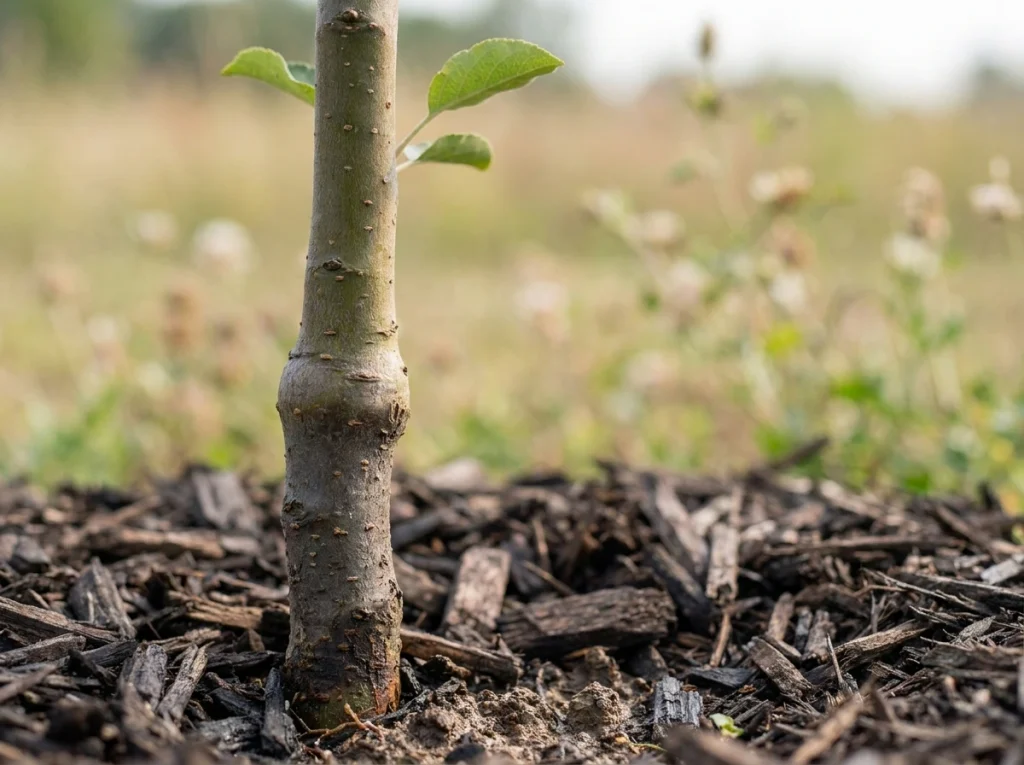
An M9 tree is a composite plant. The M9 rootstock is below the graft union, and the scion is the above-ground variety selected for its fruit. The graft union is usually visible as a swelling a few inches above the soil line.
University of Minnesota Extension explains that rootstocks influence mature tree size and the time needed to begin bearing. They can also affect anchorage, longevity, soil tolerance, suckering, and susceptibility to some diseases. Therefore, the label “M9” is a starting point, not a complete description of the finished tree.
What M9 changes, and what it does not
M9 reduces vegetative vigor, which helps keep the canopy compact and can encourage earlier flowering. It does not turn a poor apple variety into a good one, remove the need for cross-pollination, or guarantee identical tree size in every yard.
The scion, soil depth, water supply, pruning, climate, and training system all affect performance. In addition, a vigorous variety may make a larger tree on M9 than a naturally compact variety grown under the same conditions.
M9 rootstock apple tree size, spacing, and support
How large does an M9 rootstock apple tree become?
M9 is a dwarfing rootstock. University of Minnesota Extension describes M9 as producing a tree about 40 to 50 percent the height of a standard tree, while the University of Maryland notes that the final size also depends on cultivar, care, pruning, soil, and growing conditions.
For planning, think in terms of a compact tree that should remain reachable for routine work. Do not treat a nursery’s height estimate as a guarantee. The same rootstock can produce different results when the scion, soil, climate, or training method changes.
How far apart should M9 trees be planted?
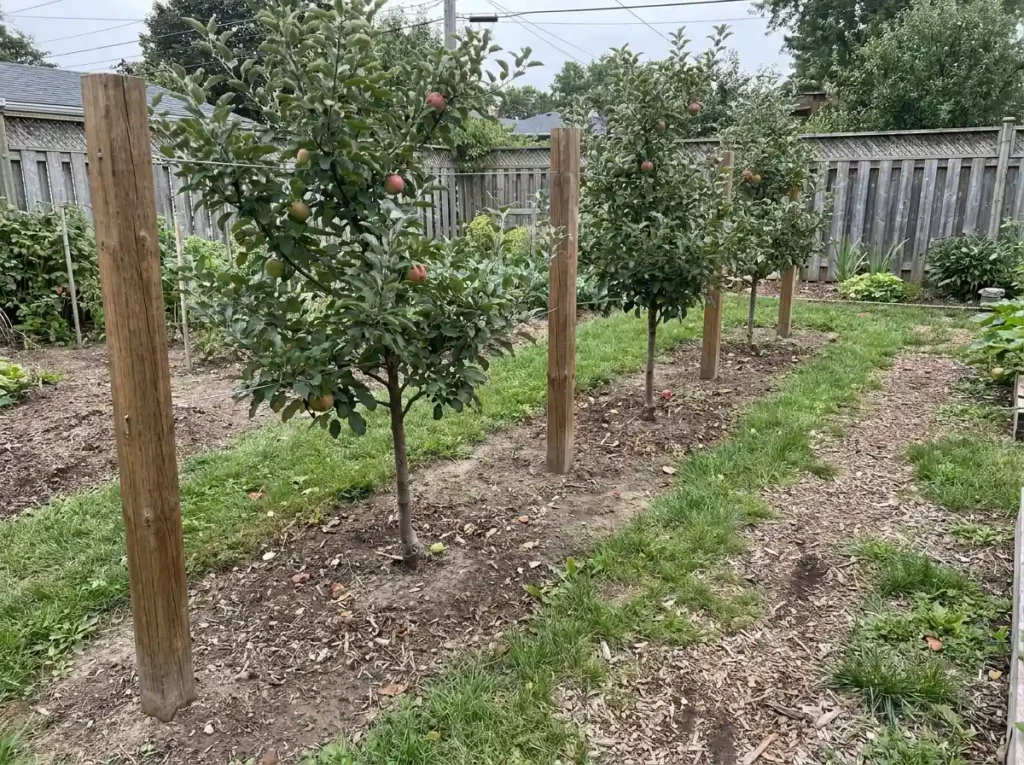
A practical starting point for dwarf apple trees is 6 to 8 feet between trees and 12 to 15 feet between rows. This range comes from University of Maryland Extension guidance for dwarf trees. Narrower systems can use less room, but they require more disciplined training and enough access for pruning and harvest.
Measure from trunk to trunk, then check the mature canopy width and the equipment or walkway needed between rows. On a windy site, a little extra room can make support installation and maintenance easier.
Does M9 need a permanent stake or trellis?
Usually, yes. University of Minnesota Extension reports that M9 has poor anchorage because of brittle roots and requires staking for the life of the tree. A permanent stake, post-and-wire trellis, or another properly engineered support system should be installed before the tree is exposed to strong winds or a heavy crop.
Support the trunk without strangling it. Inspect ties each season, leave room for trunk growth, and correct rubbing before it damages the bark. A support system also helps keep the graft union and crown stable while the tree establishes.
M9 rootstock apple tree hardiness, anchorage, and disease considerations
An M9 rootstock apple tree is not a universal answer for every climate or soil. Its small root system can make water management more important, and its weak anchorage makes exposed sites more demanding. Local nursery and extension advice is valuable when winter injury, drought, flooding, or replant problems are common.
Disease resistance also deserves attention. University of Minnesota Extension identifies M9 as very susceptible to fire blight, while Washington State University describes M9 clones as highly precocious but limited in disease resistance and very susceptible to fire blight. The scion’s disease profile still matters, but rootstock susceptibility can influence the overall risk.
Ask the nursery for the exact M9 type, such as an EMLA or another named clone, and ask how it performs with the chosen scion in your region. Avoid broad claims such as “M9 is hardy everywhere.” Performance depends on the rootstock clone, scion, site, and management.
Extension consensus: Rootstock choice is a system decision. The desired tree size, early bearing, anchorage, disease response, winter performance, soil conditions, and scion compatibility must be considered together. No single rootstock provides every desirable trait in every site.
How to plant and establish an M9 rootstock apple tree
1. Choose the site before buying the tree
Select a location for the M9 rootstock apple tree with good sunlight, drainage, and room for permanent support. Test the soil if possible, and correct major soil limitations before planting. A small root system needs consistent moisture, but saturated soil can still damage roots.
2. Keep the graft union above the soil
Plant so the graft union remains clearly above the finished soil line. If the scion takes root, it can change the intended size-control relationship. Firm the soil around the roots, water thoroughly, and avoid burying the trunk.
3. Install support and manage competition
Attach the tree to its permanent support soon after planting. Keep grass and weeds away from the root zone, apply mulch without touching the trunk, and water during dry periods according to local conditions.
4. Protect the young tree from excess crop load
Early fruiting is one reason growers choose M9, but a young tree still needs enough leaf growth to establish its framework. Follow local extension guidance on blossom and fruit thinning, especially when the tree is small or growing weakly.
5. Plan for pollination
M9 does not make an apple variety self-fertile. Most apple cultivars need pollen from a compatible cultivar with overlapping bloom. The University of Maryland and University of Minnesota both advise planning for a second variety or a reliable nearby pollen source.
Is an M9 rootstock apple tree right for your yard?
| Choice | Typical use | Main advantage | Main limitation |
|---|---|---|---|
| M9 | Small yards, intensive rows, trained trees | Compact size and early bearing | Permanent support and careful water management |
| MM106 | Larger backyard spaces | More canopy and stronger anchorage than a highly dwarfing rootstock | Needs more room and is less convenient to harvest |
| Seedling or standard | Large sites and long-lived, broadly spaced trees | Strong anchorage and wider soil adaptability | Large canopy, harder pruning, and more difficult harvest |
Choose an M9 rootstock apple tree when compact size, reachable fruit, and intensive management fit your site. Choose a larger rootstock when the planting area is exposed, irrigation is unreliable, soil is difficult, or you want a more self-supporting tree.
To compare another common option, read the guide to MM106 rootstock. If you are building a tree from a chosen scion, see how to graft apple trees for the grafting process and timing considerations.
FAQs
How big does an M9 rootstock apple tree get?
An M9 rootstock apple tree is dwarfing, but final height varies with the scion, soil, climate, pruning, and training system. Plan for a compact tree, then confirm the nursery’s estimate for the exact grafted combination.
How far apart should M9 apple trees be planted?
Use 6 to 8 feet between dwarf trees and 12 to 15 feet between rows as a starting range. Adjust for the mature canopy, row access, support system, and the vigor of the grafted variety.
Does an M9 rootstock apple tree need permanent support?
Yes, permanent support is normally recommended for an M9 rootstock apple tree. M9 has poor anchorage and brittle roots, so a stake or trellis should remain in place for the life of the tree.
Is M9 rootstock disease resistant?
An M9 rootstock apple tree should not be treated as broadly disease resistant. Extension guidance identifies a high fire blight risk, and site conditions can affect other root problems. Ask for regional, clone-specific advice before planting.
Can M9 rootstock grow into a named apple without grafting?
No. M9 is a clonal rootstock, not the named fruit variety. It needs a compatible grafted scion to produce the apple cultivar you want. For related propagation choices, read apple tree propagation from cuttings.
Related Articles
Sources
- University of Minnesota Extension, Growing apples in the home garden
- University of Maryland Extension, Growing apple and pear trees in a home garden
- University of Minnesota, How rootstocks influence apple trees
- Washington State University Tree Fruit, Matching rootstocks and scions to soils
