
Codling Moth Spray Timing: A Practical Guide for Apple Growers
Codling moth spray timing is based on the pest’s development, local temperature records, and the treatment’s label, not one date that works everywhere. Start by monitoring adult moth activity and using the degree-day model recommended for your area. Then time any permitted treatment to the vulnerable life stage named by that model and product label.
Table of Contents
Key Takeaways
- Codling moth spray timing should follow a locally appropriate degree-day model and trap records, not a national calendar date.
- Biofix-based and January 1 degree-day systems use different starting points, so their totals cannot be compared directly.
- Read the pesticide label for permitted crops, target pest, interval, protective equipment, pollinator precautions, and preharvest interval.
Finding a pinhole, frass, or a tunnel in an apple is frustrating, especially when the tree looked healthy a week earlier. The trouble is that a treatment can only help when it reaches the pest at a susceptible stage. Codling moth larvae enter fruit soon after hatching, so codling moth spray timing and monitoring matter more than spraying by habit.
This guide explains codling moth spray timing without treating an extension model as a universal prescription. Because climate, trap method, insecticide mode of action, and local pest pressure vary, use your state or county extension recommendations for the final timing decision.
Codling moth spray timing starts with a local model, not a calendar date
Codling moth development responds to accumulated heat. Degree days, sometimes called growing degree days, estimate how much insect development has occurred above a lower temperature threshold. They help predict events such as egg hatch, but they do not guarantee that every moth in a particular backyard orchard is at the same stage. That is why codling moth spray timing must be checked against field observations and local advice.
Utah State University Extension explains that calendar-based applications can miss the pest’s actual development because spring temperatures change from year to year. Its codling moth model uses 50°F as the lower development threshold and 88°F as the upper threshold. Those model details matter: a number from a different model or weather station may represent a different point in the insect’s development.
Learn what “biofix” means
A biofix is the biological starting point for accumulating degree days in a biofix-based model. For codling moth, it is commonly set when consistent adult moth captures begin in a pheromone trap. “First moth caught” and “consistent flight” are not always defined identically, so follow the definition used by your local extension model.
For example, USU describes checking traps frequently in spring and setting biofix at consistent moth flight. Once the local biofix is established, degree days are accumulated from that date. Do not enter a guessed calendar date as biofix just because a neighbor’s tree is in bloom. Reliable codling moth spray timing starts with the biofix definition in the model you are following.
Do not mix degree-day systems
Some regional systems start accumulating degree days from a trap-based biofix. WSU also describes a no-biofix model that accumulates heat from January 1. The values are not interchangeable. A threshold of 250 degree-days after biofix is not the same thing as 250 degree-days since January 1.
So, when using an online dashboard, note the model name, base and upper thresholds, start date, and calculation method. If those details are missing, ask your extension office before using the total to schedule a treatment. These model details are the foundation of sound codling moth spray timing.
Monitor moth activity before choosing a treatment window
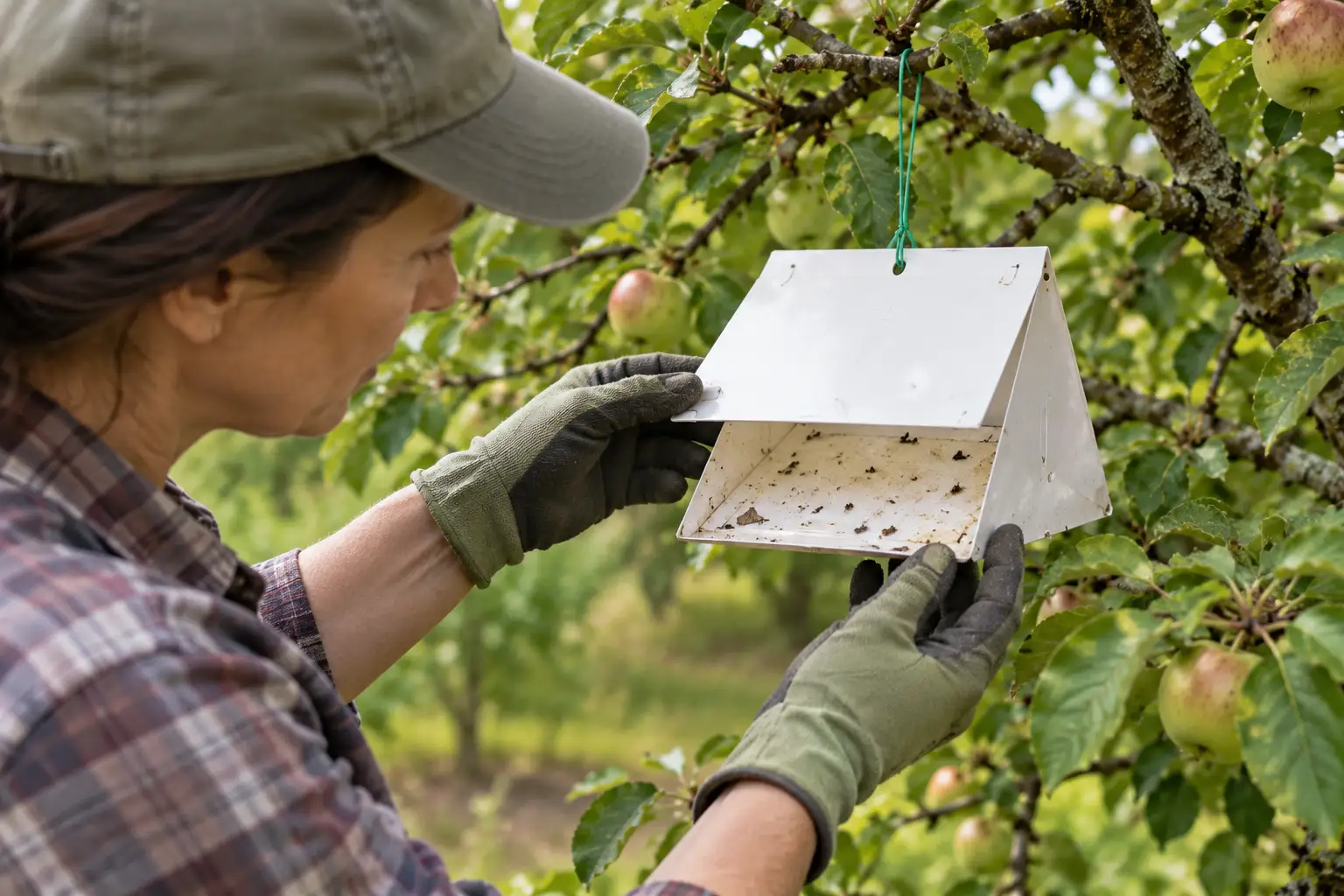
A pheromone trap helps detect adult activity and provides information for the model. Its catch is one part of codling moth spray timing, not a treatment instruction by itself. It does not kill enough moths to protect a crop by itself. Hang and service the trap according to its instructions and local extension guidance, then record the date and catch rather than relying on memory.
WSU CAHNRS’ video discusses codling moth management, predictive models, and decision points. Use it as background on the monitoring approach, not as a substitute for current local recommendations or the pesticide label.
Place and check a pheromone trap
Use the trap type and lure recommended for your orchard and region. USU advises placing traps before expected adult activity and checking them frequently while establishing the spring biofix; after that, growers continue monitoring on a regular schedule. Trap placement and density differ with orchard size and whether mating disruption is used. Follow the local recommendation before using trap data to make codling moth spray timing decisions.
Record the number of moths, date, trap location, lure type, and any lure or sticky liner replacement. Those notes make codling moth spray timing decisions easier to review with an extension educator. A zero catch does not prove that the orchard has no codling moths. Old lures, poor placement, cool evenings, or weather can affect trap catches.
How to use degree days without treating one number as universal
Published thresholds differ because sources may use different model start points, treatment targets, and regional assumptions. A threshold is meaningful only when paired with its model and intended control tactic. That context is essential to interpret codling moth spray timing correctly. The table below is a comparison of examples, not a spray calendar.
| Guidance example | Starting point / reference | What it tells a grower | Important limit |
|---|---|---|---|
| USU Extension Utah model | Biofix-based; model uses 50°F lower and 88°F upper thresholds | Egg-hatch milestones help plan monitoring and protection in Utah orchards | Use the Utah model and local advisory; do not transfer its dates or values uncritically to another region. |
| Penn State Extension example | Degree days accumulated after first male capture | Describes different timings for egg-targeting products and broad-spectrum products | Its figures are regional guidance and product-target dependent, not a universal homeowner instruction. |
| WSU predictive model | No-biofix model accumulates from January 1 | Provides model-based decision windows for egg and larval stages | Do not compare these totals directly with biofix-based degree days. |
For a concrete illustration, USU’s Utah model identifies first-generation egg hatch beginning near 220 degree days after biofix, while Penn State discusses other product-specific application windows and WSU uses a separate January 1 model. These are examples of why “spray at X degree days” is incomplete advice. Check the current regional model and confirm that the product is labeled for the pest and use.

Interpreting the first-generation window
First-generation timing is important because newly hatched larvae can enter fruit quickly. The appropriate target may be eggs, newly hatched larvae, or another stage, depending on the control method. Codling moth spray timing must match that target stage. Therefore, the product’s mode of action and the model’s intended event must match.
Do not assume a treatment aimed at eggs will work like one aimed at larvae, or that an organic-labeled product has the same residual period as another product. Follow the label and current extension recommendations, including whether repeat coverage is warranted. That is the safest basis for deciding whether codling moth spray timing calls for another application.
Later generations and ongoing fruit protection
Codling moth can have more than one generation in a season, with the number varying by region and weather. USU reports two to three generations in Utah, and notes that fruit may remain at risk through the season. Your area’s model or advisory should tell you when later-generation activity is expected. Use those updates to revisit codling moth spray timing during the season.
As harvest approaches, the label’s preharvest interval becomes especially important. If the remaining time before harvest is shorter than the label allows, do not apply that product. Ask a local extension educator about lawful options that fit your situation.
A practical codling moth spray timing workflow for a home orchard
- Identify the pest and assess the tree. Look for entry holes, frass, shallow stings, and damaged fruit. Similar fruit injuries can have different causes, so seek help if the diagnosis is unclear.
- Find the model for your county or state. Confirm whether it is biofix-based or starts from a calendar date. Record the model thresholds and the weather data source it uses.
- Set and maintain a pheromone trap. Follow regional guidance for placement, lure type, and checking frequency. Record catches so you can identify the model’s biofix rather than guessing.
- Match the timing to the label. Check that the product is labeled for apples and codling moth, then review target life stage, application interval, rain restrictions, protective equipment, pollinator directions, and preharvest interval.
- Reassess instead of repeating automatically. Check updated degree days, trap records, local advisories, and label intervals. Repeat only when the label and current recommendations support another application.
Coverage also matters. Codling moth spray timing alone cannot compensate for poor coverage or unsafe use. Follow label directions for mixing and application, and avoid drift onto people, pets, waterways, or flowering plants visited by pollinators. Do not spray open blossoms with an insecticide unless the label explicitly permits it and local pollinator precautions are followed.
If you missed the first timing window or see damaged apples
Do not compensate by applying extra product or shortening the label interval. First, check whether the local model indicates another susceptible stage or later generation. Then ask your extension office whether any labeled treatment remains appropriate for the crop stage and harvest date. A missed window does not justify changing codling moth spray timing or label directions on your own.
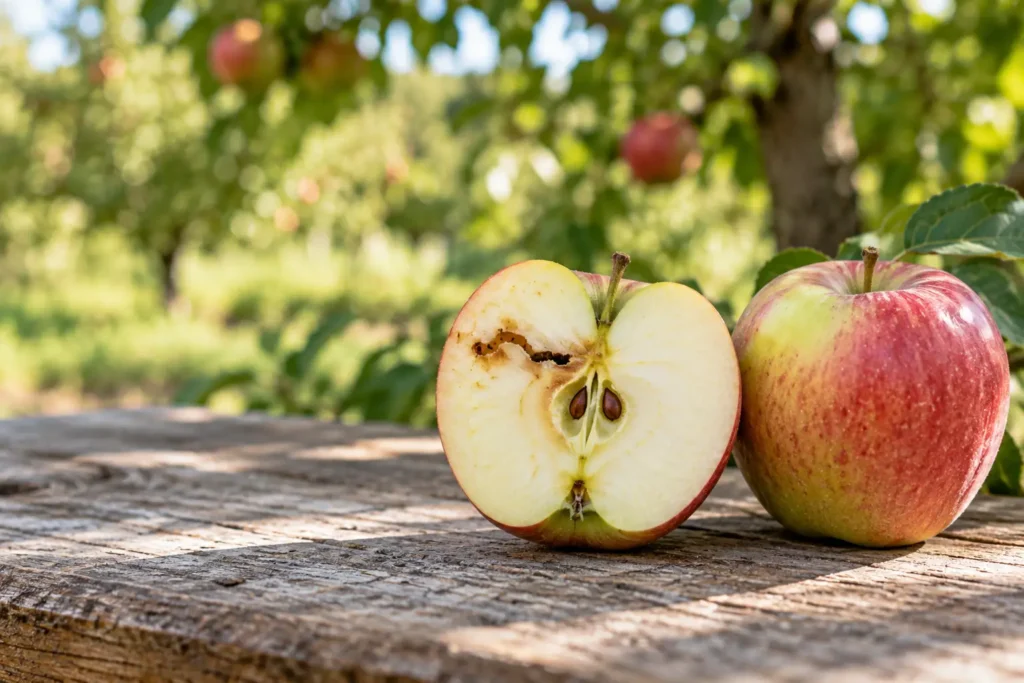
Fruit already tunneled by larvae will not be repaired by spraying. Remove infested and fallen fruit when practical, and dispose of it in a way that prevents larvae from completing development nearby. Sanitation can reduce some sources of future moths, but it does not replace monitoring where pressure is persistent.
Lower-risk measures that support a spray program
Several non-spray practices can help reduce pressure, although none should be presented as a guaranteed stand-alone fix in a heavily infested area. Pick up dropped fruit regularly, remove fruit left on the tree after harvest, and thin clusters so fruit do not touch where practical. USU also describes trunk banding as a way to intercept larvae seeking shelter, with removal and destruction timed to local recommendations.
Bagging individual fruit can provide a physical barrier, but it takes time and bags must be installed at the right stage and kept intact. Mating disruption is a specialized pheromone method used in some orchards; it is not the same as hanging a few monitoring traps. Ask your extension office whether it is suitable for a small home planting.
For identification help, compare this guide with our codling moth apple tree overview. If the damage looks different, our guides to worms in apples and apple maggot fly explain other common fruit-injury concerns.
When to ask a local extension office or licensed professional
Contact your county extension office if you cannot identify the pest, do not know which degree-day model applies, or have recurring damage despite following a monitoring plan. Bring clear photographs of the fruit entry and the whole tree, along with trap records, the product label, and the model or weather station you used.
For pesticide selection or application beyond a home-garden label, consult a licensed pesticide professional or local extension specialist. Never use a commercial-orchard recommendation unless the product label specifically allows that site and use.
FAQs
When should I start spraying apple trees for codling moth?
Start monitoring before the first expected moth flight, then use your local degree-day model to identify the treatment window. Codling moth spray timing varies with region, model start point, and product target, so a fixed month or date is not dependable on its own.
How do I use degree days and a pheromone trap?
Use the trap to monitor adult activity and establish biofix if your model requires one. Then accumulate degree days using the same model’s base, cutoff, calculation method, and weather source. Codling moth spray timing should be based on that model’s target event, not a total taken from a different system.
Can I still protect apples after I see an entry hole?
A larva already inside an apple is protected from many contact treatments, and the damaged fruit cannot be restored. Remove infested fruit and check your local model for subsequent generations. Codling moth spray timing is about preventing new entries, not curing fruit that is already tunneled.
How often should I reapply a codling moth product?
There is no single interval for all products. The label sets the permitted interval and maximum use, while weather, coverage, pest pressure, and the local model inform whether another application is needed. Never shorten the label interval.
Do pheromone traps control codling moths?
Most home-orchard pheromone traps are for monitoring, not adequate population control. They help identify moth activity and support codling moth spray timing, but should be combined with other regionally appropriate measures when control is needed.
Related Articles
- Codling moth apple tree: identification, damage, and control overview
- Worms in apples: identify likely causes and prevention steps
- Apple maggot fly: recognize a different fruit pest
Sources
- Utah State University Extension, Codling Moth in Utah Orchards
- Penn State Extension, Tree Fruit Insect Pest: Codling Moth
- Washington State University Tree Fruit, Predictive Models
- Utah State University Extension, Using Degree Days to Time Treatments for Insect Pests