
Juniper Apple Rust: Proven Complete ID & Treatment Guide
Juniper apple rust usually means cedar apple rust seen on its juniper host. Look for rounded woody galls that produce orange, jelly-like horns during wet spring weather. Inspect before removing branches: a reachable gall, a large affected screen, and an elongated canker call for different decisions, and nearby apples may need separate protection.
Table of Contents
Key Takeaways
- Inspect the gall’s shape, attachment, and condition after rain.
- Remove accessible gall-bearing twigs before spring spore release when practical.
- A dry gall may produce orange horns again during the same spring.
- Keeping an established juniper is often reasonable; removing one does not eliminate regional exposure.
1. Confirm the Juniper Host First
For juniper apple rust, start with the evergreen’s identity. Eastern red cedar is a juniper, Juniperus virginiana, despite its common name. Other junipers can also host rust fungi. A tree sold simply as “cedar” needs a closer identification before you assign this diagnosis.
Check a label or nursery record. Without one, photograph the foliage and whole plant for identification.
The usual disease behind this search term is caused by Gymnosporangium juniperi-virginianae. Its alternate hosts include apples and crabapples. For the full disease cycle and apple symptoms, see our cedar apple rust guide. Here, the task is deciding what the growths on your juniper mean and what to do with that plant.
2. Read Juniper Apple Rust Galls in Context
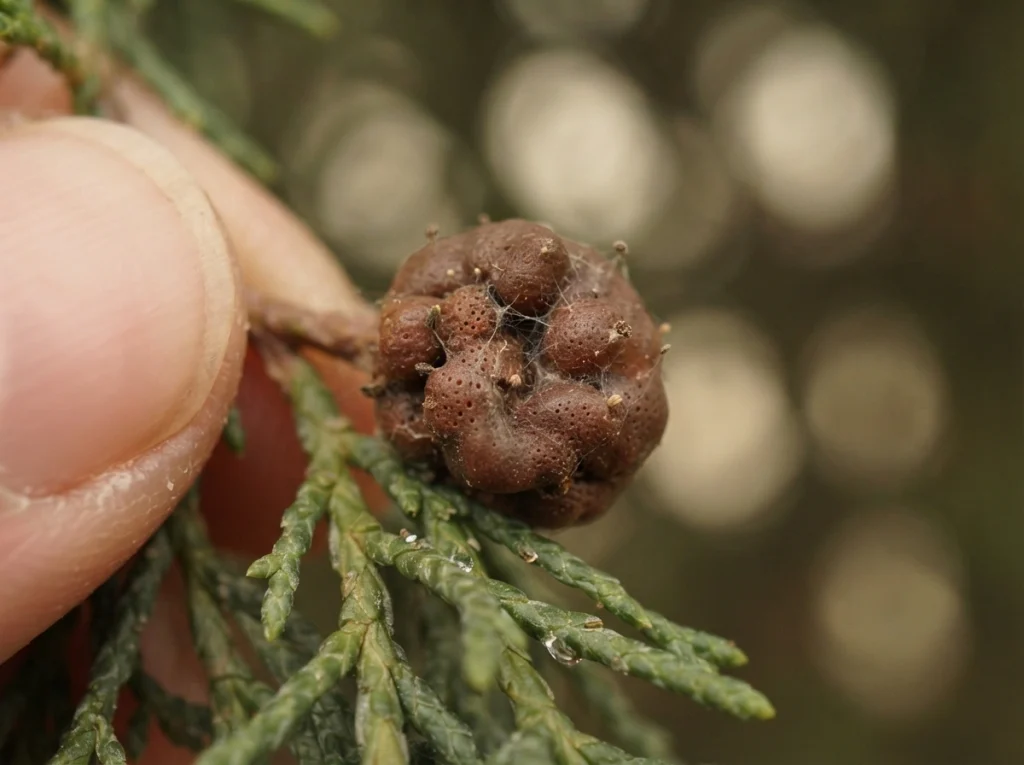
Juniper apple rust before the orange horns appear
Mature juniper apple rust galls are rounded, brown, woody growths attached to twigs. Their surfaces can look dimpled, and larger examples reach roughly two inches across. During inspection, look behind the outer foliage as well as at exposed branch tips. Record where each growth attaches rather than relying on its color alone.
What wet and dry galls tell you
In wet spring weather, orange gelatinous horns emerge from the gall. They shrink as conditions dry and can swell again after more rain during that season. Photographing the same marked twig before and after rain can explain why a growth seemed to disappear and then return.
A brown gall alone does not tell you whether spore release is still ahead or already finished. Cedar apple rust galls release spores during one spring season, then die, but old woody structures can remain attached. Different-aged galls can occur on the same tree. Record observations over time rather than classifying every dry gall as harmless.
Backyard Farmer: Nebraska Extension plant pathologist Loren Giesler explains cedar apple rust.
3. Compare the Growth, Not Just Its Orange Color
Juniper apple rust is one of several rust diseases affecting junipers. This comparison helps you describe a suspect growth to a diagnostic clinic; it cannot confirm a species from appearance alone.
| Juniper finding | Possible explanation | Useful next observation |
|---|---|---|
| Rounded woody gall with long orange gelatinous horns | Cedar apple rust is a strong possibility | Record size, attachment, and changes after rain |
| Smaller reddish-brown gall with shorter, blunter orange projections | Cedar hawthorn rust is possible | Photograph the whole twig and surrounding foliage |
| Elongated branch swelling with orange gelatinous patches rather than a round gall | Cedar quince rust or another canker problem needs consideration | Show the full swelling, bark condition, and any dead growth beyond it |
These distinctions matter because cedar quince rust cankers can persist and produce spores for multiple years. Do not apply the one-season gall rule to an elongated lesion. If the branch is dying or bark is splitting, include that damage in your diagnostic request.
Before treating a growth as juniper apple rust, obtain clear photographs while it remains attached. A loose orange fragment provides less context than a view showing the growth, twig, and living foliage together.
4. Decide Whether Gall Removal Is Practical
The useful window for removing juniper apple rust galls is before spring horns release spores. Inspect during dormancy or before local spring growth advances. Use the plant’s condition and regional guidance instead of a universal calendar date. [3, 4]
| What you find | Practical decision | Limit to remember |
|---|---|---|
| A few galls on reachable small twigs | Consider pruning out the gall-bearing portions before horns emerge | Other trees may still supply spores |
| Orange horns already active | Record the stage; remove accessible galls if worthwhile | Some spores may already have dispersed |
| Many galls deep inside a tall screen | Assess access and the amount of foliage removal required | Complete removal may be unrealistic |
| A swelling on a large limb or a branch with dieback | Confirm the diagnosis before major pruning | It may require a different management approach |
Remove the affected twig portion with an appropriate pruning cut rather than simply wiping away orange horns. The horns are temporary structures growing from the gall. Gather removed material and follow local extension advice for disposal. Avoid leaving it hanging in the canopy.
For a hedge, walk both sides before starting. Ask whether reaching the galls would require unsafe access or leave conspicuous gaps. A certified arborist can assess work above comfortable ground-level reach.
5. Decide Whether to Keep the Juniper
A juniper apple rust diagnosis does not automatically justify removing a mature tree. University of Minnesota Extension reports that these rusts usually cause little harm to junipers. The more consequential issue may be a susceptible apple or crabapple nearby.
Expert consensus, paraphrased: University of Minnesota and Penn State Extension emphasize that rust management on established landscape junipers is often unnecessary. Diagnosis, actual plant damage, and the value of susceptible nearby hosts should guide action. This is a summary of published guidance, not a personal quotation.
Existing screen or new planting?
For an established screen, weigh privacy, shade, and replacement costs alongside confirmed damage. Record whether foliage is healthy beyond each gall. A few attached galls and widespread branch dieback are different observations and deserve different follow-up.
For a new juniper, ask the nursery for the exact species and cultivar, then ask which rust diseases its resistance claim covers. “Disease resistant” is too broad to answer that question. Keep the label for future reference.
If you are also choosing an apple, use our cedar apple rust resistant varieties guide to compare options. Changing a future planting choice may be more practical than repeatedly trying to remove every gall from an established evergreen.
Should you spray the juniper?
Routine fungicide treatment of landscape junipers is generally not recommended in Minnesota Extension’s guidance. Nursery production can involve different objectives and spray schedules. Do not transfer a commercial nursery recommendation to a home garden without checking local guidance and the product label.
When the concern is protecting apples from juniper apple rust, use our separate cedar apple rust treatment guide. It covers apple protection timing. Spraying a juniper after discovering orange horns is not a substitute for a properly timed apple protection plan.
6. Look Beyond Your Property Boundary
Rust spores can travel more than a mile, so no visible juniper in your yard does not establish that exposure is absent. Likewise, removing your only juniper cannot guarantee that nearby apples will remain uninfected. Distance reduces exposure in some settings, but a small garden rarely offers complete isolation.
Map the plants you know about rather than trying to identify every evergreen in the neighborhood. Mark your apples, crabapples, and confirmed junipers. Note which trees you can inspect and which lie outside your property. This keeps your action plan tied to plants you actually manage.
If discussing juniper apple rust with a neighbor, share photographs and ask whether they know the tree’s identity. Avoid presenting removal as the only solution. Their plant may be valuable, and its identity or contribution to local exposure may still be uncertain.
7. Keep a Juniper Inspection Record
A short juniper apple rust record makes repeat inspections useful. Give each juniper a simple identifier, such as “north gate screen,” and revisit the same marked branch. Keep wide and close photographs together.
| Record | Example entry | Why it helps |
|---|---|---|
| Plant and location | North gate, cultivar unknown | Separates observations from different trees |
| Date and recent conditions | Spring inspection, day after rain | Explains changes in horn appearance |
| Growth and attachment | Round brown gall on a small side twig | Supports identification and pruning assessment |
| Access and branch condition | Reachable; foliage beyond gall green | Helps judge the effort and urgency |
| Decision and follow-up | Photograph now; ask clinic about uncertain swelling | Prevents an unresolved observation being forgotten |
These entries are examples, not diagnostic thresholds. You do not need a precise gall count for a large hedge; a consistent description and repeat photographs may be more useful.
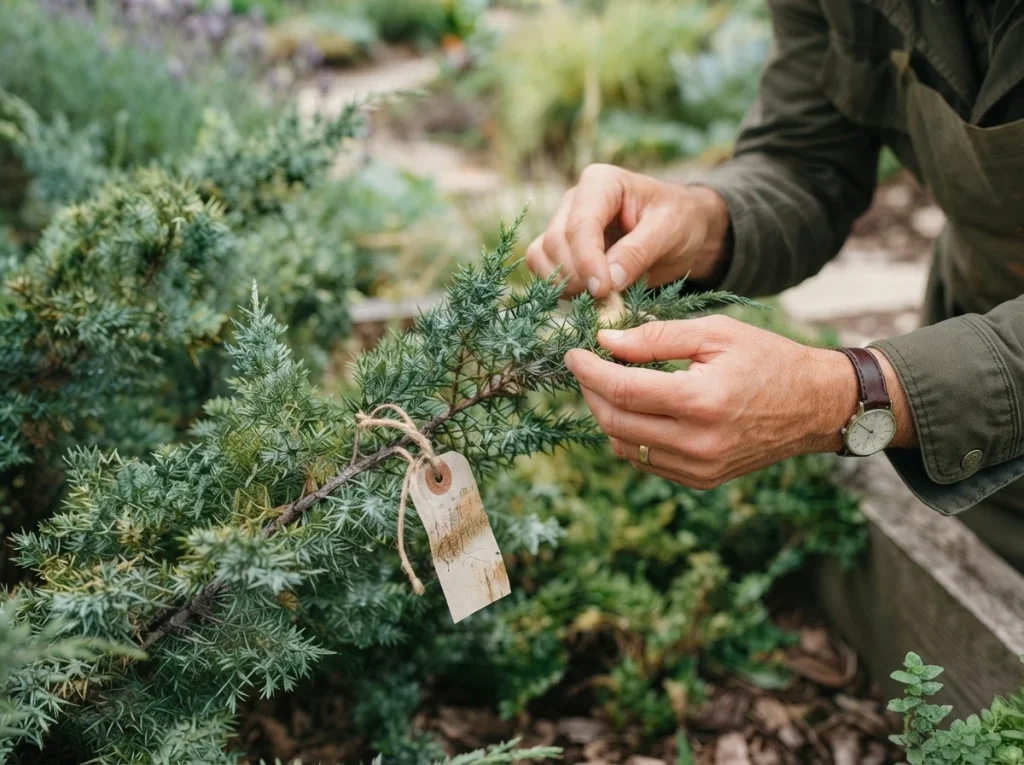
Consider two hypothetical inspections. Three round galls on reachable twigs may make selective removal straightforward. Similar-looking growths high inside a mature screen may lead you to retain the tree and concentrate on protecting a susceptible apple. An elongated swelling with dieback calls for diagnosis before either approach.
For uncertain juniper apple rust symptoms, send a clinic the plant identity if known, a whole-plant photograph, an attached-growth close-up, and dates. Ask how to collect a sample before cutting or mailing one.
FAQs
Will juniper apple rust kill my juniper?
It usually causes little damage to established junipers. Extensive dieback deserves investigation because another rust, a canker, or a separate problem may be involved. Do not assume every dying branch is explained by nearby galls.
Must every old juniper apple rust gall be removed?
Not necessarily. Confirmed spent cedar apple rust galls are no longer the same spore source as galls approaching their active spring. If age is uncertain, keep dated photographs or seek advice instead of judging by brown color alone.
Why did orange horns return after rain?
Horns can dry and rehydrate repeatedly during the active spring. Their return does not necessarily mean a new infection just occurred. Track the same gall to distinguish a change in its appearance from a newly noticed growth.
Can I keep both hosts of juniper apple rust?
Often, yes. Your plan depends on apple susceptibility, local disease pressure, and practical management. Juniper apple rust is a reason to assess those factors, not an automatic instruction to remove an evergreen.
Related Articles
- Cedar apple rust: disease overview and life cycle
- Cedar apple rust treatment: apple protection timing
- Cedar apple rust resistant varieties
Sources
- NC State Extension: Cedar Apple Rust
- University of Minnesota Extension: Cedar-apple rust and related rust diseases
- University of Maryland Extension: Rust Diseases of Trees
- Penn State Extension: Cedar Apple And Related Rusts on Ornamentals
