
Cedar Hawthorn Rust: Proven Symptoms & Treatment Guide
Cedar hawthorn rust is a fungal disease caused by Gymnosporangium globosum that alternates between susceptible junipers and plants such as hawthorn, apple, and crabapple. It causes yellow-orange leaf spots and, later, small spore-producing tubes. Management starts with checking the diagnosis and protecting vulnerable growth before infection. Spraying cannot restore leaves that already have rust damage.
Table of Contents
For an apple grower, the most useful questions are whether this is the right rust species, whether the tree is losing significant foliage, and whether the spring infection period is still underway. A few marked leaves call for a different response from repeated early defoliation.
1. Identify symptoms on both host plants
Look above and below affected leaves
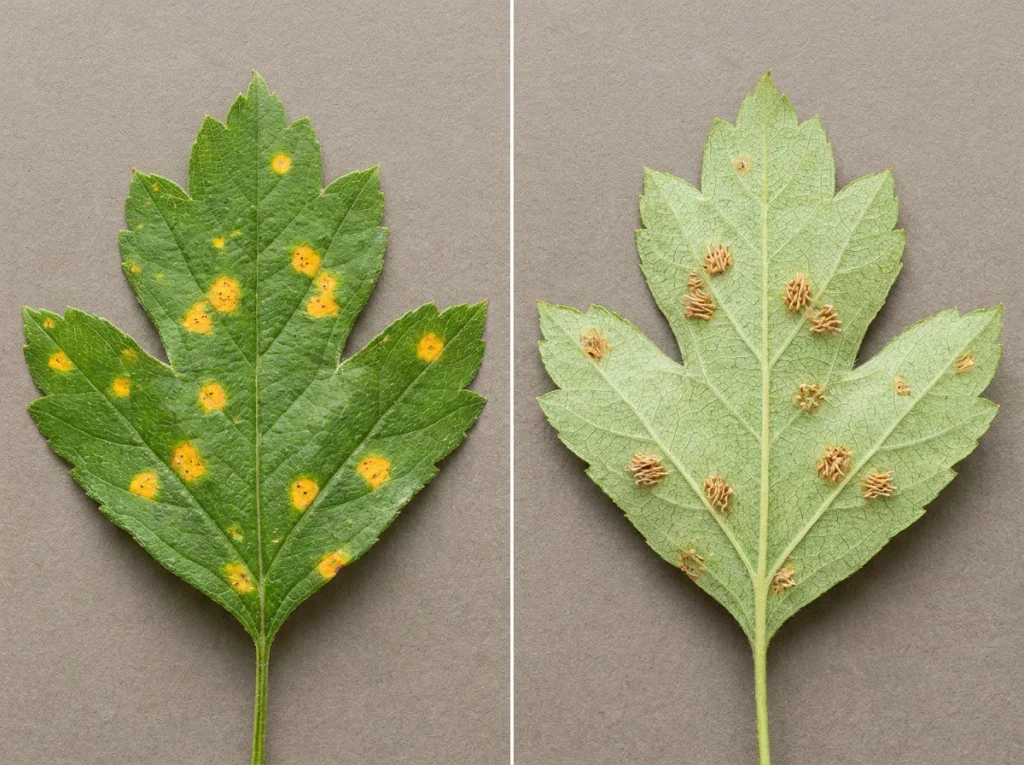
On hawthorn, small yellow spots enlarge and may develop reddish borders. Tiny dark dots appear within the lesions. Later, tube-shaped fungal structures grow on the underside beneath the spots. Heavily affected foliage may yellow and drop early. These are the features described in Iowa State Extension’s cedar-hawthorn rust guide.
Check several leaves at different stages. An early spot will not necessarily have visible tubes underneath, so their absence on one fresh lesion does not rule out rust. Photograph the upper surface, turn the same leaf over, and photograph the corresponding area below. This gives a diagnostic clinic more information than a distant picture of the canopy.
Inspect fruit and shoots without assuming every injury is rust
Apple foliage can develop cedar-hawthorn rust, but apple fruit infection is uncommon. Purdue’s guide for apples in home landscapes distinguishes this leaf-focused pattern from cedar-quince rust, which usually affects the blossom end of apples and rarely their leaves.
On hawthorn and other susceptible hosts, fruit and young shoots can also be affected. Note whether the main problem is leaf spotting, distorted fruit, swollen twigs, or dying shoots. A hawthorn covered with spiny fruit and branch swellings needs a broader rust diagnosis rather than identification from the tree’s name alone.
Check nearby junipers after spring rain
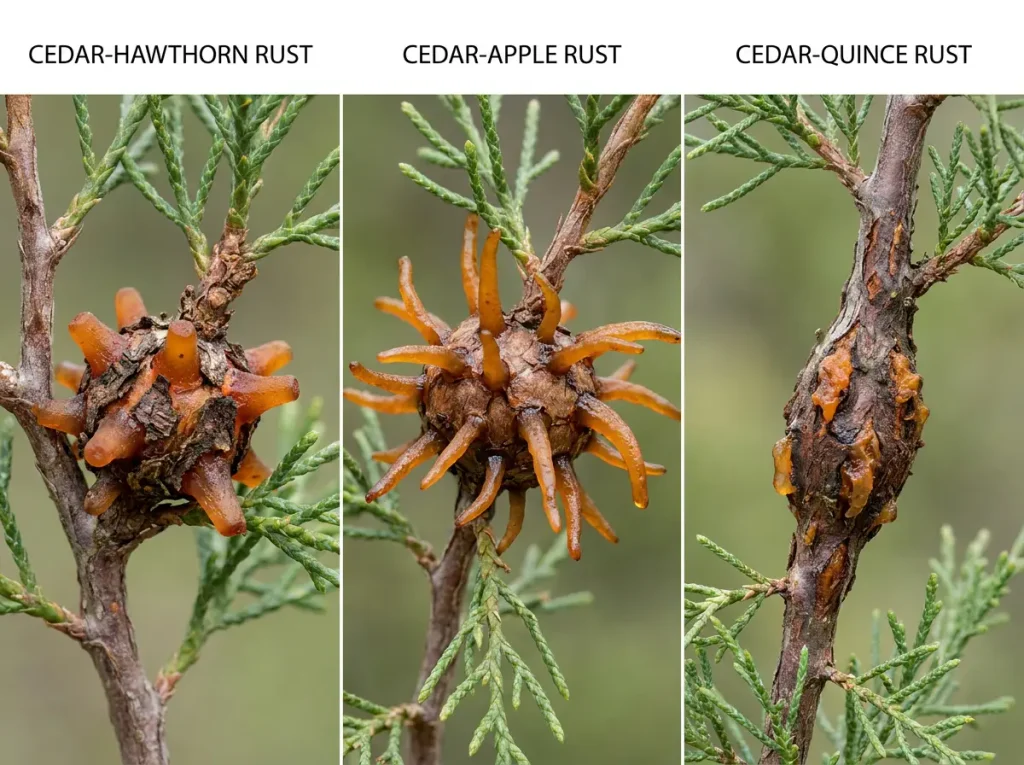
The evergreen host may be eastern redcedar, which is a juniper despite its common name. Look for small brown woody galls on twigs. During wet spring weather, cedar-hawthorn rust galls produce relatively short, broad gelatinous projections. Minnesota Extension’s juniper identification guide contrasts these with the longer tentacles of cedar-apple rust and the elongated swellings of cedar-quince rust.
Record the shape of the woody growth as well as the orange material. Wet and dry stages look different. If the nearby evergreen is unfamiliar, include a whole-branch photograph so its identity can be checked too.
2. Distinguish cedar-hawthorn rust from related diseases
Yellow-orange spots establish a reason to investigate rust, but they do not reliably establish the species. The comparison below combines host and symptom patterns from Wisconsin’s rust disease overview and the Purdue apple guide.
| Disease | Broadleaf host clues | Juniper clues |
|---|---|---|
| Cedar-hawthorn rust | Leaf spots with underside tubes; apple fruit is rarely infected. | Generally smaller galls with shorter, broader spore horns. |
| Cedar-apple rust | Similar leaf spots on apple and crabapple; fruit lesions can occur. | Often larger rounded galls with conspicuous long orange horns. |
| Cedar-quince rust | Fruit and twig damage may dominate on hawthorn. On apple, inspect the blossom end of fruit. | Elongated swollen areas that produce orange gelatinous material. |
These are screening clues, not a laboratory key. More than one rust can occur in a landscape, and symptoms overlap. If the distinction will determine a spray program, replacement tree, or major pruning decision, ask a local extension diagnostic service to examine samples.
Use the cedar-apple rust guide for the parent topic. If the spots do not fit the rust pattern, work through apple tree disease identification before treating. Leaf color by itself is too weak a basis for choosing a fungicide.
3. Understand when infection happens
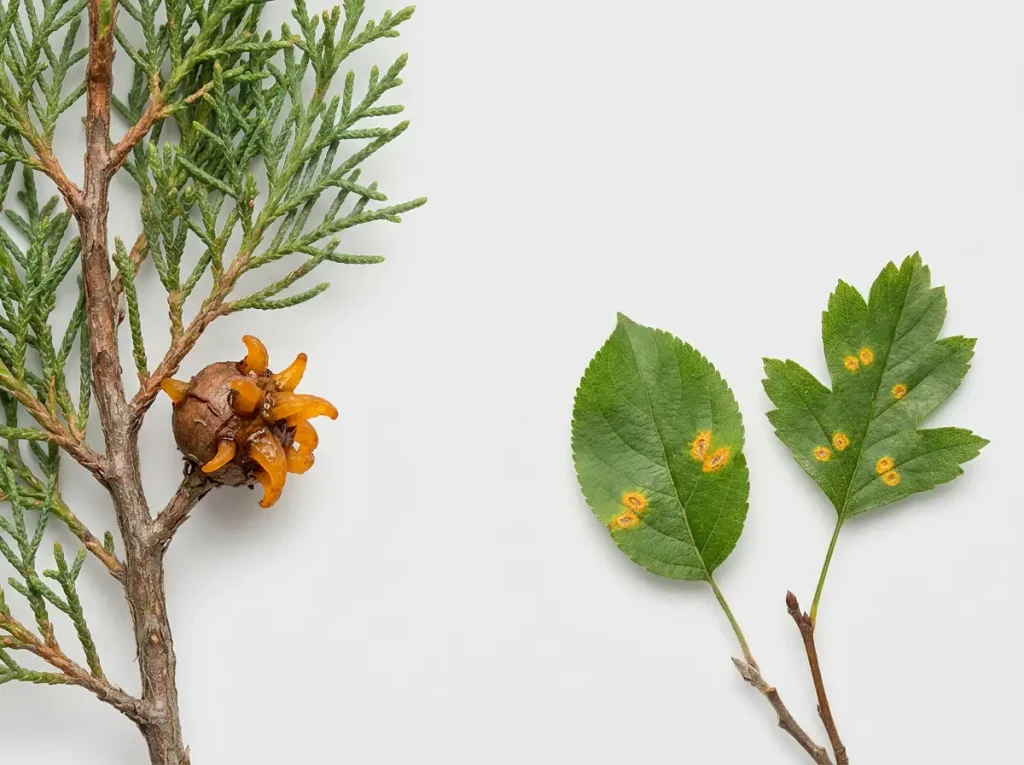
This fungus needs two kinds of living hosts to complete its cycle. In spring, infected junipers produce spores during suitable wet conditions. Wind carries the spores to susceptible broadleaf hosts. Later, spores formed on infected hawthorn or apple tissue travel back to junipers. Illinois Extension’s cedar-hawthorn rust profile describes a cycle extending across about two years.
The practical consequence is that a spotted hawthorn does not directly spread this rust to the apple beside it. The spore stage on those broadleaf hosts infects junipers. Several broadleaf trees can show symptoms together because they were exposed to a shared juniper source.
Do not interpret later-visible spots as proof of fresh tree-to-tree spread. Record when you first noticed them, but remember that observation and infection are different events. That distinction matters when deciding whether a late spray still has a preventive purpose.
Some cedar-hawthorn rust galls can remain productive for additional years, according to Wisconsin’s cedar-rust complex bulletin. Do not assume that every old gall is harmless simply because its orange horns have dried. Reinspect reachable junipers before the next spring infection season.
4. Choose treatment according to damage and timing
Decide whether observation is enough
A tree retaining most of its leaves may tolerate light infection. Repeated heavy leaf loss deserves more attention because it can reduce vigor and crop performance. Maryland Extension’s rust guidance describes the consequences of substantial defoliation and fruit injury.
| Your observation | Useful next action | What to avoid |
|---|---|---|
| Scattered spots, mostly full canopy | Photograph symptoms and monitor leaf retention. | Removing large amounts of foliage for appearance alone. |
| Early leaf loss across the canopy, especially in successive years | Confirm the diagnosis and plan prevention before the next vulnerable season. | Assuming a stronger late spray will repair lost foliage. |
| Swollen twigs, branch death, or substantial fruit distortion | Submit photographs or samples to distinguish related rusts and other problems. | Calling every symptom cedar-hawthorn rust. |
| Active juniper galls while susceptible growth is emerging | Check local infection advice and whether an appropriate preventive program is warranted. | Copying an ornamental spray recommendation onto edible apples. |
Protect healthy tissue only while protection can help
Fungicides are used to prevent infection; they do not make established rust lesions disappear. Preventive applications may be justified for valuable, susceptible trees with recurring damage. Purdue’s landscape rust bulletin ties protection to spore production on junipers, rather than waiting for obvious damage on the broadleaf host.
If you discover spots while spring infection risk continues, ask whether uninfected growth still needs protection. If that period has ended, further rust spraying cannot reverse the season’s injury. Tree development, local weather, disease activity, and the chosen label must align; a calendar date from another state isn’t a treatment schedule.
Check the exact product and crop before spraying
Edible apples and ornamental hawthorns are different label uses. Before selecting a product, confirm the crop, applicable rust directions, allowed growth stages, repeat-application limits, and required waiting period before harvest. Check protective equipment, bloom precautions, drift restrictions, and any crop-injury warnings as well.
Purdue publishes separate guidance for edible fruit and ornamental plants because recommendations cannot simply be transferred between them. This guide does not prescribe a product or mixing rate. For related apple-rust product comparisons, see fungicide options for cedar-apple rust, then confirm suitability for the diagnosed disease and the exact formulation you intend to use.
Reduce reachable sources without stripping the trees
Removing juniper galls before they produce spring spores can reduce a nearby source. Once the orange structures have appeared, some dispersal may already have occurred. The juniper rust inspection guide can help you examine the evergreen side of the problem.
Keep removal proportionate. A few reachable galls are different from extensive infection throughout a mature hedge. Do not sacrifice major branches merely to chase every growth. Photograph suspect twig infections on broadleaf hosts and seek advice before extensive pruning, especially when the diagnosis remains uncertain.
5. Build a realistic prevention plan
Choose resistance to the disease you actually have
A nursery description that says “rust resistant” needs clarification. Resistance to one rust does not guarantee resistance to another. Minnesota Extension specifically warns that a hawthorn cultivar may resist one rust but remain highly susceptible to another.
For new apples, use the cedar-apple rust resistant varieties guide as a starting point for cultivar questions, not proof of cedar-hawthorn rust immunity. Ask a local nursery or extension specialist for evidence relevant to the confirmed rust and your growing area.
Improve separation without expecting a guaranteed safe radius
Avoid deliberately placing susceptible junipers beside susceptible apples or hawthorns. However, windborne spores can arrive from well beyond your property. Removing a nearby tree therefore cannot guarantee protection. Iowa State notes that spores may travel several miles.
Before replacing a valued tree, compare the actual annual damage with the effort and cost of management. Light cosmetic spotting, repeated canopy loss, and damage to a harvest are different outcomes. A replacement makes more sense when its local suitability and resistance are documented, rather than simply because it carries a different cultivar name.
Treat organic options as preventive choices too
There is no basis here for promising that neem oil, compost tea, or a homemade mixture will cure existing lesions. In an Ohio extension case involving a young hawthorn, a reader reported unsuccessful neem treatment, and the expert identified cedar-quince rust rather than the cedar-hawthorn rust the reader suspected.
That case illustrates two separate checks: identify the disease and evaluate a treatment’s evidence. An organic gardening preference does not remove either requirement. If considering an organically permitted fungicide, verify its crop and disease uses, effectiveness, and restrictions instead of assuming “natural” means suitable.
Keep a small record that improves next year’s decision
Use the same few branches as observation points. Record the date, affected plant parts, approximate leaf loss, juniper activity, and any treatment. Take comparable photographs during the season and again the following spring. This is a practical observation method, not a validated disease-scoring system.
For example, in a hypothetical yard, a hawthorn with scattered spots that retains its canopy may remain under observation. If that same tree later develops dying, swollen shoots, the next action changes to diagnosis. The change in plant condition, rather than the number of orange marks alone, drives the decision.
FAQs
Can cedar-hawthorn rust infect apple trees?
Yes. Apple and crabapple are among its hosts. On apples, foliage is more commonly affected than fruit. Its name does not mean the disease is confined to hawthorn.
Will cedar-hawthorn rust kill my tree?
Light leaf infection usually does not justify removing a tree. Repeated severe defoliation can weaken it. Branch death or extensive twig swellings deserve diagnosis because another rust or a separate problem may be involved.
Should I pick off every spotted leaf?
No. Removing a large share of the canopy is not a useful response to cosmetic spotting. Photograph representative leaves, monitor the tree, and remember that spores produced on broadleaf hosts return to junipers rather than directly reinfecting nearby apples.
Can I stop the disease by removing one cedar?
Removing an infected juniper may reduce a local source, but spores can travel from other properties. Confirm the evergreen’s identity and consider the severity of damage before making a removal decision.
When should I prepare for next year’s treatment?
Review the diagnosis and options before spring growth begins. Inspect nearby junipers before spore production, then use local guidance and the exact product label to determine whether and when protection is needed.
