
Apple Tree Drought Stress Symptoms: 5 Proven Warning Signs
Apple tree drought stress symptoms include wilting leaves, scorched edges, yellowing or early leaf loss, reduced fruit growth, and premature apple drop. However, these signs also have other causes. Check moisture around the roots before watering, then restore moisture gradually and monitor whether healthy foliage remains firm.
Table of Contents
Key Takeaways
- Confirm apple tree drought stress symptoms with a root-zone moisture check.
- Water dry roots slowly, checking that moisture reaches below the surface.
- Track surviving foliage and further damage rather than expecting brown leaves to turn green.
A tree can look thirsty even after you have watered it. Water may miss the original root ball, or a different problem may be limiting uptake. Therefore, identifying apple tree drought stress symptoms starts with two observations: what the canopy is doing and what the soil feels like.
This guide helps you decide what to check and what to do next. For routine seasonal care after the immediate problem is under control, use our apple tree watering guide.
5 Apple Tree Drought Stress Symptoms to Check
These are warning signs, not a diagnostic scorecard. You do not need all five before acting, and seeing several does not prove drought. Instead, use the accompanying checks to decide whether a water shortage fits the evidence.
1. Leaves droop or curl during hot weather
Wilting is one of the earliest visible apple tree drought stress symptoms. Leaves lose their usual firmness, and tender growth may hang downward. However, midday wilting can also occur when heat drives water loss faster than roots can replace it.
Compare the same branch in the afternoon and the following morning. Maryland Extension explains temporary heat-related wilting, including recovery when moisture is available. Persistent morning wilt deserves closer investigation.
2. Leaf edges become brown and dry
Scorched margins can accompany prolonged water stress, but brown edges are not specific to drought. Salt injury, excess fertilizer, poor drainage, and compacted soil can produce similar damage, according to Maryland Extension’s diagnostic comparison.
For this reason, interpreting apple tree drought stress symptoms requires some history. Record when browning started and whether fertilizer, irrigation, or nearby ground conditions changed. Photograph an affected leaf beside a healthy one so later comparisons are useful.
3. Leaves yellow or fall before autumn
Premature yellowing and leaf fall can follow an extended dry period. However, yellow leaves also occur with excess moisture or nutrient problems. The same extension diagnostic guide lists these overlapping causes.
Map the pattern before deciding that apple tree drought stress symptoms explain the loss. Is it scattered throughout the tree, concentrated on one branch, or accompanied by distinct spots? Keep that description with your photos for a diagnostic consultation if needed.
4. Developing apples remain unusually small
Water shortage can reduce fruit size and restrict root growth. Moreover, apples on dwarf rootstocks are especially vulnerable because their root systems are smaller, as explained in Minnesota Extension’s apple drought guidance.
However, small apples alone cannot confirm apple tree drought stress symptoms. Compare fruit with earlier photos from the same tree, rather than supermarket apples or a different variety. A heavy crop can also produce smaller fruit.
5. Apples drop before their normal harvest
Premature fruit drop is more severe in dry seasons without irrigation, according to Michigan State Extension’s explanation of apple drop. Nevertheless, fruit load, pests, temperature, and variety also influence it.
Before treating fallen apples as apple tree drought stress symptoms, note the date, expected harvest window, and condition of the fruit. Normal early-season shedding differs from a sudden increase during a dry spell. Photograph a few representative fallen apples, including any visible injuries.
Video: Purdue Extension Starke County’s “Watering trees during a drought” provides general tree-watering context. Apply the soil checks below to your own apple tree.
Confirm Dry Roots Before Adding Water
Check below the surface in more than one place
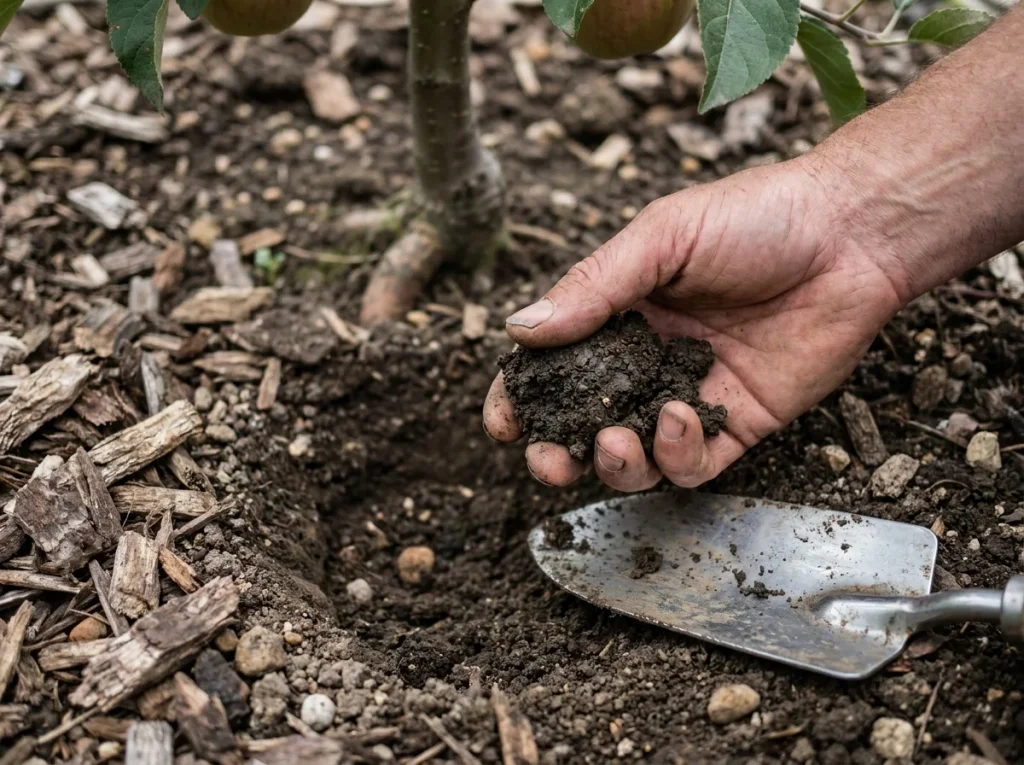
Move mulch aside and carefully inspect soil under the canopy without cutting substantial roots. For established trees, Minnesota Extension recommends checking moisture 6 to 9 inches deep. A dry surface alone is insufficient evidence.
For a recent planting, inspect the original root ball as well as surrounding soil. Maryland Extension notes that a nursery root ball can dry while adjacent soil still contains moisture. Consequently, apple tree drought stress symptoms can persist despite a damp planting bed.
Match the soil finding to the next action
| What you find | What it suggests | Next action |
|---|---|---|
| Dry soil at root depth with wilt | Insufficient available water is plausible | Water slowly, then check penetration |
| Dry root ball but moist surrounding soil | Uneven moisture at a recent planting | Direct water over the root ball and reassess |
| Wet soil with yellowing or wilt | Poor drainage or impaired roots may be involved | Pause extra watering and investigate |
| Hooked, blackening shoots or bark ooze | Fire blight needs consideration | Request a diagnosis rather than treating as drought alone |
If the root area stays wet, compare overwatered apple tree symptoms. Meanwhile, Minnesota Extension’s fire blight guide describes hooked shoots, blackening foliage, and possible ooze. These signs need a different investigation.
How to Help a Drought-Stressed Apple Tree Recover
Step 1: Restore moisture slowly where the roots are
Once dry soil supports the diagnosis, begin watering at a rate the ground can absorb. For established trees, moisten a broad area under and around the canopy. For new trees, include the root ball and adjacent backfill.
For example, reduce the flow or pause if water runs away. Then check the soil after it has soaked in. Do not judge success by a wet surface or by whether apple tree drought stress symptoms disappear immediately.
Step 2: Check irrigation coverage and adjust the interval
Watch the system while it runs, then compare moisture at several locations. A working outlet does not establish that the whole intended area received water. Our drip irrigation for apple trees guide explains placement and run-time planning.
Next, use soil conditions and tree age to choose the following watering. Younger trees generally need closer attention, while established roots occupy a larger area. See how often to water apple trees for scheduling beyond this recovery check.
Step 3: Reduce moisture loss with mulch
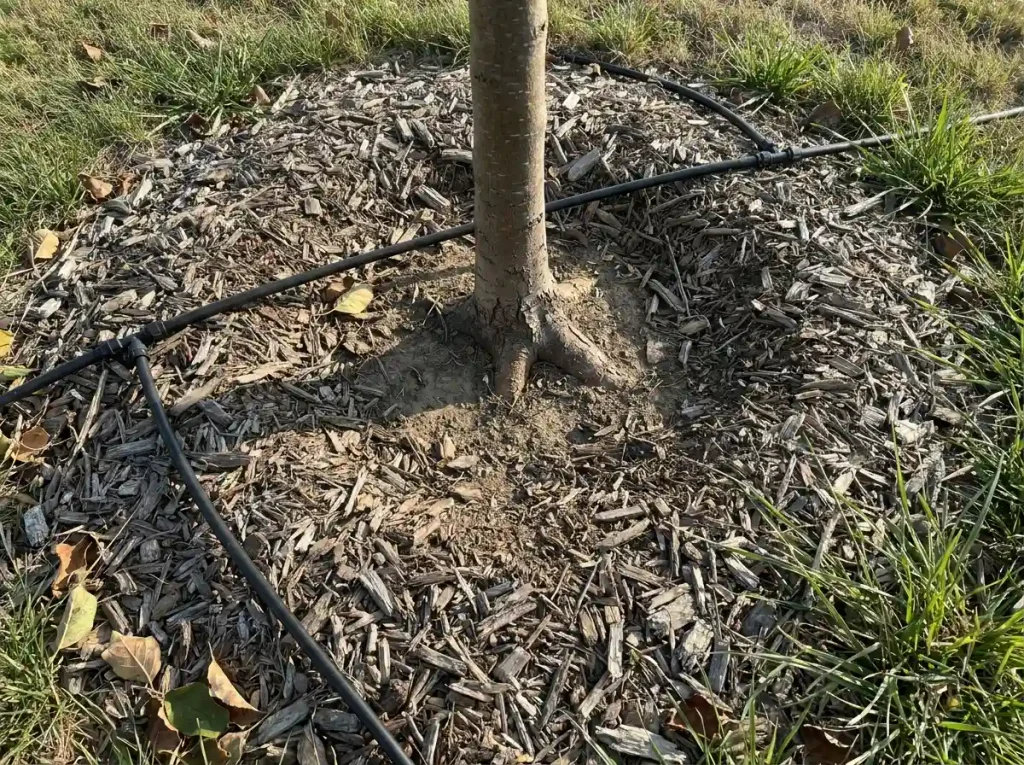
Mulch helps conserve moisture and suppress competing weeds. Minnesota Extension recommends a 3-inch organic mulch layer, keeping the root flare exposed and mulch off the trunk.
However, adding mulch does not rehydrate dry roots. Check existing depth before topping up, and follow our apple tree mulching guide for placement. Avoid burying the trunk while trying to solve apple tree drought stress symptoms.
Step 4: Avoid fertilizer and heavy pruning as rescue treatments
Do not fertilize during drought, as advised in Penn State Extension’s plant-health guidance. Also, retain living foliage rather than heavily cutting back a stressed tree. Penn State’s young-tree care guidance explains why preserving foliage supports establishment.
Later, assess nutrition with soil testing and growth history. Minnesota gives general annual shoot-growth benchmarks of 12 to 18 inches for young nonbearing apples and 8 to 12 inches for bearing trees. However, drought-reduced growth alone does not establish fertilizer need.
For longer-term soil management, Penn State recommends an apple soil pH of 6.0 to 6.5. Treat pH correction as a soil-test decision, not an emergency response to wilting.
Step 5: Track the response without promising a recovery deadline
Use a short log to monitor apple tree drought stress symptoms: date, morning leaf appearance, soil moisture, watering location, and new damage. Photograph the same branch from the same angle. This creates a useful record even if the cause remains uncertain.
Check the following morning and over subsequent days, but do not treat those checkpoints as guaranteed recovery times. Penn State notes that dry-soil root injury can delay recovery after moisture returns. Persistent decline deserves investigation.
When to Get Help and What to Watch Next
Seek local extension or arborist help if apple tree drought stress symptoms keep spreading despite verified moisture, or if whole shoots rapidly blacken. Include whole-tree photos, leaf close-ups, planting date, recent watering, and any fertilizer history. Those details are more useful than a single detached leaf.
Additionally, continue checking soil after harvest during dry weather. Maryland Extension explains that late-season drought can affect next year’s fruit buds. Harvesting the apples does not end the tree’s need for water.
FAQs
Can a tree recover from drought stress?
Yes, recovery is possible, but its extent depends on the injury and surviving roots and branches. Apple tree drought stress symptoms are a reason to investigate promptly, not proof the tree is dead. However, dead leaf tissue will not become healthy green tissue again.
Should you water an apple tree every day?
Not automatically. A newly planted tree may need daily watering initially, but established trees require a different approach. Therefore, use root-zone moisture and planting age, rather than persistent apple tree drought stress symptoms alone, to decide whether more water is needed.
Why is my apple tree wilting even though I water it?
Water may be missing dry roots, while excessive moisture or root damage can also interfere with uptake. First, compare the root ball with surrounding soil and review irrigation coverage. If moisture is adequate, reconsider whether apple tree drought stress symptoms explain the problem.
Related Articles
Sources
- University of Maryland Extension: Drought and Excessive Heat Stress
- University of Maryland Extension: What Causes Trees and Shrubs to Die?
- University of Minnesota Extension: Drought Monitoring and Irrigation for Apples and Grapes
- Michigan State University Extension: Why Does Apple Fruit Drop Prematurely? (page 5)
- University of Minnesota Extension: Watering Established Trees and Shrubs
- University of Minnesota Extension: Watering Newly Planted Trees and Shrubs
- University of Minnesota Extension: Fire Blight
- Penn State Extension: Promote Plant Health
- Penn State Extension: Making Sure Your Young Shade Trees Survive
- University of Minnesota Extension: Growing Apples in the Home Garden
- Penn State Extension: Nutritional Requirements of Apples in Home Fruit Plantings
- Penn State Extension: Meeting the Watering Needs of a Newly Planted Tree
- University of Maryland Extension: Fruit Plant Care
Disclaimer: This article provides general growing guidance based on university extension research. Soil conditions, climate zone, and variety selection significantly affect results. Contact your local cooperative extension service for region-specific recommendations.
