Apple Tree Aphids: 5 Proven Types, ID & How to Get Rid
Apple tree aphids are small, sap-feeding insects that gather on tender apple shoots, leaf undersides, bark, or roots. Curled leaves, sticky honeydew, and white cottony colonies are useful identification clues. Most light infestations need monitoring rather than spraying, but rosy and woolly species deserve closer attention because they can damage fruit or weaken trees.
Table of Contents
Key takeaways
- Identify apple tree aphids by checking new leaves, curled shoots, pruning wounds, and root suckers.
- Five relevant species are rosy apple, green apple, spirea, woolly apple, and apple grain aphids. Their risk levels differ.
- Rosy apple aphids may distort developing fruit. Woolly colonies can cause galls and damage roots.
- Preserve lady beetles, lacewings, hoverfly larvae, and other natural enemies before considering insecticides.
- Use water, selective pruning, or a product labeled for aphids on edible apple trees only when monitoring shows a need.
Discovering a cluster of tiny insects inside a curled apple leaf can be unsettling, especially on a tree planted this year. However, the insects’ location, the age of the tree, and the kind of damage matter more than the mere presence of aphids.
This guide explains how to distinguish five kinds of apple tree aphids, assess whether they need control, and choose an approach that protects helpful orchard insects. It also separates recommendations for newly planted trees from those for established fruiting trees.
What do apple tree aphids look like?
Most leaf-feeding apple tree aphids have soft, pear-shaped bodies and gather in groups on tender tissue. Green forms are easy to miss against new growth, while rosy apple aphids look dusky pink or purple and woolly aphids hide beneath white, waxy filaments.
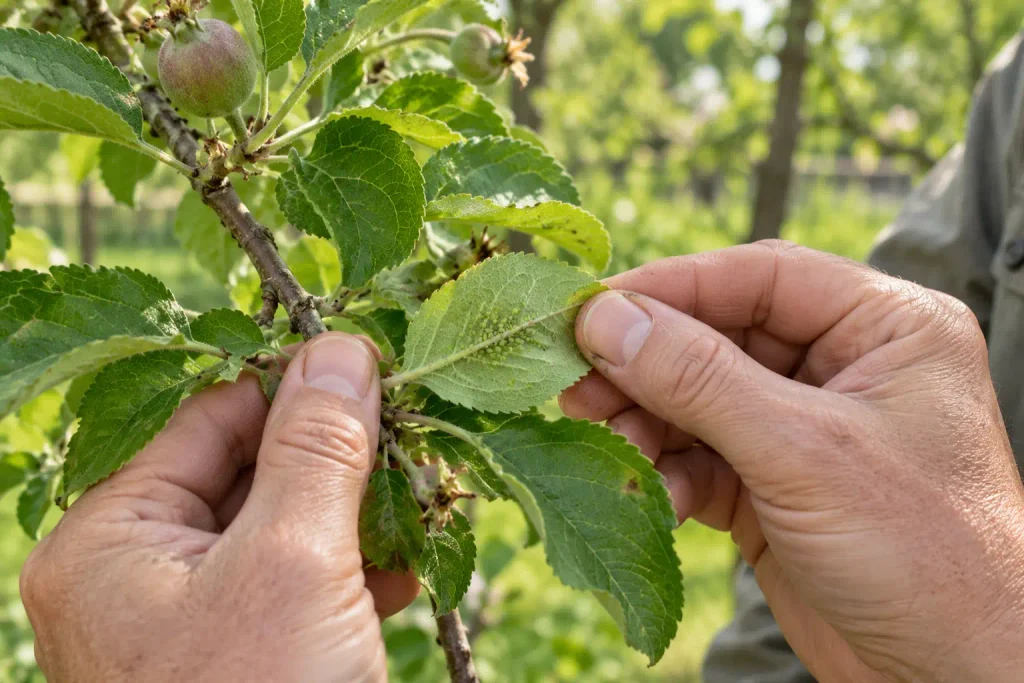
Start by gently opening a curled leaf and examining its underside. Then inspect shoot tips, branch junctions, bark crevices, and old pruning wounds, because different species occupy different parts of the tree.
Video: Washington State University and USDA-ARS demonstrate how to inspect apple shoots for aphids and look for lacewing predators.
Five types of apple tree aphids and how to tell them apart
These five types of apple tree aphids are not equally damaging, and not every green colony can be identified to species by eye. Penn State Extension notes that green apple and spirea aphids are especially difficult to separate in the field, so home growers can manage them as a green-aphid group.
| Type | Where to look | Best field clue | Typical concern |
|---|---|---|---|
| Rosy apple aphid (Dysaphis plantaginea) | Flower clusters and curled young leaves | Dusky pink-purple aphids in tightly curled leaves | Distorted leaves and developing fruit |
| Green apple aphid (Aphis pomi) | Shoot tips and leaf undersides | Green colonies with sticky honeydew | Stunting of tender shoots if populations are high |
| Spirea aphid (Aphis spiraecola) | Vigorous new apple shoots | Looks much like green apple aphid | Leaf curling and honeydew |
| Woolly apple aphid (Eriosoma lanigerum) | Bark, pruning wounds, suckers, and roots | White cottony wax over colonies | Galls, root feeding, reduced vigor |
| Apple grain aphid (Rhopalosiphum fitchii) | Opening buds early in spring | Early-season dark-green aphid, sometimes with a dorsal stripe | Usually little or no lasting damage |
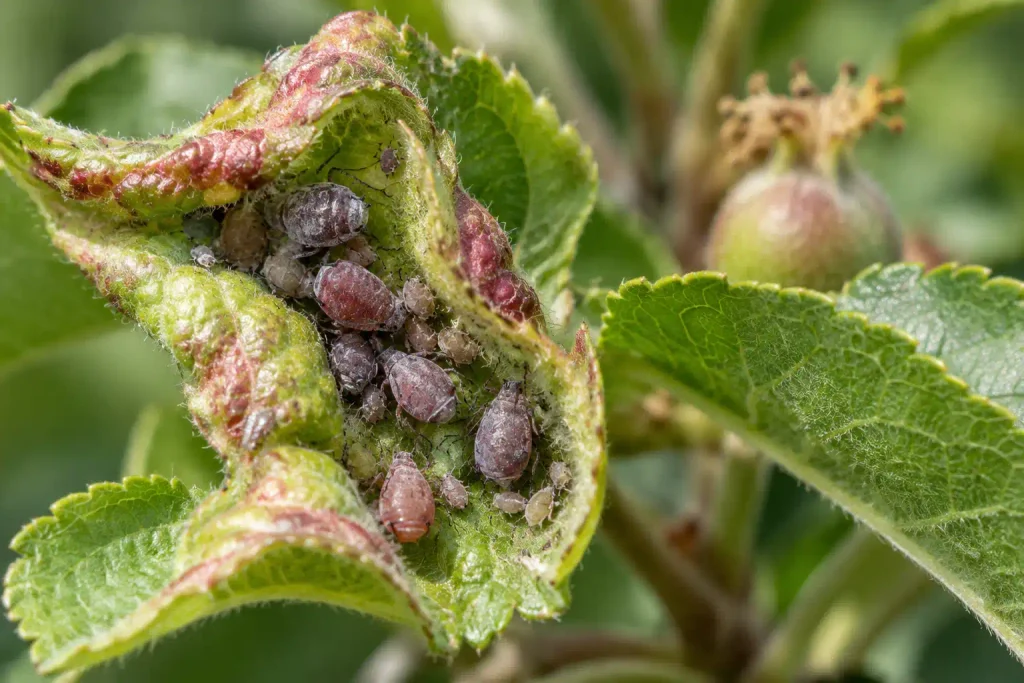
1. Rosy apple aphids: watch the fruit clusters
Rosy apple aphids are important to recognize early because their feeding can deform developing apples. Colonies typically hide inside strongly curled foliage around clusters, so a tree may show conspicuous damage before the insects are easily visible.
Unlike a few green aphids on an outer shoot, a rosy colony near young fruit deserves closer inspection. Once the fruit is misshapen, killing the insects will not reverse that injury.
2. Green apple aphids: common on fast-growing shoots
Among apple tree aphids, the green apple aphid is often found on actively growing shoot terminals, water sprouts, and the undersides of leaves. Their feeding can curl foliage, while expelled honeydew leaves a glossy, sticky coating that may support black sooty mold.
However, an otherwise vigorous mature tree frequently tolerates small colonies. On a newly planted tree, the same feeding pressure deserves more attention because it can reduce the growth needed to establish the canopy.
3. Spirea aphids: a close look-alike
Among apple tree aphids, spirea aphids are a separate species even though they can resemble green apple aphids closely. Penn State Extension groups the two together for identification and management, noting that spirea aphids have a wider host range and are now common in orchards.
Therefore, do not rely on body color alone to name a green colony. For backyard decisions, record the amount of infested new growth and whether natural enemies are present.
4. Woolly apple aphids: cottony growth on bark and roots
Woolly apple aphids stand apart from other apple tree aphids that feed chiefly on leaves because colonies also develop on woody tissues and roots. Their white wax makes a colony resemble a tuft of cotton, especially near pruning cuts, wounds, root suckers, and bark cracks.
Feeding may create swollen galls on twigs or roots, and prolonged heavy root infestations can reduce tree vigor. Importantly, treating visible aerial colonies does not necessarily eliminate aphids already established below ground.
See our dedicated woolly apple aphid identification and control guide for a closer look at this distinct pest.

5. Apple grain aphids: early but usually harmless
Apple grain aphids may be the first apple tree aphids seen when apple buds begin to open. The insects later move to grass or cereal hosts; Penn State Extension describes their appearance on apple as generally harmless, even when the early population seems surprisingly large.
Consequently, early aphids do not automatically justify an insecticide. Confirm that you are not seeing a rosy apple aphid colony before deciding whether intervention is needed.
Symptoms: what aphid damage means for your tree
Curled leaves and distorted shoots
Leaf curling is a common first sign of apple tree aphids, but it is not proof by itself. Carefully unroll a fresh leaf, rather than tearing it away, and look for living aphids, pale shed skins, or sticky deposits along the veins.
If the leaves are curled without insects, consider other causes before spraying. Our apple tree pest identification guide can help sort insect injury from other visible damage.
Sticky leaves, ants, and black residue
Many apple tree aphids release honeydew as they feed. Ants may visit that sugary coating, and dark sooty mold can develop on leaves or fruit, leaving a blackened surface that looks alarming but is not the aphid itself.
Therefore, cleaning residue alone does not solve a continuing infestation. Find the feeding colony, then check whether predatory insects are already reducing the population.
Small or misshapen apples
Among apple tree aphids, rosy apple aphid feeding can injure fruit while the apples are forming. Fruit distortion is not a typical consequence of every green aphid colony, so examine affected clusters and nearby curled leaves before making the diagnosis.
Existing deformation is not repaired by a late spray. Instead, focus on reducing current pressure and improving next spring’s early-season scouting.
Swollen bark or declining vigor
White colonies near bark fissures, together with swollen woody tissue, suggest woolly apple aphids. These galls are different from ordinary curled-leaf symptoms, and root involvement may not be visible without professional assessment.
If overall growth is poor, also assess irrigation, root health, and other stressors. Aphids may be only one contributing factor rather than the whole explanation.
When and where to scout apple tree aphids
Early spring: check buds and flower clusters
Several kinds of apple tree aphids overwinter as eggs on twigs, then hatch as buds open. Look near expanding clusters and new leaves, especially if the previous season included leaf curl or fruit deformation.
Early checking is particularly important for rosy apple aphids, because their feeding can damage young fruit. However, the calendar date varies with local spring development, so use the tree’s growth stage rather than a fixed nationwide spray date.
Late spring and summer: check the first shoots
As shoots elongate, examine the newest leaves and their undersides. For apple tree aphids on large trees, sampling several different branches gives a more reliable picture than inspecting only the most visibly damaged tip.
WSU’s orchard scouting demonstration shows how to inspect young shoots and look for lacewing larvae. Its commercial sampling numbers should not be treated as universal backyard treatment thresholds.
For woolly colonies: inspect wood, wounds, and suckers
Do not limit an inspection for apple tree aphids to foliage. From mid-spring onward, scan bark cracks, pruning wounds, shoot junctions, and root suckers for the white colonies associated with woolly apple aphids.
Also note any ants, new galls, or poor shoot growth. Record the locations so that you can revisit the same spots and tell whether the infestation is expanding.
A repeatable five-minute scouting routine
- Choose several shoots around the canopy, including shaded and sunny sides.
- Inspect new leaves, the leaf undersides, and any curled foliage.
- Check bark wounds and suckers for white, waxy colonies.
- Look for lacewing larvae, lady beetles, hoverfly larvae, and aphid mummies.
- Note the number of affected shoots, visible growth injury, and whether conditions improve on the next check.
This quick record makes treatment decisions less reactive. A few aphids accompanied by active predators may require only observation, whereas repeated damage to a young tree calls for closer follow-up.
Do apple tree aphids need treatment?
Not always. When deciding whether to control apple tree aphids, Utah State University advises that home orchardists can often tolerate leaf-feeding aphids unless numbers become very high, young tree growth is stunted, or sooty mold is affecting fruit.
However, species and tree age change the decision. Rosy apple aphids near developing fruit and woolly apple aphids associated with galls should not be judged by the same standard as a small colony of green aphids.
| What you find | First response | Why |
|---|---|---|
| Few green aphids, healthy mature tree, predators present | Monitor and conserve predators | Minor colonies often decline without intervention |
| Expanding colonies on a newly planted tree | Dislodge accessible aphids; reassess growth | Tender establishment growth is more vulnerable |
| Rosy colonies beside developing fruit | Identify promptly; seek local extension guidance | Fruit distortion can become permanent |
| Woolly colonies with galls or poor vigor | Document sites; use targeted advice | Waxy protection and root colonies complicate control |
| Sticky leaves but no live aphids | Reinspect before treating | The insects may have moved or been suppressed |
Extension-based consensus: Low aphid populations can often be tolerated on established apple trees. Decisions should reflect tree age, growth injury, fruit injury, and the presence of natural enemies, rather than simply the sight of a few insects.
How to get rid of apple tree aphids: an IPM approach
Step 1: dislodge small, accessible colonies
For accessible foliage, a directed stream of water can remove many exposed apple tree aphids without applying an insecticide. Support tender shoots with one hand, use enough pressure to shift insects without tearing young growth, and target the underside of leaves.
Afterward, inspect again rather than assuming every aphid is gone. Very tightly curled foliage and woolly colonies on woody tissue are less accessible to this method.
Step 2: remove only heavily affected soft growth
If a few shoot tips are badly distorted, selective removal can reduce colonies that a spray cannot reach. However, do not strip a young apple tree of the limited foliage it needs to establish itself.
For broader pruning and canopy care, consult our apple tree pruning guide. Healthy branch structure and restrained pruning are preferable to repeated severe cutting in response to insects.
Step 3: let beneficial insects work
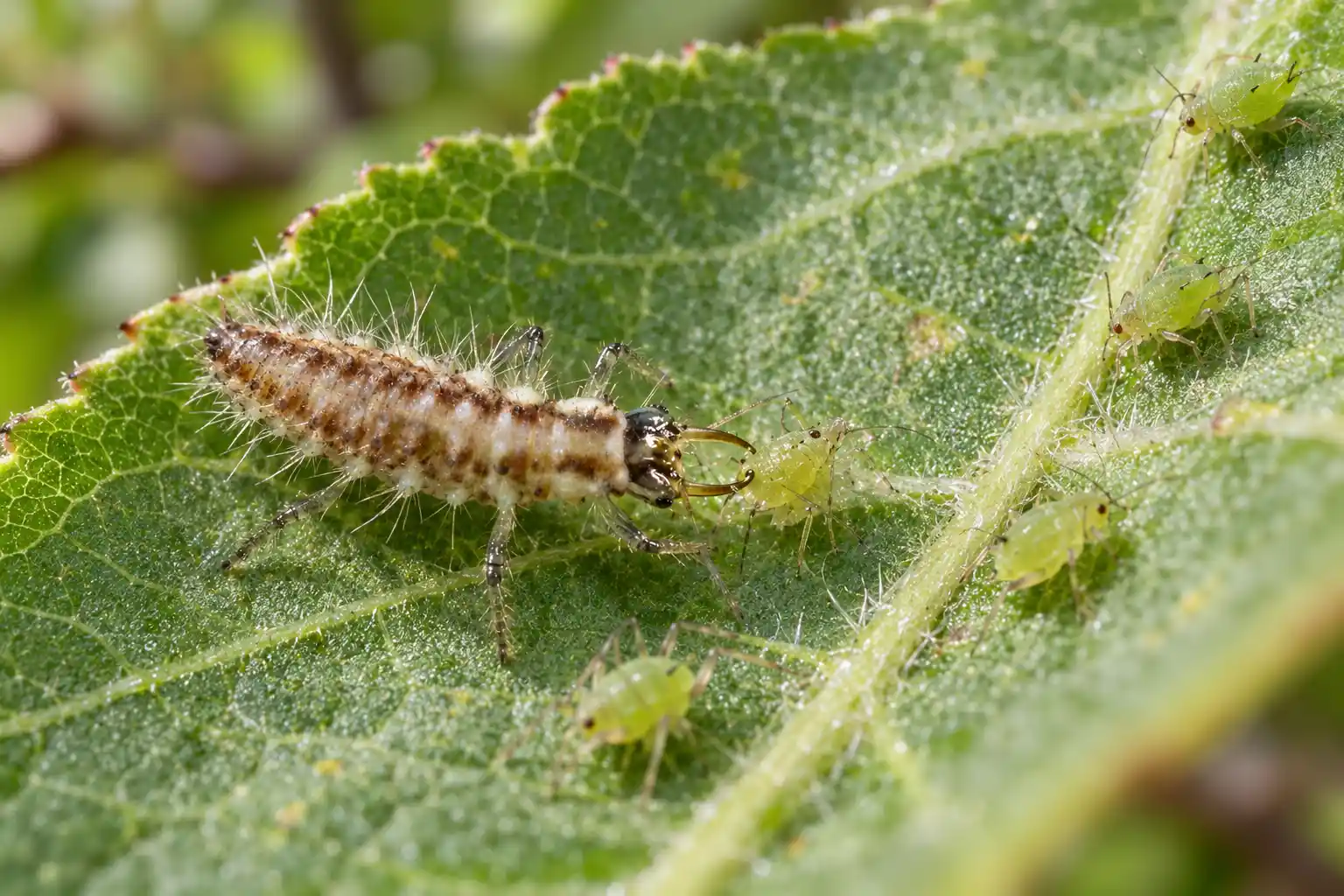
Lady beetle adults and larvae, lacewing larvae, hoverfly larvae, and parasitic wasps naturally attack apple tree aphids. Inspect colonies before taking action, because the predators are sometimes smaller or less recognizable than the pests.
For example, a lacewing larva has an elongated, alligator-like body, while parasitized aphids may appear as swollen mummies. Broad-spectrum sprays can remove these allies and allow later pest outbreaks.
Step 4: consider labeled soaps or oils if needed
Insecticidal soap and horticultural oil may be useful for exposed, actively feeding colonies when a product is labeled for aphids on edible apple trees. These contact treatments depend on reaching the insects, so a colony sealed inside a leaf curl may escape coverage.
Follow the product’s directions for dilution, application conditions, compatibility, reapplication, protective equipment, harvest interval, and pollinator protection. Do not substitute household dish detergent for a registered insecticidal soap, and avoid spraying heat- or drought-stressed foliage.
Step 5: reserve stronger insecticides for justified cases
Some conventional insecticides can kill apple tree aphids, but that does not make them the best first choice. Utah State University warns that repeated applications and damage to natural enemies can make resistance and resurgence more likely.
Before using a conventional product, consult current local extension recommendations and confirm that its exact label permits the target pest, edible apples, and intended use. Never apply during bloom when the label restricts use around bees or other pollinators.
Organic versus conventional options for aphids
An organic-compatible program for apple tree aphids starts with correct identification, monitoring, cultural practices, and conservation of predators. A conventional program should do the same; using a stronger pesticide does not replace diagnosis or good timing.
| Approach | Potential role | Main limitation |
|---|---|---|
| Monitoring and natural enemies | First choice for most light leaf colonies | Needs regular checking |
| Water spray | Removes exposed aphids from accessible shoots | Does not reach root colonies |
| Selective removal of curled shoots | Reduces protected colonies in localized cases | Too much pruning removes productive foliage |
| Insecticidal soap or horticultural oil | Targeted treatment when labeled and needed | Coverage, crop label, and plant sensitivity matter |
| Other registered insecticides | Potential option for difficult infestations | May injure beneficials; registration and resistance concerns |
The word “organic” does not mean harmless to bees or foliage, and it does not automatically mean a product is permitted on apple fruit. See our organic apple tree pest control guide for broader orchard tactics.
Why aphids keep returning
The life cycle explains repeat infestations
Some aphids pass winter as eggs on apple twigs and begin feeding as spring buds open. Others move between apple and alternate plant hosts, while woolly apple aphids can persist as living colonies on roots or protected bark.
As a result, one summer intervention cannot guarantee an aphid-free tree next spring. The practical goal is to protect tree growth and fruit while keeping pest pressure below a damaging level.
Excessive tender growth invites feeding
Apple tree aphids favor succulent shoots. Heavy nitrogen fertilization or vigorous water sprouts may provide more of the soft tissue they feed on, especially when the canopy keeps producing lush growth.
Therefore, base feeding on tree growth and soil needs instead of applying fertilizer simply because insects are present. Our apple tree fertilizer guide explains how to assess nutrition without encouraging unnecessary growth.
Ants may interfere with predators
Ants visiting sticky shoots are a clue to check for apple tree aphids, not proof that they caused the infestation. Some ants collect honeydew and interfere with aphid predators, allowing colonies to persist longer.
Before using any trunk treatment, check that it is appropriate for apple bark and does not damage the tree. Keeping weeds or adjacent branches from bridging onto the canopy may also make inspection easier.
Seasonal prevention for home orchards
Late winter to budbreak
Review notes from last year and look for aphid eggs or old damage on shoots and spurs. If oil is recommended locally, use only a product labeled for apples at the correct growth stage, because timing and plant sensitivity vary.
Do not expect a dormant oil program to resolve woolly aphids living on roots. Utah State University specifically notes that many woolly populations overwinter below ground.
Bloom and early fruit development
Check flower clusters and new leaf rosettes for rosy apple aphids, especially where fruit was distorted before. Avoid unnecessary broad-spectrum insecticides, and follow bee-protection restrictions on any label.
For early apple tree aphids, monitoring before leaves curl tightly is generally more useful than applying a spray after fruit distortion appears. Maintain a record of what species or symptom you observed.
Summer through leaf fall
Watch water sprouts, shoot terminals, and woolly colonies along bark. As growth matures, some green aphid populations decline or become less damaging, so reassess the need for treatment rather than continuing a fixed spray schedule.
Finally, note recurring trouble spots at season’s end. Those observations help prioritize the first inspection the following spring.
Young versus established apple trees
Newly planted and young trees
Young apple trees have less leaf area and may be more affected when apple tree aphids repeatedly attack their limited new shoots. Evaluate whether active shoot tips are still extending and whether colonies occupy much of the available growth.
Choose gentle controls first and avoid excessive pruning. If apple tree aphids return despite these measures and growth stalls, ask a local extension office to identify the species and confirm a safe treatment approach.
Mature bearing trees
Established trees often tolerate light green-aphid feeding while predators reduce colonies. Nevertheless, watch for honeydew staining fruit, rosy aphid distortion on young apples, and woolly aphid colonies associated with decline.
Also consider the size of the tree before attempting spraying. If safe access and coverage are difficult, professional advice is more appropriate than climbing or improvising high-pressure chemical applications.
Common mistakes to avoid
- Spraying every curled leaf before checking for live insects.
- Assuming every green aphid is the same species or causes the same level of damage.
- Waiting until rosy apple aphid injury has already distorted the fruit before scouting.
- Ignoring cottony colonies on bark while checking only the leaves.
- Using homemade dish-soap mixtures or products not labeled for edible apples.
- Repeating broad-spectrum sprays that also kill beneficial insects.
- Applying extra fertilizer to a stressed tree without checking why growth is poor.
These errors share a common problem: they treat the appearance of damage instead of the actual pest and tree condition. A short, regular inspection is usually more informative than an automatic spray.
When to call a professional
Contact your county cooperative extension office or a certified arborist when apple tree aphids are associated with persistent dieback, suspected root galls, recurring poor growth, or damage you cannot confidently identify. A local diagnostic clinic may also be useful when leaf curl could have several causes.
Seek qualified help before using restricted-use pesticides or treating a canopy you cannot reach safely. Bring clear photographs of whole shoots, leaf undersides, bark colonies, and affected fruit, along with notes on tree age and recent care.
FAQs
Can aphids kill an apple tree?
Small populations of apple tree aphids rarely threaten a mature, otherwise healthy tree. However, repeated heavy infestations can slow young shoot growth, and prolonged woolly aphid feeding on roots deserves particular attention.
Why are my apple tree leaves curling but I cannot see insects?
Apple tree aphids may be hidden inside folded leaves, or a colony may already have declined. Uncurl several newly affected leaves and check for aphids, shed skins, and sticky honeydew before assuming that the curling is caused by insects.
Does spraying water get rid of aphids?
A directed water spray can dislodge exposed apple tree aphids from leaves and tender shoots. However, it will not reach protected root colonies, and heavily curled foliage may shelter insects that are difficult to remove.
Do ants cause aphids on apple trees?
Ants do not create aphids, but they may gather honeydew and guard colonies from predators. If ants are moving repeatedly onto curled shoots, inspect those shoots for apple tree aphids before taking action.
Is neem oil or insecticidal soap safe for apple trees?
Some registered formulations are labeled for aphids on edible apple trees, but safety depends on the exact product, growth stage, weather, and application instructions. Check the current label rather than assuming that all neem oils, soaps, or horticultural oils can be used interchangeably.
Will aphid-damaged apple leaves straighten out?
Already curled or distorted leaves may remain misshapen after the insects are gone. Instead of judging success by the old leaves, examine new growth for fewer apple tree aphids and less fresh curling.
Do I need a pheromone trap for aphids?
No. Aphids are primarily monitored by inspecting shoots, leaf undersides, buds, and bark; pheromone traps are associated with monitoring certain other orchard pests, such as codling moth.
If apples have entry holes, larval tunnels, or other chewing damage rather than sticky leaves, use our apple tree pests overview to investigate different insects.
Related articles
- Apple tree pests: major insects and damage patterns
- Woolly apple aphid: identification and control
- Apple tree pests identification
- Apple tree pest control by season
- Organic apple tree pest control
Sources
- Penn State Extension. Green Aphids (Apple and Spirea Aphid). Identification and distinguishing the two green species.
- Penn State Extension. Green Aphids in the Home Fruit Garden. Shoot feeding and honeydew.
- Utah State University Extension. Aphids (Rosy Apple and Green Apple). Life cycle, symptoms, and management cautions.
- Utah State University Extension. The Backyard Orchard: Apple Pests. Home-orchard treatment decisions and beneficial insects.
- Utah State University Extension. Woolly Apple Aphid. Root and bark colonies, galls, and monitoring.
- Penn State Extension. Apple Grain Aphid. Early-season identification and low damage potential.
- Oregon State University Extension. Fruit Tree Integrated Pest Management. Monitoring, beneficial insects, and selective controls.
- Washington State University Tree Fruit. Lacewing and Aphid Scouting. Scouting demonstration with USDA-ARS.
- Royal Horticultural Society. Aphids. Ecological role and tolerating low populations.