
Woolly Apple Aphid: 4 Simple Ways to Control a Harmful Pest
Woolly apple aphid is a small sap-feeding insect that hides beneath white, cotton-like wax on apple trees. Look around pruning cuts, bark cracks, and young shoots, then gently part the fluff to check for reddish-purple aphids. Small colonies can often be managed without spraying, although root infestations need closer attention.
Table of Contents
Key takeaways
- The white fluff is wax made by the insects. Look underneath it before deciding what is on your tree.
- A mature apple tree may tolerate a few colonies. Heavy feeding on the roots of a young tree is a different concern.
- Start with reachable colonies and beneficial insects. Reserve pesticide treatments for situations where they are justified and the product is labeled for edible apples.
You notice what looks like a bit of cotton snagged on a branch. Then you spot another patch near an old pruning cut. By the time you look closely, several twigs have the same white material tucked into their bark.
That is a common way growers discover woolly apple aphid. The good news is that a few white patches do not automatically mean your apple tree is in trouble. You need to find out whether the colonies are active, where they are feeding, and how the tree itself is growing.
How to identify woolly apple aphid on an apple tree
Start with the places the insects like to hide
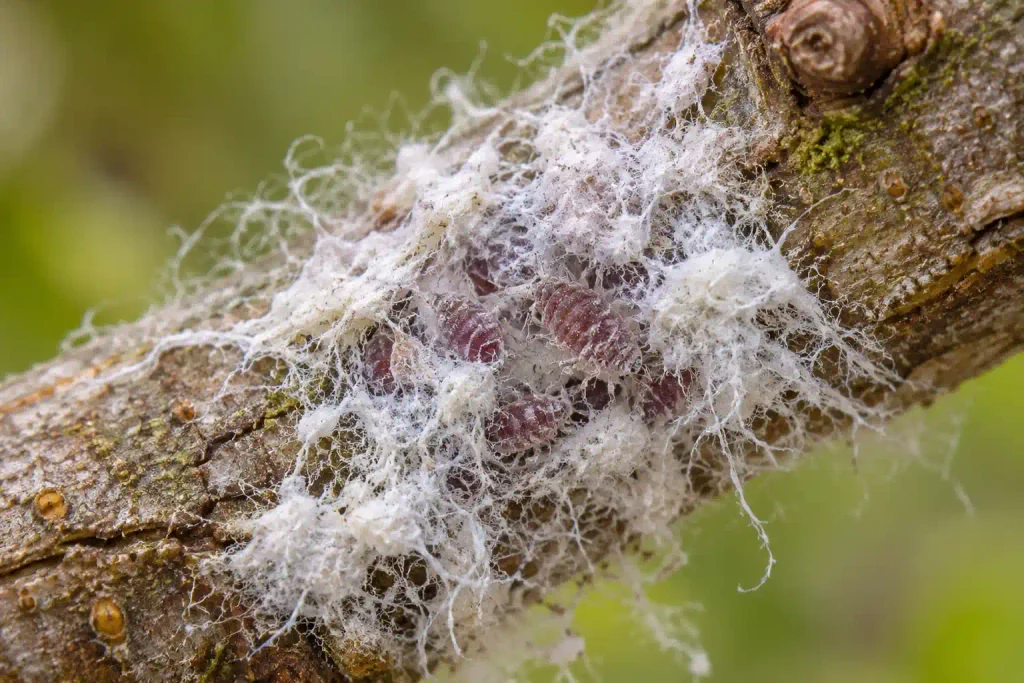
Check the edges of old pruning cuts, branch forks, and rough spots on the trunk. You may also find colonies along fresh shoots or on suckers growing from the base of the tree. The white covering often makes the insects easier to spot from a distance than up close.
On a sunny branch, the material can look almost like a tuft of wool. Rain may flatten it, while a sheltered crevice can hold a thick patch. Utah State University Extension describes these colonies as reddish-purple aphids covered by long, white wax filaments. Its identification guide includes photographs of the insects and their damage.
Look beneath the white coating.
Use a hand lens if you have one. Gently open a small colony with a gloved finger and look for living, soft-bodied insects underneath. You do not need to scrape the bark or dig into the wood.
That check matters because a white patch is not always an aphid colony. Mealybugs, some scale insects, and even harmless growth on bark can confuse the picture. If you cannot find the insects, take a close photograph before treating anything.
Look for old feeding damage as well as fresh insects
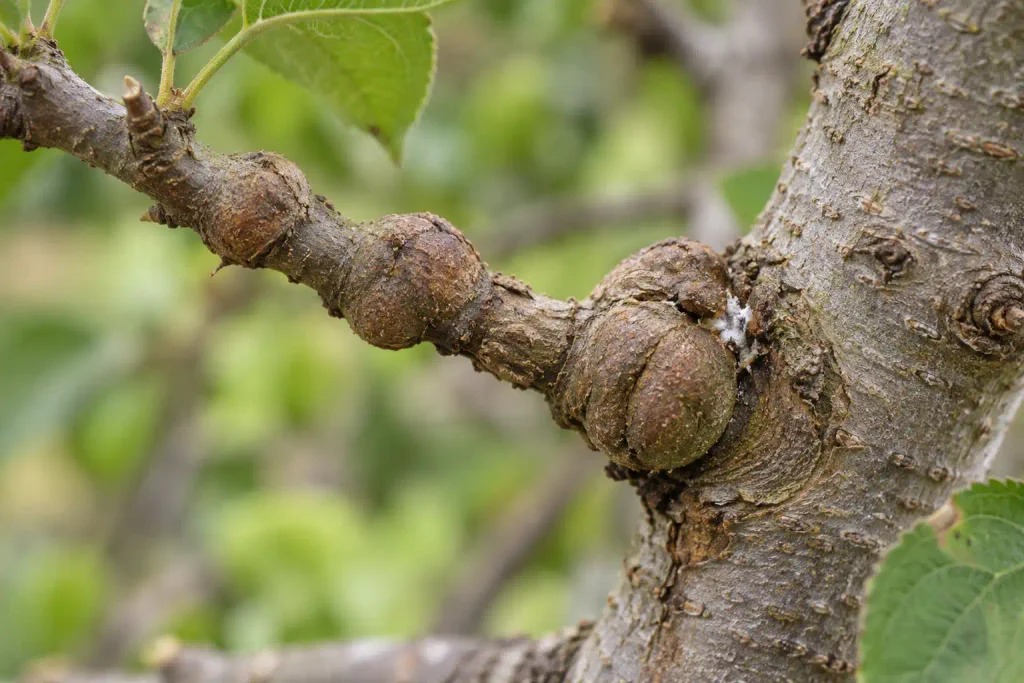
Active colonies sometimes sit beside swollen, knobby sections of a twig. Feeding can produce gall-like growths, and the bark around an injured spot may crack. Those swellings can remain after the insects have moved, so they are worth noting but do not establish that a colony is still alive.
Honeydew may leave nearby surfaces sticky. A tree can also lose vigor when feeding is severe, especially below ground. Because yellow leaves and poor growth have many causes, use them as reasons to investigate further, not as proof of an aphid problem.
Video: Utah State University Extension, “How to Manage Woolly Apple Aphids.”
How much damage can woolly apple aphid cause?
Two apple trees can have similar-looking white colonies and very different levels of injury. On an established tree, a few aboveground colonies usually cause limited damage. Young trees with heavy feeding on their roots face a greater risk.
NC State Extension explains that underground feeding can produce a shallow, fibrous root system. Severely affected young trees may develop yellow foliage and become easier to uproot. Its guide also makes an important point: colonies on branches are not a reliable measure of what is happening on the roots.
| What you notice | What it tells you | What to do next |
|---|---|---|
| A few fresh white patches on a healthy mature tree | Visible colonies, often with limited aboveground injury | Confirm the insects and monitor or remove reachable colonies |
| Knobby swellings near shoots or old cuts | Possible past or continuing feeding at that site | Look for live aphids before deciding whether treatment is needed |
| Sticky deposits around infested branches | Honeydew from feeding insects | Check how widely colonies are distributed |
| A newly planted tree with yellowing foliage and weak growth | A possible root or general tree-health problem | Ask your local extension service to help assess the cause |
There is no useful shortcut from “lots of fluff” to “damaged roots.” A heavily infested-looking branch may belong to an otherwise vigorous tree. Conversely, root trouble can be hidden from view. Avoid pulling back soil or disturbing healthy roots just to look for aphids.
When woolly apple aphid appears during the year
Woolly apple aphid spends much of winter on apple roots. Some survive in protected bark cracks higher up the tree, particularly after a mild winter. As growth resumes, colonies begin to develop on shoots and around old wounds.
The first visible patches do not appear on the same date everywhere in the United States. Utah State University advises checking in mid-spring, although prominent cottony colonies may become easier to find later. Climate and winter severity affect the timing.
- Spring: Look around pruning scars, branch junctions, and root suckers as the tree begins growing.
- Summer: Check whether colonies are spreading onto new shoots. Look for beneficial insects before choosing a spray.
- Fall: Make a note of heavily affected branches and recurring spots while reviewing the tree’s condition.
- Winter: Inspect bark and old galls during routine pruning, but remember that much of the population may be hidden on the roots.
Why do colonies come back after you remove them?
A woolly apple aphid colony on the bark is only the part you can see. Other aphids may be tucked into nearby crevices, and the population can survive elsewhere on the tree. Cleaning off one branch may leave those insects untouched.
When woolly apple aphid reappears, check the same locations and look for fresh growth nearby. You will learn more by comparing active colonies over time than by counting every old gall on the tree.
How to control woolly apple aphid: 4 practical methods
Choose your response according to the size of the colonies, how accessible they are, and whether the tree shows injury. A small infestation on a mature tree seldom calls for the same effort as a declining young tree.
Method 1: Remove the colonies you can reach
For a handful of woolly apple aphid colonies on low branches, first make sure live insects are present. You can gently crush or wipe off the insects with a gloved hand. A carefully directed stream of water is another physical option, provided it will not strip tender bark or damage a graft union.
Work on the affected spots rather than blasting the entire tree. On your next inspection, see whether fresh wax has appeared at the same wounds. The Royal Horticultural Society recommends tolerating light populations where practical and physically removing reachable colonies.
Method 2: Leave the aphids’ natural enemies alone
Before reaching for a pesticide, look closely at the infested twigs. Hoverfly larvae can feed among the aphids, and the tiny parasitic wasp Aphelinus mali attacks this species. Penn State Extension also identifies these natural enemies as important in orchards.
Natural enemies may arrive after a woolly apple aphid colony has already grown. Broad-spectrum insecticides can kill them and allow aphid numbers to rise afterward. Keeping flowering plants in the garden and avoiding unnecessary spraying gives beneficial insects a better chance to stay.
Method 3: Deal with suckers and overcrowded growth
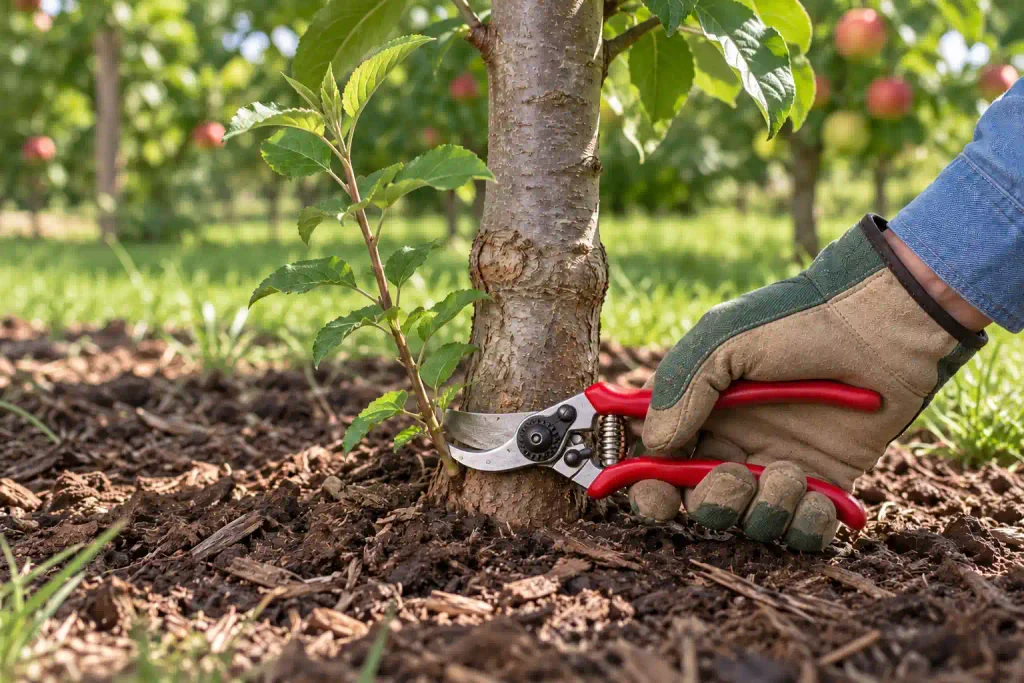
Look for colonies on shoots emerging from the rootstock and on vigorous upright water sprouts. Remove suckers that are not needed for the tree’s structure, following sound pruning practice. Do not cut away a productive branch simply because one patch of woolly apple aphid has appeared on it.
Fertilizer deserves a look too. Too much nitrogen encourages lush new growth, which can favor aphid problems. Oregon State University’s fruit tree IPM guide recommends managing fertilizer and preserving beneficial insects as part of orchard pest care.
For pruning technique, use the University of Minnesota Extension’s apple pruning guidance or our apple tree pruning guide. Major corrective pruning is better planned for the appropriate season than carried out in frustration over a small colony.
Method 4: Consider a labeled spot treatment
Sometimes woolly apple aphid colonies spread despite physical removal and natural enemies. At that point, ask your local extension office which products are currently registered for use on edible apple trees. Some homeowner labels cover insecticidal soap or horticultural oil for aphids.
Contact treatments must reach the insects, and the wax makes that difficult. Read the entire product label, including application directions, temperature limits, protective equipment, pollinator precautions, and the interval before harvest. Never substitute household dish soap for a labeled pesticide.
A canopy spray does not reliably reach underground colonies. Dormant oil is also incomplete protection because much of the winter population may be on the roots, beyond the spray. If you suspect root injury, a series of unplanned treatments can waste time without addressing the cause.
Which method fits your apple tree?
There is no established woolly apple aphid treatment threshold that works for every orchard. NC State Extension notes that the pest’s uneven distribution and variable damage make a fixed threshold difficult to set. The choices below are a homeowner’s decision guide, not an official spray schedule.
| Situation | Reasonable first response | When to get more help |
|---|---|---|
| Two or three reachable colonies, normal tree growth | Remove the insects or leave a light population under observation | Fresh colonies spread or shoots begin to show damage |
| Several colonies with predators already present | Observe the affected sites and avoid unnecessary broad-spectrum sprays | Insects continue multiplying and the tree shows injury |
| Repeated colonies on a young tree | Inspect its graft area, suckers and new growth; check routine care | Growth slows, foliage yellows, or the trunk seems poorly anchored |
| Possible root injury | Seek diagnostic help before disturbing roots or using pesticides | Promptly, especially if a recently planted tree is declining |
University extension guidance favors careful identification, regular inspection and protection of natural enemies. Where treatment is needed, choose a method aimed at the insects you have actually found, while recognizing that roots require a different assessment from branches.
For other pests that may be present at the same time, see our apple tree pests identification guide. The organic apple tree pest control guide covers additional ways to reduce routine pesticide use in a backyard orchard.
Keeping the problem from returning
Examine a tree before bringing it home.
Look for woolly apple aphid around the graft union, trunk, and lower shoots when buying a nursery tree. Fresh cottony colonies or heavily swollen young wood deserve a closer look before planting. Infested nursery stock can carry woolly apple aphid into a new orchard.
Rootstock choice can also make a difference. Penn State Extension describes the Malling-Merton group as bred for resistance to this pest and specifically names M.111. Rootstock resistance helps with one risk, but you still need to choose a tree suited to your soil, climate, and desired size.
Our apple tree rootstocks guide explains how those choices affect the tree you eventually grow. When you’re shopping, ask the nursery for the actual rootstock name rather than relying only on the words “dwarf” or “semi-dwarf.”
Watch for changes in tree health
If woolly apple aphid appears on a tree that is short of water, competing with grass, or struggling in poor soil, address those problems too. Follow local watering and fertilizer advice instead of adding extra nitrogen in response to a weak-looking canopy.
During regular garden visits, check the bark spots where woolly apple aphid appeared before. You are looking for living insects and changes in the tree’s growth. Old wax and old galls, by themselves, are poor reasons to spray.
When a local expert should examine the tree
If woolly apple aphid is present and a young tree develops yellow foliage, poor shoot growth, or loose anchorage, get help assessing the roots. Those signs can result from root feeding, but drought, planting problems, and other diseases may look similar. A diagnosis is especially useful before you disturb the roots.
Photograph the whole tree as well as the affected branch. Include a close view with the wax parted, plus the trunk and graft union if they are involved. Tell your extension clinic the tree’s age, known rootstock, recent pruning, and any products already applied.
FAQs
Is the white fluff on my apple tree a fungus?
Often it is wax produced by woolly apple aphid. Part a small patch and look for live, reddish-purple insects underneath. A photograph of the uncovered colony can help your extension office distinguish it from other white material.
Can woolly apple aphid kill an apple tree?
Heavy root feeding can seriously weaken young trees, although a few aboveground colonies are often tolerated by healthy mature trees. Poor growth or loose anchorage deserves professional attention because several root problems can cause those signs.
Can I control it without insecticide?
Yes, particularly when only a few colonies are present aboveground. Reachable insects can be removed by hand, and predators may suppress colonies over time. Keep checking the tree because sheltered aphids can remain after the visible fluff is gone.
Will dormant oil get rid of the aphids?
No, dormant oil does not fully control woolly apple aphid. Utah State University notes that many individuals overwinter on roots where the spray cannot reach them. Follow your local extension guidance before deciding whether any oil treatment is appropriate.
Does white cotton on the branches mean the roots are infested?
No. NC State Extension reports that aboveground colonies do not reliably predict root infestation. If the tree is growing poorly, ask for a diagnosis rather than digging around healthy roots to search for hidden aphids.
Related articles
- Apple tree aphids: identification and control
- Apple tree pests identification: compare common problems
- Apple tree pest control through the seasons
Sources
- Utah State University Extension. Woolly Apple Aphid.
- NC State Extension. Woolly Apple Aphid.
- Penn State Extension. Tree Fruit Insect Pest: Woolly Apple Aphid.
- Royal Horticultural Society. Woolly Aphid.
- Oregon State University Extension. Fruit Tree Integrated Pest Management.
- University of Minnesota Extension. Pruning and Training Apple Trees.