
Caterpillars On Apple Trees: Proven ID & Get Rid of Them
Caterpillars on apple trees may chew leaves, tie foliage with silk, make large web nests, or tunnel into fruit. Identify the feeding pattern before treating: leafrollers hide in folded leaves, tent caterpillars build spring nests at branch forks, fall webworms cover branch tips, and codling moth larvae enter apples. Most light leaf feeding needs monitoring rather than spraying.
Table of Contents
Key Takeaways
- Look at where the silk is before deciding which pest you have.
- One or two damaged leaves on a healthy mature tree rarely justify an insecticide.
- Remove reachable nests or rolled leaves while larvae are still present, without stripping healthy branches.
- Use for certain caterpillars on apple trees, Bacillus thuringiensis var. kurstaki (Btk) only when appropriate for the identified feeding caterpillar and label.
- Worms inside apples require a different plan from caterpillars feeding openly on leaves.
What Are the Caterpillars on Apple Trees?
The phrase caterpillars on apple trees can refer to several species. The word caterpillar describes the larval stage of moths and butterflies, not one particular apple pest. Several groups eat apple foliage, while codling moth caterpillars burrow into developing fruit; their location and damage help separate them.
To identify caterpillars on apple trees, check four clues before taking action: season, leaf damage, silk placement, and whether the insect is outside or inside an apple. A clear close-up photograph with an entire branch in frame is often more useful for identification than color alone.
Where to look first for caterpillars on apple trees
Inspect the youngest shoot tips, undersides of leaves, branch forks, and any apples with small entry holes. If you find silk, gently open a folded leaf or look inside a reachable web to confirm that larvae are present rather than relying on an old, empty nest.
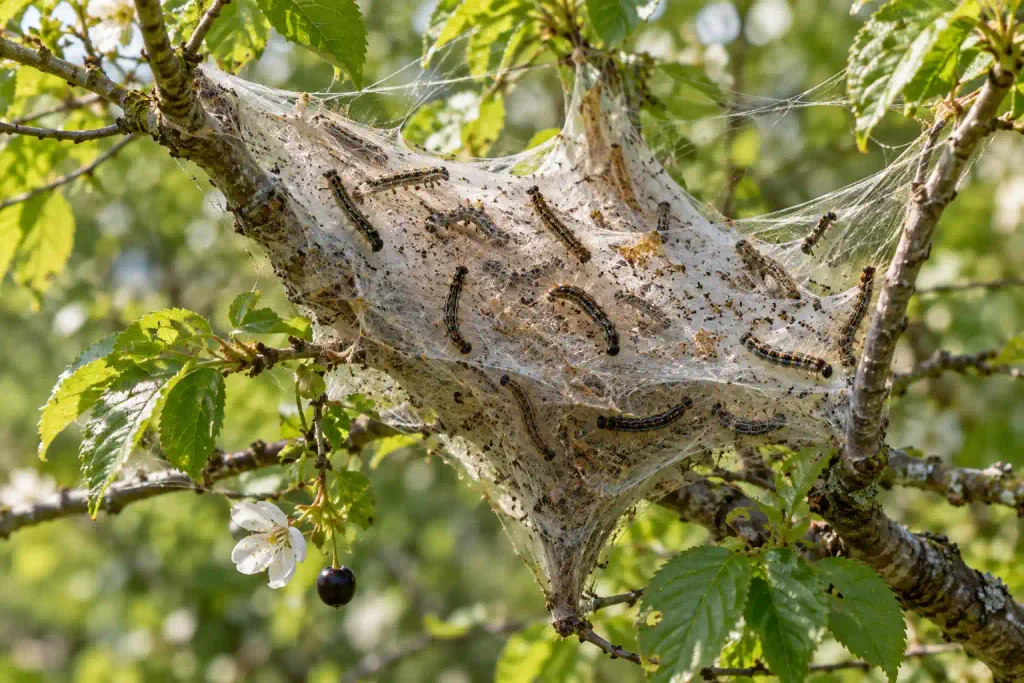
Identify the Pest by Its Damage
| Likely pest | Useful identification clue | Typical damage | First response |
|---|---|---|---|
| Leafroller | Single leaf or cluster rolled and held with silk; small greenish caterpillar may wriggle away | Chewed leaves and sometimes shallow fruit scars | Open a rolled leaf, verify a live larva, remove isolated shelters |
| Eastern tent caterpillar | Communal spring tent at a branch fork; dark hairy larvae with pale dorsal stripe | Spring leaf loss | Assess defoliation; remove reachable small tents if necessary |
| Fall webworm | Loose late-summer web enclosing leaves near a branch end | Leaf chewing within expanding web | Monitor mature trees; remove accessible webbed tips when practical |
| Cankerworm | Inchworm movement; no conspicuous communal tent | Spring chewing, occasionally extensive defoliation | Inspect young foliage and protect repeatedly affected young trees |
| Codling moth | Larva in apple, often with entry hole and crumb-like waste | Internal fruit feeding and premature fruit drop | Remove infested fruit and use species-specific monitoring |
University of Minnesota Extension distinguishes spring tents at branch crotches from the later, tip-covering webs of fall webworms. Utah State University Extension describes leafrollers as larvae that shelter in leaves tied with silk, which is particularly useful when several pests are active together.
Rolled leaves and small green caterpillars
Among caterpillars on apple trees, leafrollers often hide between two leaves or in one folded leaf, held shut with fine silk. The obliquebanded leafroller can feed on apple foliage and the surface of fruit, and its greenish-yellow caterpillar has a darker head.
Because larvae are partly sheltered, a casual glance may miss them. Open a few recently damaged shoot tips and note whether you find active larvae, silk, or old empty shelters.
Spring web nests at branch forks
One conspicuous group of caterpillars on apple trees, eastern tent caterpillars, build a conspicuous shared silk shelter where branches meet, typically in spring. The larvae leave the tent to feed, so a nest can remain visible even while the insects are elsewhere on the tree.
Healthy established apple trees often recover from this seasonal feeding. A recently planted tree, a drought-stressed specimen, or a tree stripped repeatedly deserves closer attention.
Webbing over branch ends in late summer
Another type of caterpillar on apple trees, fall webworms enclose leafy branch tips within loose silk, often mixed with chewed leaves and droppings. They differ from tent caterpillars in both their usual season and the position of their webs.
Before cutting, examine how many branches are involved. An isolated tip on a vigorous mature tree usually calls for a smaller response than extensive defoliation of a young tree.
Worms found inside apples
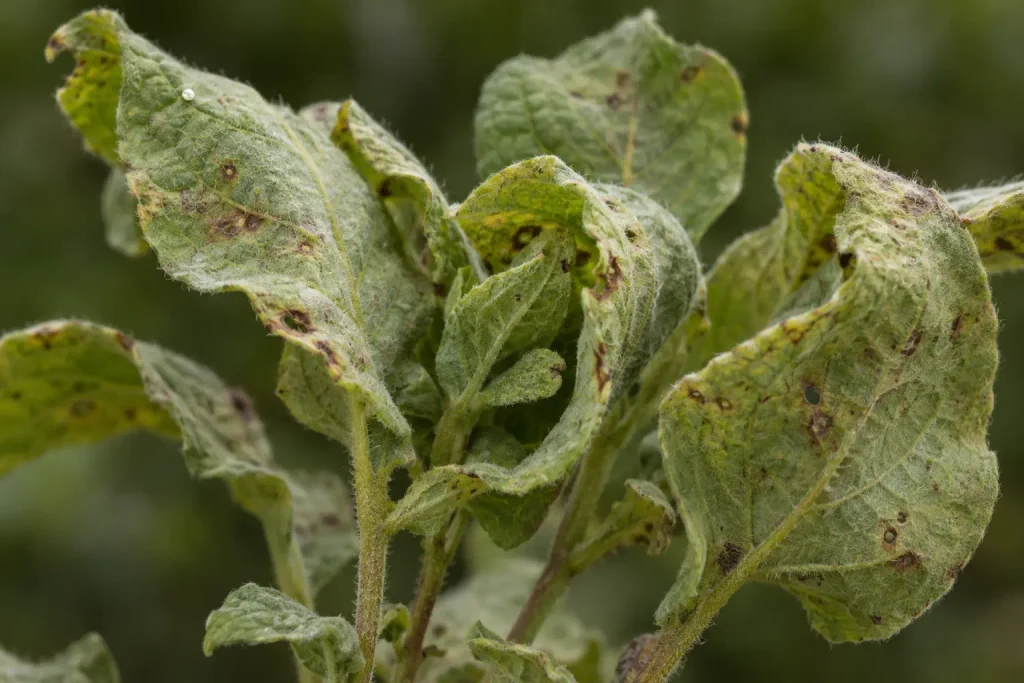
When examining caterpillars on apple trees, a pale larva inside an apple points toward a fruit-feeding pest, especially codling moth, rather than the leaf-feeding groups above. Look for entry holes and frass, and cut affected fruit to document the feeding path.
For that problem, see our codling moth on apple trees guide. Removing leaf tents alone will not stop larvae already protected inside fruit.
How to Get Rid of Caterpillars on Apple Trees: 7 Steps
1. Confirm live caterpillars and record the damage
When you discover caterpillars on apple trees, examine several affected branches rather than treating the whole canopy after seeing one damaged leaf. Note where the insects are feeding, whether new damage is appearing, and whether the tree is losing a substantial portion of its foliage.
Take photographs today and again several days later. This simple comparison separates an active outbreak from old damage that a spray cannot reverse.
2. Decide whether treatment is needed
Although caterpillars on apple trees can look alarming, many leafroller infestations in backyard orchards do not reach a level that needs insecticide treatment, according to Utah State University Extension. Likewise, light tent caterpillar feeding on an established tree is frequently more conspicuous than harmful.
Give extra priority to small, newly planted, weakened, or repeatedly defoliated apple trees. However, do not assume that every visible caterpillar threatens the harvest.
3. Hand-remove reachable leafrollers and webs
To remove caterpillars on apple trees without widespread spraying, unfold occupied rolled leaves and remove larvae by hand with gloves. You can also bag an accessible small web or clip a heavily infested shoot tip when doing so will not compromise the tree’s structure.
Do not climb into an unstable canopy or cut large scaffold branches solely to reach a nest. Never burn webbing in the tree, because fire can injure the bark and surrounding vegetation.
4. Keep infested apples and fallen fruit out of the orchard
If caterpillars on apple trees are feeding within fruit, pick up damaged apples. When fruit feeding is present, pick up prematurely dropped apples and remove visibly infested fruit regularly. Codling moth larvae can continue their development after fruit drops, so leaving damaged apples beneath the tree can perpetuate the problem.
Dispose of infested material according to local extension guidance instead of assuming an ordinary cold compost pile will kill larvae. For fruit-focused prevention, Oregon State University also discusses fruit bagging and trunk bands as management tools.
5. Consider Btk for exposed, actively feeding larvae
Bacillus thuringiensis var. kurstaki is a microbial insecticide used against certain moth and butterfly larvae. It works when susceptible caterpillars eat treated foliage, so identification, feeding activity, and coverage matter.
Btk is generally most useful against young larvae. It will not repair chewed leaves, and a treatment aimed at exposed leaf eaters is not a reliable way to reach a codling moth larva already inside an apple.
6. Reserve other labeled products for a justified infestation
For caterpillars on apple trees that justify treatment, extension guidance also discusses spinosad for some caterpillar pests, including leafrollers and tent caterpillars. However, product labels differ by formulation, crop, pest, location, preharvest interval, and application restrictions.
Always check that the exact product is registered for apples and the pest in your state, and follow every label requirement. Avoid applications during bloom that could expose pollinators, and do not assume a product described as organic is harmless to beneficial insects.
7. Recheck the tree instead of spraying on a calendar
After managing caterpillars on apple trees, return to the same branches after removal or any permitted treatment and look for fresh chewing and live, small larvae. If the damage has stopped, further intervention may provide no benefit.
Use local extension alerts when outbreaks recur, because temperature and seasonal development differ across US regions. For a broader decision process, consult our apple tree pest control guide.
Organic and Conventional Options Compared
| Approach | Best fit | Main limitation |
|---|---|---|
| Monitoring without treatment | Light foliage damage on a healthy mature tree | Requires follow-up inspections |
| Hand removal | Small accessible webs and rolled leaves | Difficult in a tall canopy |
| Btk, where labeled | Young susceptible caterpillars actively eating leaves | Must be eaten; less useful once larvae mature or hide in fruit |
| Spinosad, where labeled | Confirmed damaging infestations where extension guidance supports it | Can affect non-target insects; label and pollinator precautions apply |
| Species-specific pheromone traps | Tracking moth activity, especially codling moth and selected leafrollers | Usually monitoring tools, not a stand-alone cure |
Extension-based integrated pest management starts with correct identification, monitoring, and a realistic assessment of damage. Selective intervention is preferable to routine broad-spectrum spraying because beneficial predators and parasitoids also help limit caterpillar populations.
For practical low-impact strategies, read our organic apple tree pest control article. Oregon State University’s fruit tree integrated pest management guide explains why combining observation and several tactics is more effective than relying on one pesticide.
When Caterpillars on Apple Trees Are a Serious Problem
When assessing caterpillars on apple trees, look beyond the number of insects. Visible caterpillars on apple trees do not automatically signal a crisis. A few webs on an established, vigorous tree may warrant no more than observation, whereas major canopy loss on a first-year tree deserves attention.
Be more concerned when new leaves are disappearing quickly, large areas of the canopy are bare, the tree has already been weakened by drought, or serious feeding repeats over multiple seasons. If the damage involves the trunk rather than leaves, inspect for different insects altogether.
Do not confuse leaf-feeding caterpillars with wood borers
The apple tree borer guide covers insects whose immature stages tunnel beneath bark or into wood. The roundheaded apple tree borer and flatheaded apple tree borer produce damage patterns unlike a caterpillar chewing exposed leaves.
Look for trunk injury, galleries, exit openings, or sawdust-like material when investigating a suspected borer. These are separate identification pathways, so spraying a web nest is not an appropriate response to suspected wood-boring injury.
How to Prevent Caterpillars on Apple Trees Next Season
Inspect at bud break and throughout the growing season
To catch caterpillars on apple trees early, start checking new shoots as leaves expand. Spring scouting can reveal leafrollers and tent caterpillars early, while summer inspections can detect fresh leafroller shelters or fall webworm nests before they cover several branch tips.
Regional timing matters more than a single nationwide month. Utah, Minnesota, and southern growing regions do not share identical emergence dates, so pair tree inspections with local extension updates.
Protect natural enemies and avoid excess sprays
Natural enemies matter when controlling caterpillars on apple trees. Birds, predators, and parasitic insects consume or attack various caterpillar pests. Consequently, repeated broad-spectrum sprays can remove some of the insects that would otherwise help manage pest populations.
Maintain a diverse garden without allowing vegetation to crowd the trunk or shelter rodents. For general identification before a treatment decision, use our apple tree pests identification guide.
Support recovery without forcing soft growth
Adequate water during dry spells helps a damaged tree rebuild foliage. However, applying extra fertilizer simply because caterpillars ate leaves is not a substitute for soil testing and may encourage unwanted growth.
For a newly established or stressed apple tree, review our apple tree watering guidance and check local growing conditions. On older trees, routine pruning for light and access may make inspections easier, but do not remove sound limbs just to eliminate an old empty web.
Common Mistakes That Make an Infestation Worse
- Spraying an empty nest: Confirm live, feeding caterpillars first.
- Using homemade fuel or fire: Never torch a nest attached to a living tree.
- Treating all green larvae alike: Leafrollers, cankerworms, and fruit-boring larvae have different exposure patterns.
- Using a pesticide without checking the apple label: Home orchard uses and harvest intervals depend on the exact formulation.
- Assuming leaf loss means the tree will die: Many established trees tolerate a limited seasonal outbreak.
- Ignoring fruit injury: A worm inside an apple requires different monitoring and sanitation than foliage pests.
FAQs
Will caterpillars on apple trees kill the tree?
Usually not when a mature, otherwise healthy apple tree experiences limited feeding. Young, stressed, or repeatedly defoliated trees are more vulnerable, so assess their vigor and the amount of live foliage remaining.
What are the green caterpillars rolling up apple leaves?
Leafrollers are a strong possibility, especially if silk holds the leaf shut and a larva wriggles inside. Open a few leaves and compare the insect with the Utah State Extension description before choosing control.
What makes big webs in an apple tree?
A spring web at a branch fork suggests eastern tent caterpillars, while a late-season web around leafy branch tips suggests fall webworms. The position of the web and season together offer a better clue than web size alone.
Does dish soap get rid of caterpillars on apple trees?
Household dish detergent is not a substitute for a pesticide product labeled for use on apple trees. It can damage foliage, and its effectiveness and safety are not established by the extension guidance used here.
Can I use Bt on apple tree caterpillars?
Some Btk formulations are useful for young, actively feeding caterpillars when the label permits apple use. Correct species identification and leaf coverage matter, and Btk cannot reliably reach larvae already inside fruit.
Should I cut off the branches with webs?
Remove a small, reachable infested tip only when this does not harm tree structure. For a healthy mature tree with cosmetic feeding, observation or removal of the web itself may be better than sacrificing a major branch.
Related Articles
- Apple tree borer: identify trunk and wood damage
- Roundheaded apple tree borer signs
- Flatheaded apple tree borer signs
- Codling moth in apple fruit
- Apple tree pests overview
- Organic apple tree pest control methods
Sources
- Utah State University Extension, Fruit Leafrollers.
- Utah State University Extension, Leafrollers in Fruit Orchards.
- University of Minnesota Extension, Eastern Tent Caterpillars.
- University of Minnesota Extension, Apple Branch Webbing Diagnostic Guide.
- University of Maryland Extension, Tent Caterpillars on Trees.
- Oregon State University Extension, Softer, Smarter Codling Moth Control for Home Orchards.
- Oregon State University Extension, Fruit Tree Integrated Pest Management.
Disclaimer: This article offers general educational pest-management guidance, not a confirmed diagnosis. Field identification can be difficult; for uncertain or severe damage, consult your local cooperative extension diagnostic clinic or an ISA-certified arborist. Pesticide registrations vary by state and product: always read and follow the complete label, including crop, pest, pollinator, application, and harvest restrictions.
