
Organic Treatment For Cedar Apple Rust: 3 Best Options
Organic treatment for cedar apple rust starts with reducing nearby juniper infection sources, choosing resistant apple varieties, and considering a labeled copper fungicide when preventive protection is justified. None of these options repairs orange spots already on a leaf. For an existing tree, the useful question is whether you can still prevent infection or should prepare for next spring.
Table of Contents
A few spots do not automatically mean a lost tree or a failed harvest. This guide explains three approaches for US home growers who want to manage rust organically, including where each approach falls short. The choices reflect disease biology, practical access, and published guidance, rather than a trial ranking of three sprays.
Check the symptoms and the stage of infection
Look for round yellow-orange spots on apple leaves. As lesions develop, small dark dots may appear on the upper surface, followed by tube-like structures underneath. Susceptible fruit can develop lesions too. These features warrant a closer look at rust, but a leaf’s color alone is not a diagnosis.
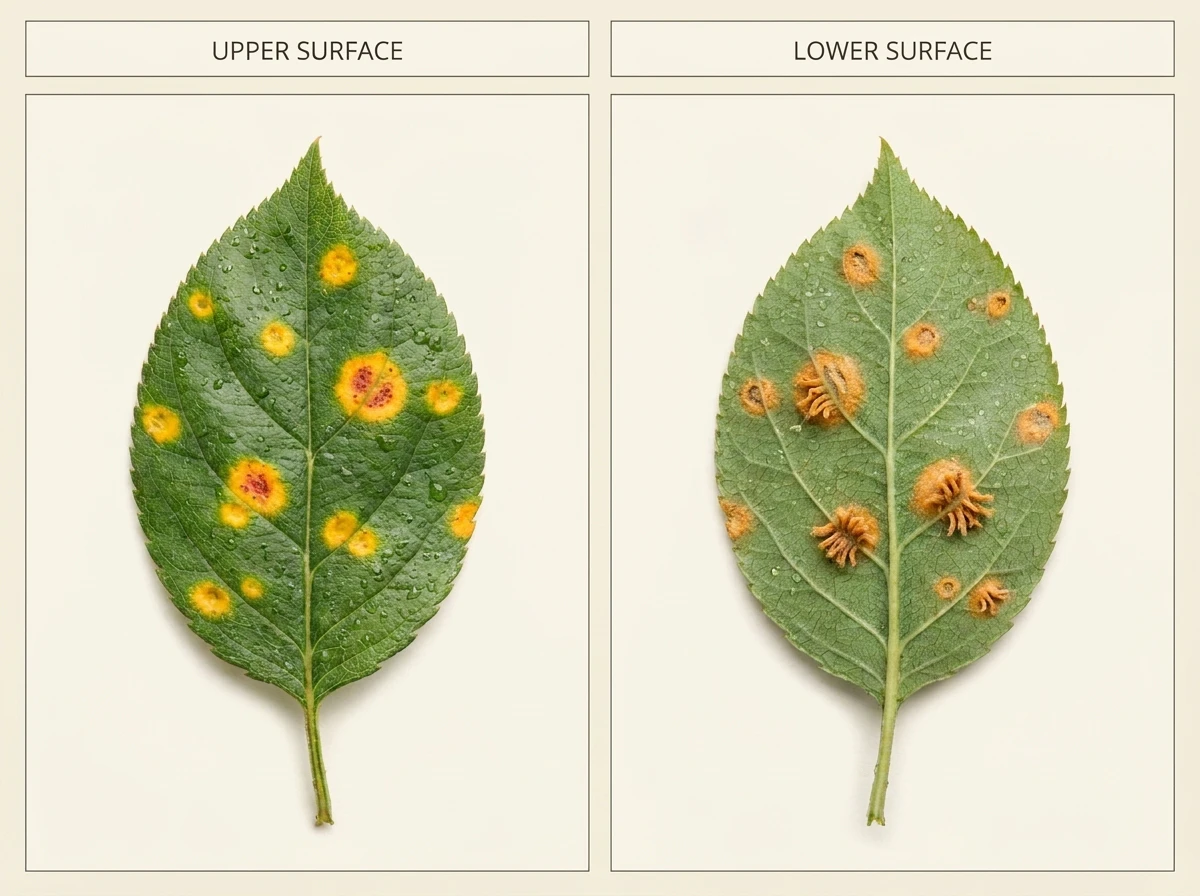
Cedar-apple rust is caused by Gymnosporangium juniperi-virginianae. It alternates between apples or crabapples and susceptible junipers, including eastern red cedar. During wet spring weather, infected juniper galls produce conspicuous orange, jelly-like horns. Wind carries spores from those structures to apple growth.
NC State Extension’s disease profile explains that symptoms generally appear about 10 to 14 days after infection. Finding spots today therefore does not tell you that infection happened today. Later in the season, spores produced on apple tissue infect junipers; they do not start another infection cycle on apples.
Related rusts can confuse the picture. Cedar-hawthorn rust also produces leaf spots, while cedar-quince rust can cause conspicuous fruit and twig damage. Compare unusual symptoms with the cedar-hawthorn rust guide. For the broader disease cycle, see the cedar-apple rust overview.
Organic treatment for cedar apple rust: choose among three options
These approaches solve different problems. Removing galls addresses an accessible spore source. Resistant varieties help with future plantings. Copper is a conditional option for protecting susceptible growth. You may combine approaches, but none guarantees a spotless tree.
| Option | Best fit | Main limitation |
|---|---|---|
| Remove reachable juniper galls | You own an infected juniper with a manageable number of galls. | Spores may still arrive from elsewhere. |
| Choose resistant apple varieties | You are planting a tree or replacing one with recurring damage. | It cannot change the susceptibility of the tree already growing. |
| Consider labeled copper protection | A susceptible tree has a history of damage and still needs preventive protection. | Performance varies, and copper can injure fruit or foliage. |
Observation is also reasonable when damage is light. University of Minnesota Extension notes that leaf spots often have little effect on tree health when leaf loss does not occur. Repeated early defoliation deserves more attention than scattered marks on a full canopy.
In Family Plot’s Apple Tree Diseases video, retired UT Extension Agent Mike Dennison discusses cedar-apple rust among several apple diseases. Use it for identification context. It is not an organic-only spray program, and current product labels govern pesticide use.
1. Remove juniper galls before spring spore release
Inspect reachable juniper branches in late winter or early spring, before orange horns develop. Look for woody brown galls attached to small twigs. The juniper apple rust guide helps explain the evergreen side of the disease.
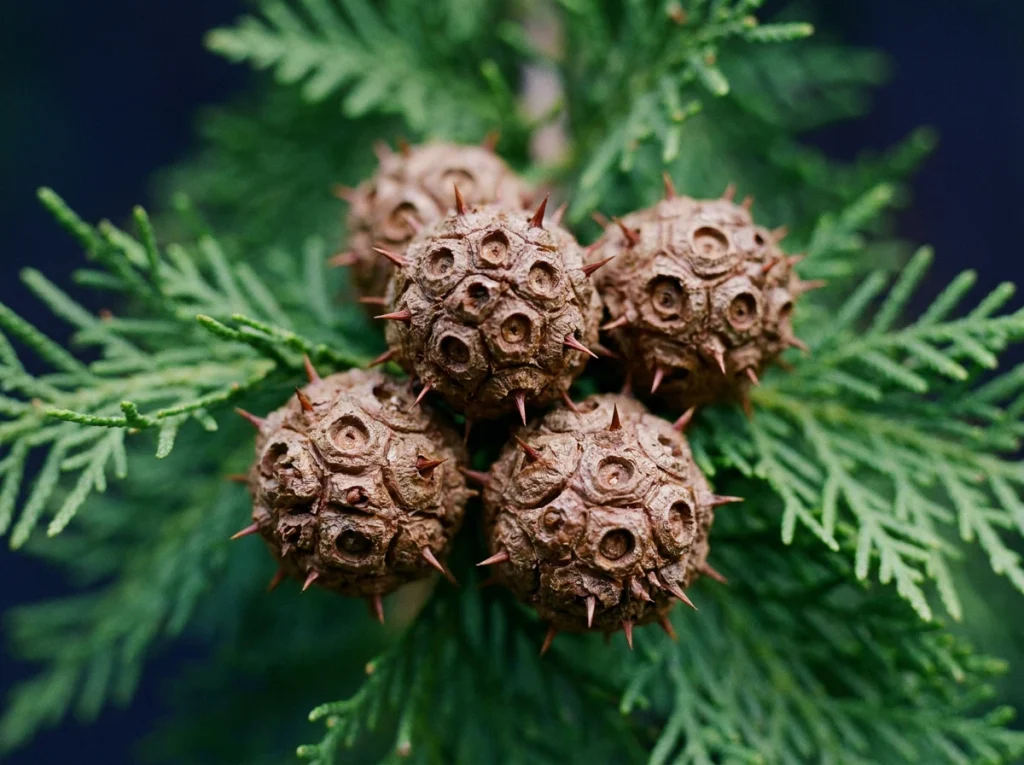
- Confirm that the growth is a rust gall. Photograph both the gall and the branch if identification is uncertain.
- Locate a suitable pruning point that removes the gall-bearing twig without sacrificing a large healthy limb.
- Remove the affected material before the gall begins producing its spring spores.
- Reinspect accessible branches before the next spring season, since developing galls can be overlooked.
Oklahoma State Extension describes late-winter gall removal as a backyard control measure. Its value depends heavily on nearby untreated sources. A hedge beyond your fence can continue supplying spores even after you have removed every visible gall on your own tree.
Keep the job proportionate. If galls are high in a mature tree, or removal would disfigure most of a hedge, compare the actual apple damage with the cost of that work. Do not prune a neighbor’s tree without permission. A sketch showing your apples and nearby junipers is useful when discussing options with extension.
One dry inspection is not enough to establish that spore release has ended. Juniper galls can dry and swell again through successive wet periods. Minnesota’s guidance also notes that spores can reach susceptible trees more than a mile away, so removing a nearby source reduces exposure without creating a guaranteed safe boundary.
2. Choose resistant varieties for new or replacement trees
Resistance is the most useful starting point when you want to reduce future spraying. NC State lists Liberty among resistant apple cultivars, and Oklahoma State also rates it highly resistant in its regional guidance. That makes Liberty worth discussing with a local nursery, provided it suits the rest of your planting needs.
Begin with the cedar apple rust resistant varieties guide, then ask the nursery to confirm the exact cultivar, local performance, and pollination requirements. A label saying only “disease resistant” leaves too much unanswered.
Resistance must match the disease. Wisconsin Extension’s rust overview describes several related fungi with overlapping hosts. A cultivar’s cedar-apple rust rating should not be treated as proof that it resists every rust or every apple disease.
For an existing tree, make the replacement decision from a season’s record. Note whether it keeps its canopy, produces usable fruit, and needs repeated intervention. A tree that retains its foliage despite some spotting presents a different case from one that repeatedly sheds leaves early.
When planning a new site, avoid deliberately placing susceptible apples beside susceptible junipers. Wisconsin recommends considering other landscape plants where the rust complex repeatedly causes trouble. More distance may help, but neighboring vegetation still matters. There is no backyard spacing measurement that guarantees protection under every wind and weather pattern.
3. Consider a labeled copper fungicide for preventive protection
Copper deserves a careful discussion because some formulations are permitted in organic growing and carry an apple-rust label. That establishes an option to evaluate, not a promise of strong control in every orchard.
The New England Tree Fruit Management Guide reports encouraging Vermont results with a copper formulation, but also increased fruit russeting. Russeting is rough, corky skin damage. Formulation, cultivar, timing, and conditions affect the tradeoff between disease suppression and crop injury.
For a residential label example, Bonide’s Liquid Copper Fungicide Concentrate lists cedar apple rust under pome fruits, including apples. Its manufacturer-linked label also warns about russeting on susceptible apples. Bonide markets this product for organic gardening. Match the full product name and EPA registration number, 67702-2-4, rather than transferring directions from another copper bottle.
Build the plan before mixing
Send your local extension office the cultivar name, photographs, previous damage, and exact label. Ask whether that formulation is a useful choice under local rust pressure and when protection would begin. The cedar apple rust treatment guide explains the wider timing sequence.
Read the apple-specific concentration limit and application directions together. Also check repeat intervals, seasonal limits, harvest restrictions, protective clothing, and compatibility warnings. The label’s general mixing range does not override a narrower crop instruction. If you follow a certified organic program, confirm the exact formulation with your certifier.
Protect healthy growth while infection remains possible. A generic direction to start when disease appears does not mean copper will remove existing lesions. Follow the selected label’s coverage and weather requirements, and record what you applied. Keep people and pets away as directed, and prevent drift or runoff toward water.
If copper’s limitations make it unsuitable, revisit the amount of damage you are willing to tolerate. The separate fungicide comparison includes conventional options; those products should not be mistaken for organic alternatives.
What about sulfur, neem oil, and homemade sprays?
Sulfur appears in plenty of general fruit-disease advice. However, the New England guide specifically states that sulfur is ineffective against rust diseases on apples. It also describes injury risks when sulfur materials are used too close to horticultural oils. Do not substitute a sulfur program for apple scab and assume it will manage cedar-apple rust.
Guidance can look contradictory because a broad rust label and demonstrated field performance answer different questions. Wisconsin lists sulfur among ingredients labeled for the wider rust complex; the New England guide addresses performance on apples. For this article, that is insufficient support to rank sulfur as a dependable option.
No cedar-apple-rust-specific evidence reviewed for this guide establishes neem oil, baking soda, vinegar, or compost tea as a cure for existing lesions. Avoid experimenting with kitchen mixtures on already stressed foliage. If someone recommends a spray, ask for the exact product, edible-apple directions, and evidence for this rust.
What to do if your apple tree already has spots
Start a short observation record before changing treatments. Take one whole-tree photograph and close-ups of both leaf surfaces. Write down the date, cultivar if known, whether leaves are dropping, and any fruit damage. Include previous sprays, since injury after spraying also needs consideration.
Use the same few branches for later photographs. This is a practical tracking method, not a formal disease threshold. Record changes in leaf retention and fruit condition instead of counting every orange spot.
For example, suppose a tree has scattered lesions but a full canopy after spring infection has ended. Monitoring and preparing a winter gall inspection would be reasonable. If it loses substantial foliage early in successive years, take the record to extension before the next growing season. These are hypothetical decisions, not results from a treatment trial.
Maryland Extension explains that severe rust can cause defoliation and fruit injury. Branch swellings, dying shoots, or symptoms that do not fit the expected pattern are reasons to obtain a diagnosis instead of simply increasing spray strength.
Avoid stripping the tree of spotted leaves. Apple-produced rust spores return to junipers, so removing a large part of the canopy does not stop an apple-to-apple infection cycle. Maintain appropriate routine care while you assess damage. If soil moisture is also a concern, use the apple watering guide to assess that separately; extra water is not a rust treatment.
FAQs
Can cedar apple rust be cured organically?
Existing lesions will remain damaged. Organic management aims to reduce future infection through source reduction, resistant plantings, and carefully selected preventive protection. Success may mean acceptable leaf retention and fruit quality rather than eliminating every spot.
Will removing one cedar stop the disease?
It may remove a local spore source, but windborne spores can arrive from other junipers. Confirm the tree’s identity and infection before considering removal, and compare that work with the actual damage to your apples.
Is neem oil the best organic treatment?
The evidence reviewed here does not support that ranking. A broad fungicide claim does not demonstrate reliable cedar-apple rust control, and neem cannot restore leaf tissue already damaged by infection.
When should I prepare for next year’s rust season?
Review this year’s photographs and damage before spring growth starts. Inspect accessible junipers before orange horns develop, and settle any preventive spray plan with local guidance and the exact label before the infection period begins.
