Apple Tree Chill Hours: Proven Growing Guide
Apple tree chill hours are the accumulated periods of suitable winter cold that help dormant buds resume normal growth and flowering in spring. Many traditional apple cultivars need substantial chilling, while low-chill selections need less. The best approach is to compare a named cultivar’s requirement with local winter records before planting.
Table of Contents
Key Takeaways
- Apple tree chill hours describe winter exposure, not the lowest temperature a tree can survive.
- One common counting method adds hours between 32°F and 45°F, but different models produce different totals.
- Choose a cultivar using local chilling records, USDA cold-hardiness information, bloom overlap, and site conditions.
An apple tree can survive winter, leaf out in spring, and still produce few flowers. For a gardener in a mild-winter area, a shortage of apple tree chill hours belongs on the list of possible explanations, especially when the cultivar was developed for much colder winters.
However, a disappointing crop does not establish a chilling problem. Frost injury, inadequate pollination, young tree age, shade, and pruning can also affect production. This guide explains how to estimate apple tree chill hours without confusing those separate causes.
What Are Apple Tree Chill Hours?
During autumn, an apple tree’s buds enter a resting phase. Exposure to suitable cold helps satisfy their internal chilling requirement, after which warmer conditions can support normal spring bud development. University of Maryland Extension explains this relationship between winter temperatures and bud growth in its home fruit garden guidance.
For practical planning, apple tree chill hours are often counted as hours from 32°F through 45°F during the dormant season. That is a useful teaching model, but it is not a universal formula: other models use different temperature ranges or weighted units, so their totals should not be compared as though they were identical.
Chilling Requirement Versus Winter Hardiness
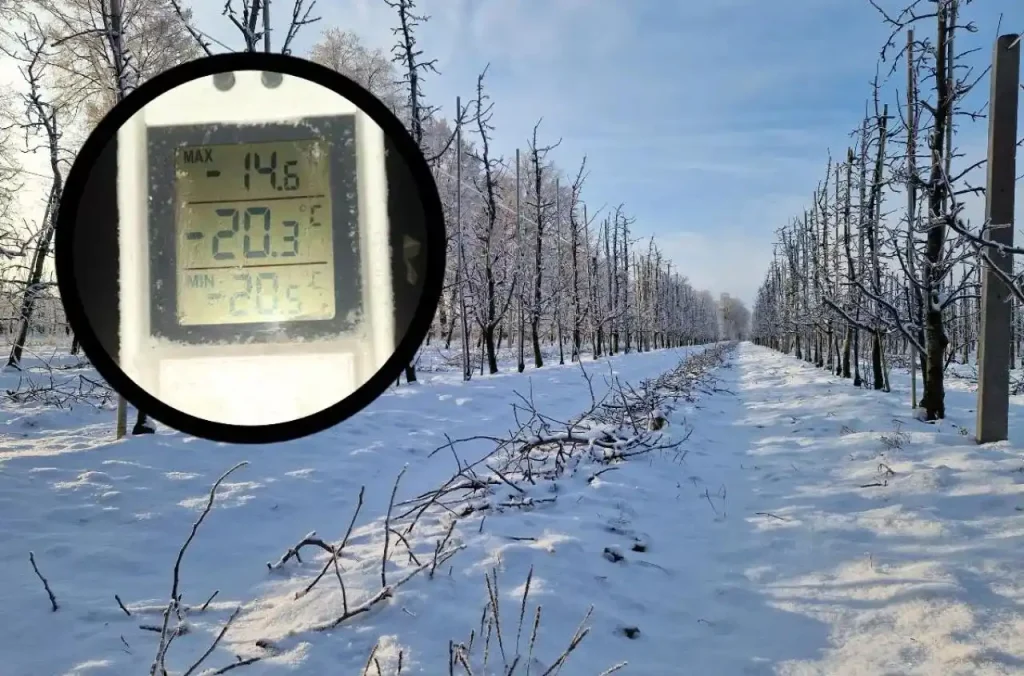
A USDA hardiness zone reflects typical extreme winter minimum temperatures. By contrast, the chilling requirement concerns enough suitable cool weather for normal bud development. Consequently, a tree may be cold-hardy where you live but poorly matched to the area’s mild winters.
In colder regions, choose a tree that can withstand local winter lows and ripen fruit before autumn freezes. In warmer regions, investigate the cultivar’s chill requirement as carefully as its disease resistance and heat tolerance. Utah State University Extension discusses hardiness, frost timing, and site microclimates in its apple variety recommendations.
Extension consensus, paraphrased: Match fruit-tree varieties to their local climate, including winter chilling, hardiness, frost exposure, and pollination. Meeting a chilling requirement alone does not guarantee a harvest.
The video below shows a nursery demonstration of apples growing in a mild-winter climate. It is useful context for understanding local variation, but one demonstration should not replace regional extension guidance or a cultivar-specific recommendation.
How Many Chill Hours Do Apple Trees Need?
There is no single apple tree chill hours requirement that fits every variety. University of Maryland Extension lists roughly 800 to 1,200 hours as a broad planning range for many temperate tree fruits, including apples, while defining low-chill fruit varieties as those needing fewer than 300 hours. It also warns that selections from warmer or colder regions may fall outside that range.
Those apple tree chill hours figures are categories, not a substitute for the requirements of an individual named apple. For instance, an unnamed supermarket apple or a tree labeled only “red apple” provides too little information to make a reliable planting decision.
| Chilling Category | Indicative Hours | What a Home Grower Should Do |
|---|---|---|
| Low chill | Fewer than 300 | Consider for mild-winter sites, then verify spring frost exposure and a compatible pollinizer. |
| Broad conventional apple range | About 800 to 1,200 | Check the named cultivar against local records instead of applying the range to every apple. |
| Requirement unknown | Not established | Request a cultivar name and documented chilling information before purchase. |
These are extension-based planning ranges, not cultivar-by-cultivar guarantees. The 32°F to 45°F method and the nursery’s stated measurement method must be comparable.
Can an Apple Get Too Many Chill Hours?
Meeting a minimum chilling requirement does not mean a tree immediately flowers. Bud growth also responds to later warmth, so the practical concern with a low-chill variety in a colder region is the possibility of earlier development during warm spells followed by damaging freezes. Maryland Extension flags this timing risk.
Therefore, don’t reject an established low-chill tree simply because a map shows more winter chilling than its stated minimum. Watch when it actually blooms, whether compatible pollen is available, and whether late frosts repeatedly damage its flowers.
How to Calculate Apple Tree Chill Hours in 5 Steps
You can estimate apple tree chill hours with hourly temperature records and a spreadsheet. The purpose is a consistent local comparison, not a claim that the resulting total precisely measures every biological response inside a bud.
Step 1: Identify the Exact Apple Cultivar
Read the nursery label, order receipt, or graft tag for the scion cultivar. Ask the nursery which chilling model supports its advertised number, because labels that omit the method can be difficult to compare.
Also record the rootstock separately. Rootstock affects factors such as size and adaptation, while the named fruiting cultivar remains central to the flowering decision. See our apple tree varieties by zone guide when narrowing the selection.
Step 2: Find Local Winter Temperature Records
Look for an hourly weather dataset from a nearby reliable weather station or a regional extension chilling report. Favor a station with similar elevation and exposure, and review several recent winters instead of choosing a single unusually cold year.
For apple tree chill hours, a nearby airport’s data can provide a starting point, although a sheltered backyard and a valley frost pocket may differ. Utah State Extension describes how slope, exposure, and cold-air drainage create meaningful microclimates.
Step 3: Use One Counting Method Throughout
For a simple apple tree chill hours estimate from 32°F to 45°F, count each recorded hourly temperature that falls within that band. Start in the dormant-season window indicated by your data source, commonly around the first autumn frost, and continue through the end of the relevant chilling period.
For example, suppose 15 nights each contain eight eligible hours. The calculation is 15 × 8 = 120 hours for that sample, not a forecast for your orchard. Add the remaining days using the same rule, and keep the original records for comparison.
- Count: An hourly reading of 39°F under the chosen 32°F to 45°F method.
- Do not count in that method: An hourly reading of 60°F or 25°F.
- Do not mix: Traditional chill hours and weighted chill portions without a validated conversion.
Michigan State University Extension describes an alternative reporting approach using hours around 35°F to 45°F and notes that apple requirements vary substantially. Consequently, always label the model beside the total instead of presenting the result as a universal measurement.
Step 4: Compare Several Winters With the Requirement
To interpret apple tree chill hours properly, create a small comparison table with the cultivar, its documented chilling requirement, the weather station, the model, and each winter’s estimated total. If the lowest recent winters fall below the cultivar’s stated need, ask local extension educators about the variety’s performance before buying.
Apple tree chill hours fluctuate with weather, so a long-term regional average is more useful than guessing from one cold night. The number of days below freezing by itself is not an accurate substitute for the defined temperature window.
Step 5: Check Bloom Timing and Pollination
Compare the prospective apple’s typical bloom period with another compatible apple or crabapple. Most apple cultivars require cross-pollination, and two trees of the same cultivar cannot provide genetically different pollen for one another. Maryland Extension explains these compatibility requirements.
Finally, consider spring frost patterns. A low-chill cultivar may receive enough winter chilling yet face repeated flower loss when warm spells are followed by freezes. A suitable site and pollination plan matter just as much as the count.
How to Interpret Low Chill and High Chill Locations
In zones with mild winters, apple tree chill hours deserve special attention because nighttime cooling may be intermittent. For example, a coastal garden and an inland valley can share a USDA hardiness zone but accumulate different amounts of suitable cold.
When considering apple tree chill hours in colder northern areas, winter hardiness and the length of the growing season may be bigger limiting factors. Still, unusual winter warmth and spring frosts can affect blooming, so use local observations rather than assigning a fixed chilling total to USDA Zone 5, 8, or 9.
A Practical Decision Table for a Backyard Tree
| What You Observe | Possible Explanation | Useful Next Check |
|---|---|---|
| Slow, scattered budbreak after a mild winter | Chilling shortfall is possible | Review the cultivar requirement and local hourly temperatures. |
| Leaves grow normally, but flowers are absent | Tree age, excessive pruning, or other growing conditions may matter | Check age, pruning history, light, and previous season’s shoot growth. |
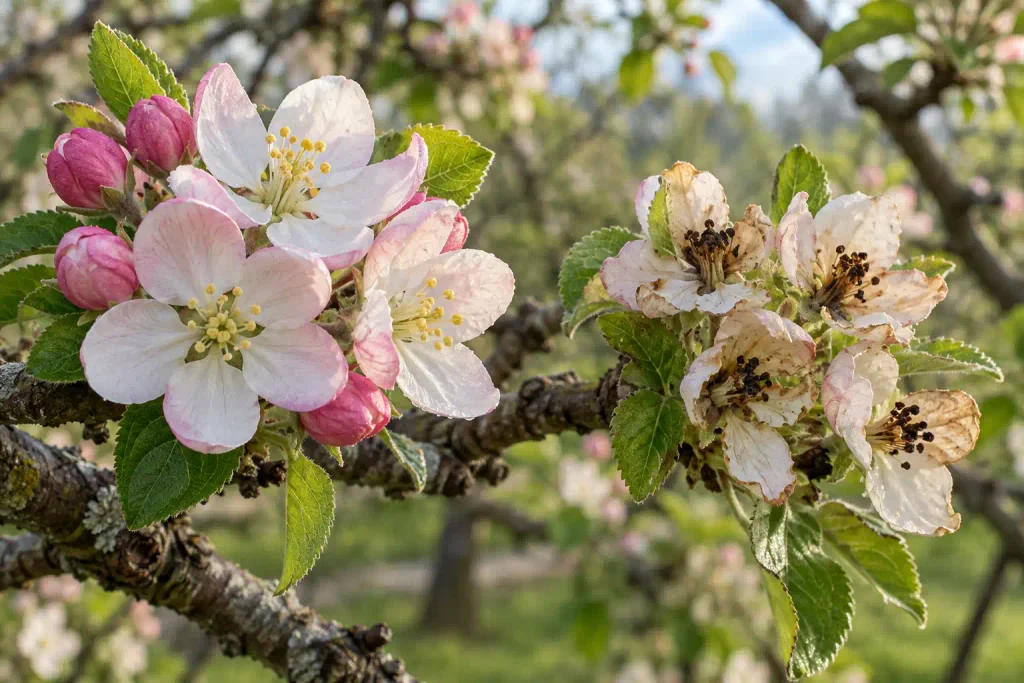
| Flowers open, then turn brown after a cold night | Freeze injury to flowers | Compare bloom stage with weather records and inspect flower centers. |
| Many healthy flowers but little fruit | Pollination or weather during bloom may be limiting | Verify pollen compatibility, overlapping bloom, and pollinator activity. |
Use this table as a sorting tool, not a diagnosis. If a tree fails to leaf out across entire branches, inspect for winter injury or other damage rather than assuming its chilling requirement was missed. Our apple tree dormancy guide explains what healthy resting buds and delayed spring growth can look like.
Common Mistakes When Choosing an Apple Tree
Confusing Chilling With Cold Survival
An apple’s minimum survival temperature and its apple tree chill hours requirement answer different questions. Read both the hardiness rating and the chilling guidance before deciding a cultivar suits your yard.
Using a National Map as an Exact Backyard Reading
Apple tree chill hours maps help screen locations, but a weather station cannot describe every wall, slope, or exposed planting bed. Therefore, favor nearby records, note their collection method, and compare results with actual bloom behavior.
Treating an Early Blossom as Proof of Sufficient Chilling
Visible flowering can occur under complicated seasonal conditions, and a single successful bloom does not establish reliable long-term performance. Keep several years of notes on budbreak, flower abundance, frost damage, and harvest.
Trying to Fix Low Chilling With Fertilizer or Heavy Pruning
Fertilizer cannot replace the cold exposure needed during dormancy. Heavy pruning may also reduce flower-bearing wood, so avoid aggressive corrective cuts based solely on an uncertain chill estimate. For pruning timing, see apple tree pruning in winter.
What to Do If Your Apple Tree Receives Too Little Chill
If apple tree chill hours records suggest a mismatch, first confirm the cultivar and observe the tree through a full spring. Take photographs of bud development and record how the same variety performs in nearby gardens, because no single symptom proves inadequate apple tree chill hours.
Keep normal care steady: use well-drained soil, suitable watering, and enough sun. Before fertilizing, use a soil test and assess growth; University of Minnesota Extension explains that tree vigor, nutrition, and fruiting should be evaluated together in its home apple-growing guide.
For a future planting, choose a cultivar with documented local performance and adequate pollination partners. If an established tree persistently flowers poorly, ask a university extension horticulturist to consider chilling alongside age, soil, pests, pruning, and temperature injury before you replace it.
FAQs
Do Apple Trees Need Temperatures Below Freezing for Chill Hours?
No. Under the commonly used 32°F to 45°F model, the counted hours occur near, rather than below, freezing. Other chilling models differ, so identify which model produced any apple tree chill hours number you see.
Will an Apple Tree Grow in USDA Zone 9 or 10?
Some apples can grow in warm-winter locations, but the specific cultivar, annual chilling, summer conditions, and bloom-time pollination all matter. Check local extension recommendations before relying on the zone alone, and do not treat a nursery’s broad zone label as proof of consistent fruiting.
Can I Make Up Missing Chill Hours by Putting Ice Around My Apple Tree?
Ice around the trunk or roots is not a reliable substitute for the temperature exposure of dormant buds across the canopy. If apple tree chill hours are repeatedly insufficient at your site, selecting a better-suited cultivar is a more defensible long-term response.
Why Does My Apple Tree Have Leaves but No Apples?
Missing apple tree chill hours are only one possible explanation: a lack of fruit can arise from poor flowering, incompatible pollen, frost-damaged blossoms, tree immaturity, or pruning. Review flowering first, then local winter data and pollination conditions rather than blaming chill hours without evidence.
Sources
- University of Maryland Extension. Starting a Home Fruit Garden. Chilling hours, cultivar selection, pollination, and frost exposure.
- Utah State University Extension. Apple Production and Variety Recommendations for the Utah Home Garden. Microclimates, winter hardiness, and variety selection.
- Michigan State University Extension. Northern Michigan FruitNet Report, February 23, 2017. Winter chilling ranges and model differences.
- University of Minnesota Extension. Growing Apples in the Home Garden. Orchard care, apple selection, and tree development.