
Flatheaded Apple Tree Borer: Proven Signs & Treatment Guide
Flatheaded apple tree borer is a metallic wood-boring beetle whose larvae feed beneath apple-tree bark, leaving winding tunnels, dead bark patches, and sometimes oval or D-shaped exit holes. Young or stressed trees are especially vulnerable. Control starts with identifying the damage, assessing the trunk, and preventing further attacks; larvae already inside wood can be difficult to reach.
Table of Contents
A split in the bark deserves attention, but it does not establish which insect caused it. This guide helps you inspect the tree without enlarging the wound, separate old damage from evidence of current feeding, and choose a practical next step. For other insects that tunnel into apple-tree trunks, see our apple tree borer identification and control guide.
How to identify flatheaded apple tree borer
The name usually refers to Chrysobothris femorata. Related flatheaded borers cause similar injury, including the Pacific flatheaded borer, Chrysobothris mali. Finding a pale grub in an apple tree does not establish its exact species.
The larva and adult look very different
The larva is pale, segmented, and legless, with a slender body and a conspicuously broad, flattened area immediately behind its small head. That enlarged area is the thorax. An adult has a flattened, oval-to-wedge-shaped body and metallic coloring. NC State’s identification guide describes adults as gray to bronze above with metallic lower surfaces.
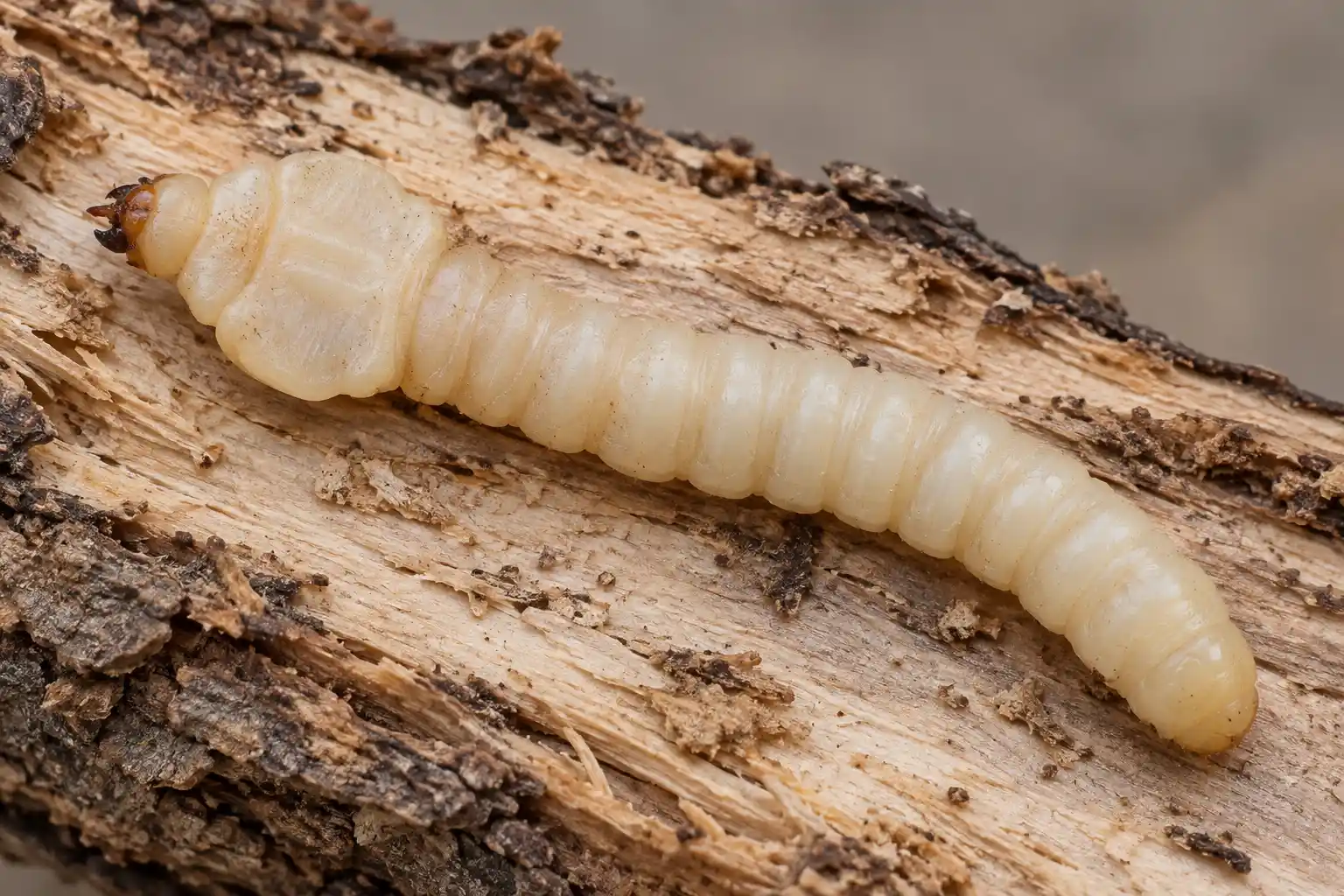
Color alone is unreliable. Photograph an insect from above and from the side, with a ruler nearby if possible. Preserve any specimen already exposed during inspection and ask your county Extension office how to submit it. Closely related species may require specialist examination.
Look for a pattern of bark damage
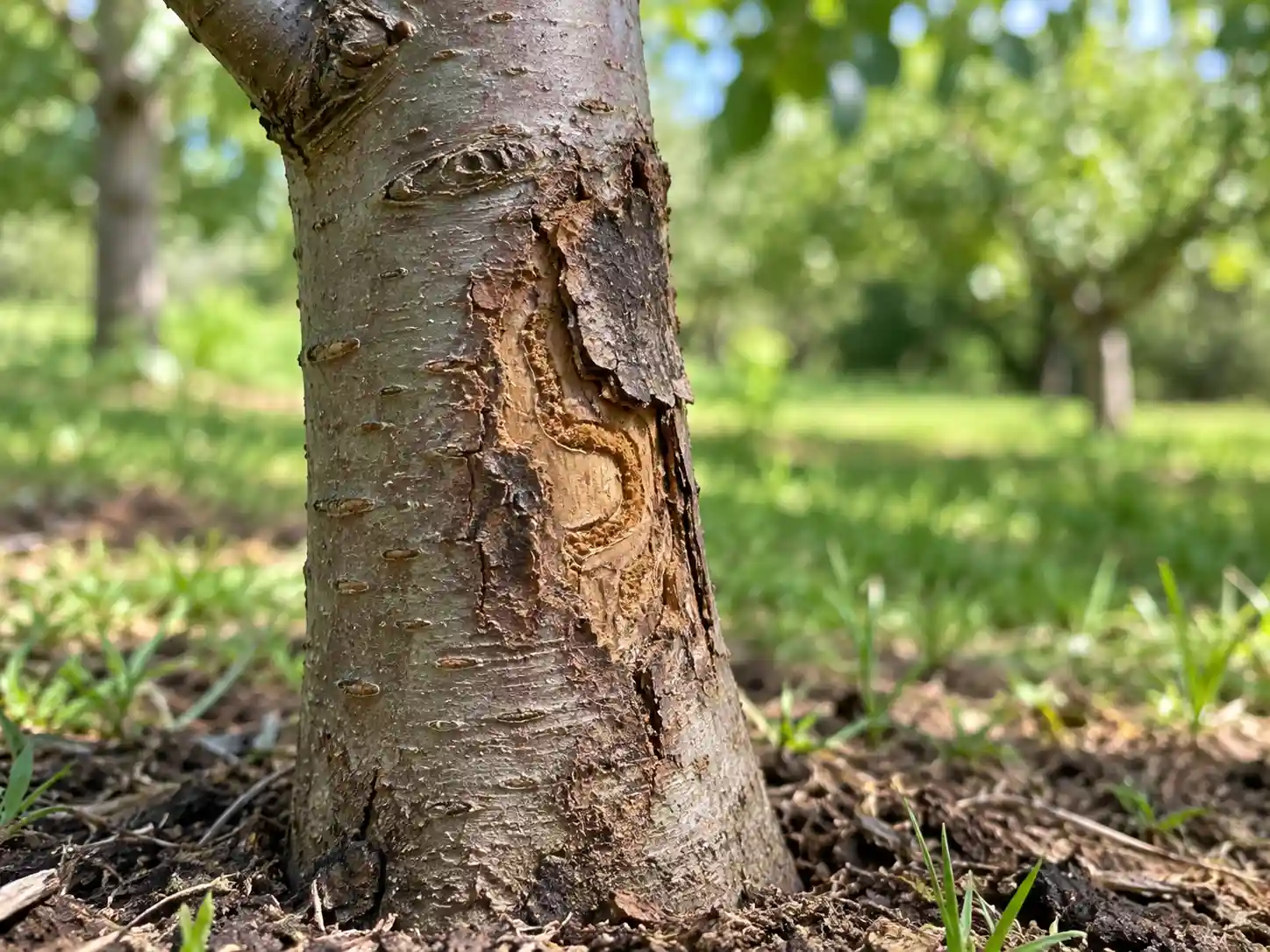
Suspect flatheaded borer injury when a dark or sunken bark patch overlies broad, winding galleries. Frass, the insect’s waste mixed with chewed material, may be packed inside those galleries. Splitting or peeling bark and wet patches can also occur. Utah State’s flatheaded borer fact sheet describes these signs, including oval or D-shaped emergence holes.
An exit hole means a beetle emerged at that location. It does not prove that another larva is feeding there now. Likewise, a tree can have substantial concealed tunneling without an obvious pile of sawdust at its base. Check the whole injury rather than judging the tree by one hole.
| Observation | What to investigate | Useful next step |
|---|---|---|
| Legless larva with a broad, flattened thorax | A flatheaded beetle borer | Obtain specimen identification before naming the species. |
| More cylindrical grub and damage concentrated near the trunk base | Roundheaded appletree borer | Compare our roundheaded apple tree borer guide. |
| Larva with legs and fleshy abdominal prolegs | A moth caterpillar, including possible wood-boring moths | Use the larva’s features and feeding location for identification. |
| Dead or cracked bark without a visible insect or gallery | Sunscald, mechanical injury, disease, or concealed feeding | Photograph the wound and investigate its history. |
Virginia Tech’s apple borer key distinguishes beetle larvae from caterpillars using these body features. If several plant parts are affected, our apple tree pests identification guide can help organize the evidence.
When attacks happen and why timing matters
Females lay eggs in bark crevices or around injured areas. After hatching, larvae enter the tree and feed in tissues beneath the bark. As they mature, they may move deeper into wood to overwinter. Development commonly takes about a year, although some individuals take longer.
Timing varies geographically. University of Missouri Extension reports adult emergence beginning around May and egg laying continuing from June into September. That describes Missouri conditions, not a nationwide spray calendar.
These stages explain treatment limits. A preventive bark application needs to coincide with local adult activity and egg laying. Once larvae are protected inside the tree, spraying the outside cannot be assumed to reach them. Old tunnels remain after the insects leave, so finding damage in autumn does not tell you when the attack began.
Newly planted trees deserve close inspection because transplant stress and a small trunk can make damage consequential. Established trees can also be attacked around injuries. Note when the tree was planted, recent dry weather, and any mowing, staking, or pruning damage.
SARE identifies this Tennessee State University video as a discussion of cover crops and their potential to deter flatheaded apple tree borer attacks. It concerns nursery production. Use it as background on prevention research; cover-crop practices and pesticide programs for nursery stock need separate evaluation before use around backyard fruit trees.
Inspect an affected tree without opening a larger wound
Take photographs before touching the damaged area. A close-up alone can hide its position and size, so also photograph the whole trunk and canopy. This inspection record is an editorial procedure based on the damage signs above, not a laboratory test for live insects.
- Inspect the trunk from the soil line to the first branches, including the graft union and larger limbs. Give sunny, previously injured areas particular attention.
- Move loose mulch away from the trunk so the base is visible. Open removable guards carefully and inspect underneath.
- Look through existing cracks and beneath bark that is already detached. Leave firmly attached bark in place. Stop if seeing farther would require cutting living tissue.
- Record the wound’s location, its approximate dimensions, visible frass, and any holes. Include a ruler in photographs without inserting it into the wound.
- Revisit the same locations and compare photographs. New frass, newly exposed galleries, or a live larva strengthen concern about current activity. A quiet surface check cannot rule out concealed feeding.
When requesting help, send the photographs with your state or county, planting date, watering history, and the date you first noticed damage. Explain whether the wound is confined to one branch or extends around the trunk. This gives a diagnostician more useful context than a request to identify a hole.
Cracked bark can have more than one cause. If you find no insect evidence, compare the wound with our apple tree disease identification guide and seek local diagnosis before treating it as a borer infestation.
Flatheaded apple tree borer treatment: choose by the situation
The immediate decision is whether you need to remove a reachable insect, manage infested wood, protect against another attack, or assess a seriously weakened tree. Those actions solve different problems.
| Situation | Reasonable action | Limit |
|---|---|---|
| Old exit hole with no new observed changes | Record and monitor the area; correct tree stress. | The hole alone cannot establish current activity. |
| Exposed larva in an existing opening | Arrange careful removal and identification. | Removing one larva does not prove the tree is clear. |
| Infestation confined to a removable branch | Plan pruning and disposal with local advice. | Check whether removal leaves a viable tree. |
| Recurring attacks on a vulnerable tree | Discuss locally timed preventive control. | An exact product must be labeled for edible apples and the intended use. |
| Extensive trunk injury or instability | Seek an arborist’s assessment promptly. | Insect control cannot restore missing bark or structural wood. |
Mechanical removal has a limited role
A larva already exposed beneath detached bark may be removable without creating another wound. Deep probing is much less certain. Colorado State discusses hand removal, but cautions against further tree damage. For a valued tree, ask Extension or an arborist to assess access before cutting.
Do not chase a tunnel by stripping healthy bark. If you cannot locate the insect through the existing opening, pause. The amount of living tissue sacrificed matters to the tree’s recovery, and unsuccessful excavation can enlarge the original injury.
Manage infested branches and removed wood
Where feeding is limited to a branch that can be removed, pruning can remove the infested tissue. University of Idaho recommends removing infested limbs from the area. Ask about suitable disposal locally and avoid storing untreated infested wood beside susceptible trees. Plan substantial pruning around tree condition and local pest activity.
Understand what insecticides can do
Contact treatments protect bark during the vulnerable period; systemic treatments must be absorbed into the tree. Oregon State’s management guide explains why systemic uptake requires lead time and why contact residues need suitable timing. Neither approach repairs feeding damage.
Recommendations differ by pest, crop, and location. UC IPM’s California apple guidance for Pacific flatheaded borer emphasizes cultural control and does not recommend spraying. That is a reason to obtain local advice, not to transfer a nursery treatment program to every apple tree.
Before buying a pesticide, confirm that its current label permits use on edible apples, the application method, and the intended pest use. Check harvest restrictions, application limits, protective equipment, and pollinator precautions. An ornamental tree-and-shrub label does not establish permission for a fruit-bearing apple tree. No product-specific dose or schedule is prescribed here.
Can an apple tree recover?
Recovery depends on the extent and location of injury, the tree’s remaining living tissue, and its overall condition. A small localized injury and widespread damage around a young trunk are very different situations. Girdling interrupts transport around the stem and can kill the tree.
Iowa State cautions that trees may already be severely weakened when symptoms become obvious. A leafy canopy alone cannot establish structural safety. Ask for assessment if the trunk is badly undermined, major branches are dying, or the tree could fall onto people or property.
For a retained tree, keep a simple record of new damage, leaf condition, and shoot growth. Compare the same wound photographs through the season. Continued decline despite appropriate care warrants another assessment rather than repeated treatment of an unconfirmed pest.
Reduce the conditions that encourage another attack
Prevention combines suitable care with protection from bark injuries. Check soil moisture where the roots are growing and use our guide to adjusting apple tree watering frequency. A newly planted root ball needs its own moisture checks; surrounding damp ground can be misleading.
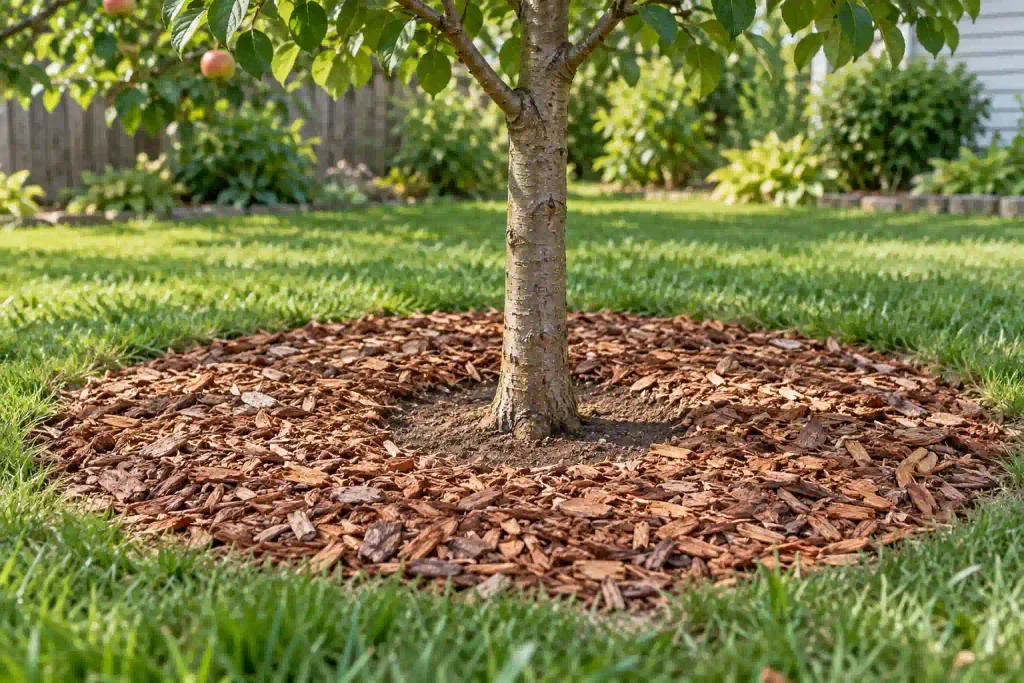
Maintain a mulched area that allows you to keep mowing equipment away from the bark. Follow our apple tree mulching guide and leave the trunk clear. Check ties and guards as the tree grows. Fertilizer should address a demonstrated need; it does not close a borer tunnel.
Sunburn and winter sunscald protection can also reduce vulnerable bark. UC IPM describes white interior latex paint diluted equally with water for suitable trunks. This is preventive whitewashing, not a pesticide or a dressing for an open wound.
Wrap recommendations vary. Some guides describe wraps as barriers, while Iowa State reports little or no benefit against borers. Winter sunscald wraps have a seasonal purpose and require removal or inspection as advised locally. Keep bark accessible and do not assume a wrapped trunk is protected from infestation.
Continue checking vulnerable trees before local spring emergence and through the growing season. Our organic apple tree pest control guide explains broader prevention practices. Natural enemies can help, but their presence does not establish that an active infestation is controlled.
FAQs
Is a flatheaded apple tree borer a caterpillar?
No. It is a beetle larva with an enlarged, flattened thorax. Caterpillars are moth or butterfly larvae with legs and abdominal prolegs. Finding those features changes which pest group you should investigate.
Does a D-shaped hole confirm an active infestation?
No. It indicates past adult emergence and supports investigating a flatheaded borer. Current activity needs additional evidence, such as a live larva or fresh changes. Species identification may still require a specimen.
Will neem oil kill a larva inside the trunk?
Do not assume a surface application reaches concealed larvae. Some regional guides list neem-derived products for particular uses, but the exact formulation, label, pest stage, and timing determine whether a treatment is appropriate.
Are healthy apple trees immune?
No. Reducing stress lowers vulnerability, but continued inspection matters, particularly after transplanting or bark injury. Good care supports prevention without guaranteeing that a tree will never be attacked.
Should I remove every apple tree with a borer hole?
No. Assess the extent of damage and the tree’s stability. A single old emergence hole does not justify removal by itself. Severe girdling, structural weakness, or continuing decline may make removal appropriate after assessment.
