
How Often to Water Apple Trees: 3 Easy Schedule Checks
How often to water apple trees depends on establishment, soil, and weather: newly planted trees need frequent moisture checks and may need water every few days, while established trees often need supplemental watering weekly or less often during dry weather. Check beneath the surface before watering, and postpone irrigation when the root zone remains moist.
Table of Contents
Key Takeaways
- Choose how often to water apple trees by checking tree establishment, soil moisture, and recent rainfall.
- Water the root zone slowly, then check whether moisture reached below the surface.
- Young trees, dwarf rootstocks, and container trees need closer attention during dry weather.
A watering reminder is useful, but it cannot tell you whether yesterday’s shower reached the roots. This guide explains how often to water apple trees with three checks you can repeat: identify the tree’s stage, inspect the soil, and account for weather.
Start with the schedule below, then adjust it to your planting site. For broader guidance on equipment and seasonal care, see our apple tree watering guide.
How Often to Water Apple Trees: A Starting Schedule
These intervals are starting points for observation, with irrigation conditional on soil moisture. University recommendations differ because a freshly transplanted root system and an established orchard tree have different access to stored water.
| Tree or situation | Starting approach | Adjustment |
|---|---|---|
| First 1 to 2 weeks after planting | Check daily; watering may be needed daily. | Skip irrigation when the root ball is already moist. |
| Weeks 3 to 12 after planting | Every 2 to 3 days is a transplant guideline. | Check the root ball before each application. |
| Young tree beyond the initial transplant period | Start with a weekly watering assessment. | Shorten the interval if its root zone dries sooner. |
| Established tree in the ground | Assess weekly in dry weather; irrigation may be weekly to roughly every 2 weeks. | Rain, soil storage, heat, and rootstock determine need. |
| Apple tree in a container | Check daily in warm weather. | Water when needed to maintain evenly moist compost. |
The video covers newly planted landscape trees generally. Apply its establishment principles alongside the apple-specific guidance here.
Why the first weeks need their own schedule
The frequent transplant intervals come from University of Minnesota guidance for newly planted trees. However, frequent watering means replenishing a limited root zone as needed, not repeatedly flooding wet soil.
A tree bought as a two-year-old nursery plant is still newly planted in your yard. Therefore, when deciding how often to water apple trees, count time since transplanting separately from the age on the label.
Why established trees differ by location
For established apples, Utah State University recommends deep watering about every two weeks during the growing season, wetting soil 2 to 3 feet deep. Its young-tree guidance ranges from 4 to 10 days depending on conditions.
In contrast, a rain-fed garden may need no irrigation during a wet stretch. Neither interval is a national rule for how often to water apple trees.
Check 1: Find Moisture Where the Roots Are
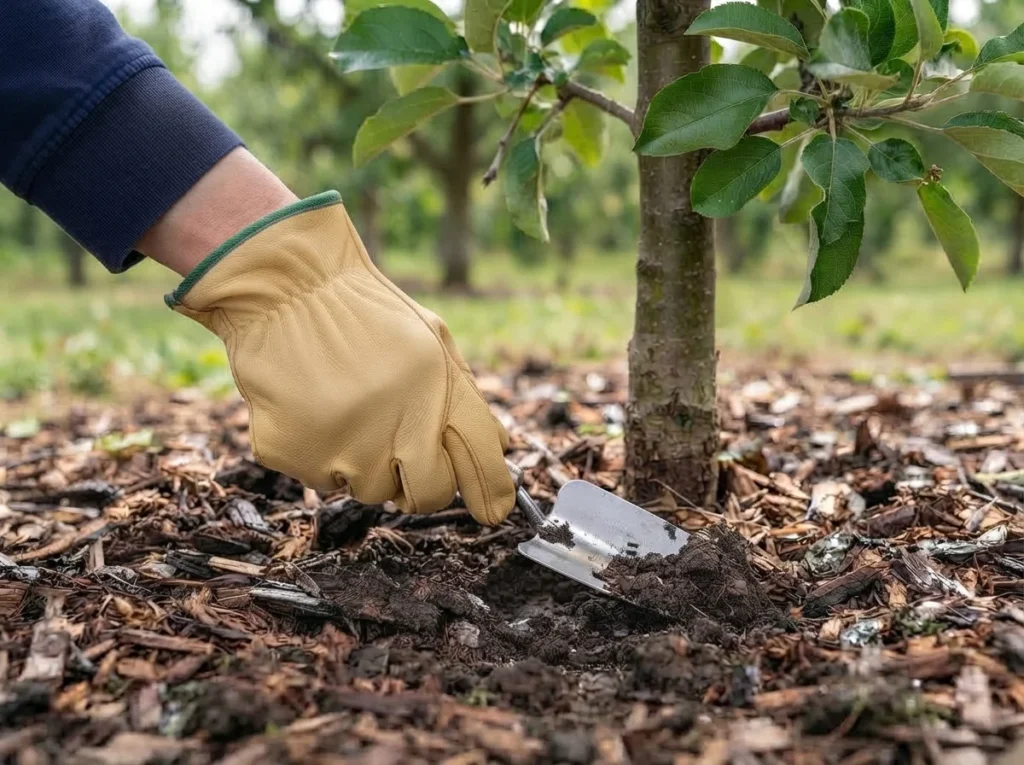
Pull mulch aside and inspect the soil itself before reaching for the hose. A dry crust can cover moist soil, so surface appearance alone is a poor guide.
Check both the root ball and surrounding soil
For a new planting, gently inspect several inches into the original root ball and nearby soil without cutting major roots. University of Maryland Extension advises checking moisture directly, including within the root ball.
If the root ball is drying while surrounding ground remains moist, direct water to the root ball. Consequently, changing where water lands may solve the problem without soaking the entire planting area again.
How often to water apple trees after a soil check
- Moist: postpone watering and check again as conditions change.
- Drying through the active root zone: irrigate slowly before obvious stress develops.
- Soggy or waterlogged: stop irrigation and investigate drainage.
For established trees, inspect below the surface at several points under the canopy. For example, Oregon State’s soil-check method uses a trowel to examine moisture 8 to 10 inches or deeper.
This is a monitoring depth, not the full depth of apple roots. Similarly, one damp spot directly beneath a dripper does not prove that the wider root zone received water.
Check 2: Match Watering Amount to the Wetted Area
Learning how often to water apple trees also requires knowing what one watering delivers. A five-minute hose session has no fixed volume because flow rates vary.
Use the weekly inch as a reference
Minnesota’s home apple guide suggests about 1 inch of rain or irrigation weekly during its May-to-October growing season. However, that is a regional reference rather than a daily allowance or an instruction to irrigate wet soil.
One inch describes a depth spread over an area. Therefore, a bucket poured into one small spot cannot automatically be counted as an inch across an entire tree’s root zone.
A worked example in gallons
The geometric conversion is gallons = square feet watered × inches applied × 0.623. For example, applying 1 inch uniformly over a hypothetical 20-square-foot area takes about 12.5 gallons, before application losses.
If that example area received 0.4 inch of effective rain, the remaining 0.6 inch would equal about 7.5 gallons. These are volume calculations, not prescribed amounts for every apple tree.
Turn gallons into hose or drip time
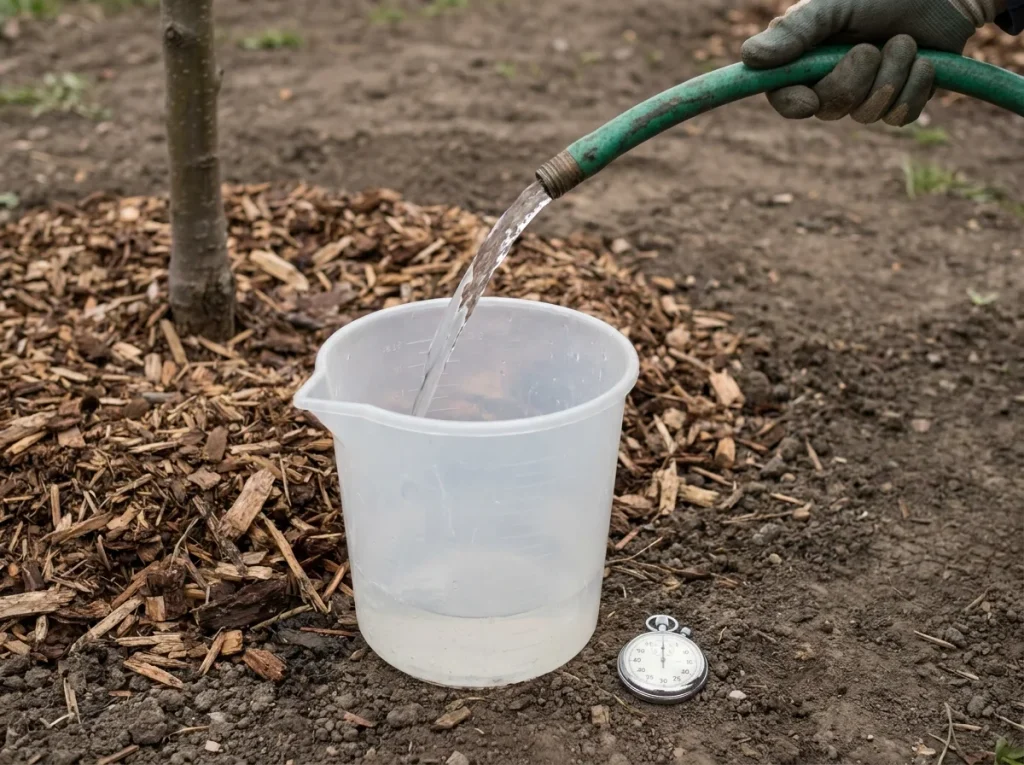
Measure how long your hose takes to fill a container of known volume at the setting you actually use. Alternatively, add the output of all emitters serving that tree.
For example, four functioning 1-gallon-per-hour emitters supply 4 gallons hourly, so 8 gallons takes two hours. However, check the resulting wetting pattern before saving that timer setting.
For placement and system design, use our guide to drip irrigation for apple trees. Then revisit how often to water apple trees whenever emitters are added or moved.
Apply slowly and confirm penetration
Spread irrigation across the root zone instead of concentrating it against the trunk. If water runs away, reduce the flow or use shorter cycles with soaking time between them.
Extension guidance, paraphrased: Check soil moisture after irrigation to confirm that water reached below the surface. Adjust the application when the intended soil depth remains dry.
Minnesota’s established-tree watering method recommends waiting two hours before checking penetration. Consequently, you can adjust delivery using evidence from your own soil.
Check 3: Adjust How Often to Water Apple Trees
Reconsider how often to water apple trees whenever the weather changes substantially. A schedule that worked during cool spring weather can become inadequate in a hot, windy week.
Sandy soil, clay, and mulch
Sandy soils generally need smaller applications more frequently, while clay stores moisture longer and may absorb water slowly. Therefore, persistent wetness calls for a drainage check before another watering.
Mulch helps conserve moisture and reduces competition from grass. Follow our apple tree mulching guide, keep mulch off the trunk, and inspect moisture beneath it.
Dwarf trees and developing fruit
Dwarfing rootstocks can make established trees more vulnerable to drought because their root systems are smaller. Additionally, water stress can reduce fruit size and restrict root growth, according to Minnesota’s apple irrigation guidance.
Therefore, do not decide how often to water apple trees from trunk age alone. Check dwarf trees and fruiting trees closely during prolonged dry weather.
Containers, autumn, and soil health
Container apples need steady moisture through the growing season, as the Royal Horticultural Society’s apple guide explains. In hot weather, check pots more often and water slowly until excess drains from the holes.
As autumn cools, reassess how often to water apple trees instead of carrying summer settings forward. Soil generally dries more slowly in cool weather, although a dry root zone still needs attention.
Separately, Penn State recommends a soil pH of 6.0 to 6.5 for pome fruit. Use a soil test for that decision; pH does not tell you when to irrigate.
Record How Often to Water Apple Trees in Your Yard
Record the date, rain received, soil condition before watering, and the amount applied. Then note the first subsequent check when the soil is drying enough to need replenishment.
For example, imagine a young tree watered Monday whose root ball is still moist Thursday. Check again rather than repeating the Monday application automatically.
If it needs water Saturday, use that observation to plan the next check earlier than Saturday. This turns how often to water apple trees into a routine that adapts to your yard.
FAQs
Should I water my apple tree every day?
Daily watering may be appropriate immediately after planting or for a rapidly drying container. However, how often to water apple trees must follow moisture checks: daily irrigation of an already wet root zone can harm roots.
Do established apple trees need watering if it rains?
Only when rain and stored soil moisture fail to meet their needs. Therefore, assess rainfall penetration and soil moisture when deciding how often to water apple trees after showers; a brief shower may leave deeper soil dry.
How can I tell whether I am watering too much or too little?
Check the soil alongside the leaves, because decline alone cannot identify the cause. Dry soil supports investigating apple tree drought stress symptoms, while persistently wet soil warrants checking overwatered apple tree symptoms.
If wilting continues despite suitable moisture, contact your local Extension office for diagnosis. Bring photographs and your watering record rather than repeatedly increasing irrigation.
Related Articles
Sources
- University of Minnesota: Watering newly planted trees and shrubs
- Utah State University: Apple production for the home garden
- University of Maryland: Watering trees and shrubs
- Oregon State University: Waterwise gardening in Central Oregon
- University of Minnesota: Growing apples in the home garden
- University of Minnesota: Watering established trees and shrubs
- University of Minnesota: Drought monitoring and irrigation for apples and grapes
- Royal Horticultural Society: How to grow apples
- Penn State Extension: Planting pome fruit
- Oregon State University: Watering basics
Disclaimer: This article provides general growing guidance based on university extension research. Soil conditions, climate zone, and variety selection significantly affect results. Contact your local cooperative extension service for region-specific recommendations.
