
Best Apple Trees For Home Orchard: Best Options Compared
Choosing the best apple trees for home orchard success starts with matching variety traits to your climate, space, and disease pressure. With more than 7,500 apple cultivars documented worldwide, the decision can feel overwhelming. However, our research team has narrowed the field to seven varieties that consistently deliver flavor, manageable care requirements, and reliable harvests for backyard growers across the United States.
Table of Contents
Key Takeaways
- The best apple trees for home orchards combine disease resistance, correct chill hour requirements, and compatible pollination partners.
- Liberty is the top-rated low-spray variety, offering immunity to apple scab and strong resistance to cedar apple rust and fire blight.
- Most apple varieties require a second compatible tree for pollination — plan for at least two trees before you plant.
- Dwarf rootstocks (such as G.935 or M.9) produce fruit in two to three years and are easiest to manage without a ladder.
- Matching chill hour requirements to your USDA zone is the single most important step before purchasing any apple tree.
A home apple orchard can be productive for decades when you start with the right varieties. The seven cultivars reviewed below were selected based on university cooperative extension recommendations, documented disease resistance ratings, and consistent performance across diverse growing zones. Each entry includes zone fit, chill hours, pollination needs, and primary use so you can make a confident decision.
Additionally, the varieties below cover a range of harvest windows, from early-ripening Gala in late August to late-season GoldRush in mid-October, so a mixed planting can supply fresh apples from summer through late fall.
What to Look for Before Choosing Apple Trees for Your Home Orchard
Before comparing individual varieties, three factors determine whether any apple tree will thrive in your yard. Understanding these criteria will help you eliminate the wrong choices before you spend money on trees.
Disease Resistance
Apple scab, cedar apple rust, fire blight, and powdery mildew are the four primary threats to backyard apple production. According to Penn State Extension, non-disease-resistant varieties require a more intensive fungicide program to produce marketable fruit, which adds both cost and effort for home growers. Varieties rated immune to scab (such as GoldRush, Liberty, and Enterprise) carry the Vf resistance gene, which blocks the most damaging orchard disease without any chemical inputs.
Therefore, disease-resistant selections are the most practical starting point for growers who want to minimize spray schedules. For a deeper look at how disease-resistant genetics work, see our guide to disease-resistant apple trees.
Chill Hours and USDA Zone Fit
Chill hours refer to the cumulative time a dormant apple tree spends at temperatures between 32°F and 45°F each winter. Varieties that do not receive their required chill hours fail to break dormancy properly, producing sparse blossoms and poor fruit set. For example, Honeycrisp requires 800 to 1,000 chill hours and performs best in USDA zones 3 through 8, making it unsuitable for growers in the South or Pacific coastal regions.
In contrast, low-chill varieties such as Anna and Dorsett Golden need only 100 to 300 chill hours and are designed for warm-winter zones. Confirming your local chill hour accumulation before purchasing is the single most important planning step you can take.
Rootstock Size and Pollination
Rootstock controls the ultimate tree size. Dwarf rootstocks such as Geneva 935 or M.9 produce trees that reach 8 to 10 feet tall and begin bearing fruit in two to three years. Semi-dwarf rootstocks such as MM.106 produce trees 12 to 15 feet tall with higher long-term yields. Standard rootstocks produce trees up to 25 feet tall that may take five to eight years to bear.
Furthermore, most apple varieties require cross-pollination from a second, compatible apple variety blooming at the same time. Golden Delicious is one of the few varieties considered reliably self-fruitful, though fruit set improves with a pollination partner nearby. Planning for two or more compatible varieties is essential for consistent harvests.
7 Best Apple Trees for Home Orchard
The table below summarizes key data for each variety reviewed in this guide. Individual variety profiles follow with detail on disease resistance, flavor, zone fit, and ideal use.
| Variety | USDA Zones | Chill Hours | Scab Resistance | Self-Fertile | Best Use |
|---|---|---|---|---|---|
| Liberty | 4–8 | 800 | Immune | No | Fresh, cider |
| Honeycrisp | 3–8 | 800–1,000 | Moderate | No | Fresh eating |
| Enterprise | 4–7 | 800 | Immune | No | Fresh, storage, cider |
| GoldRush | 5–8 | 800 | Immune | No | Storage, fresh eating |
| Gala | 5–9 | 400–600 | Moderate | No | Fresh eating |
| Fuji | 6–9 | 350–500 | Low | No | Fresh, storage |
| Granny Smith | 6–9 | 400 | Low | Yes (partial) | Baking, cooking |
1. Liberty — Best Disease-Resistant Pick
Liberty was developed in 1955 at the New York State Agricultural Experiment Station in Geneva as a cross between Macoun and Purdue 54-12. According to Cummins Nursery, it is immune to apple scab, very resistant to cedar apple rust, and resistant to both powdery mildew and fire blight, making it the closest thing to a no-spray apple available to home growers. It performs across USDA zones 4 through 8 and requires approximately 800 chill hours.
The fruit is medium-sized with deep red skin, firm flesh, and a sweet-tart flavor profile similar to McIntosh. Liberty ripens in late September to early October and stores well for up to two months. For home growers in humid, disease-prone regions, Liberty is consistently the top recommendation from university cooperative extension programs. It requires a pollination partner; compatible options include Fuji, Gala, and Enterprise.
For a comprehensive look at how Liberty and related cultivars perform across different conditions, see our review of disease-resistant apple tree varieties.
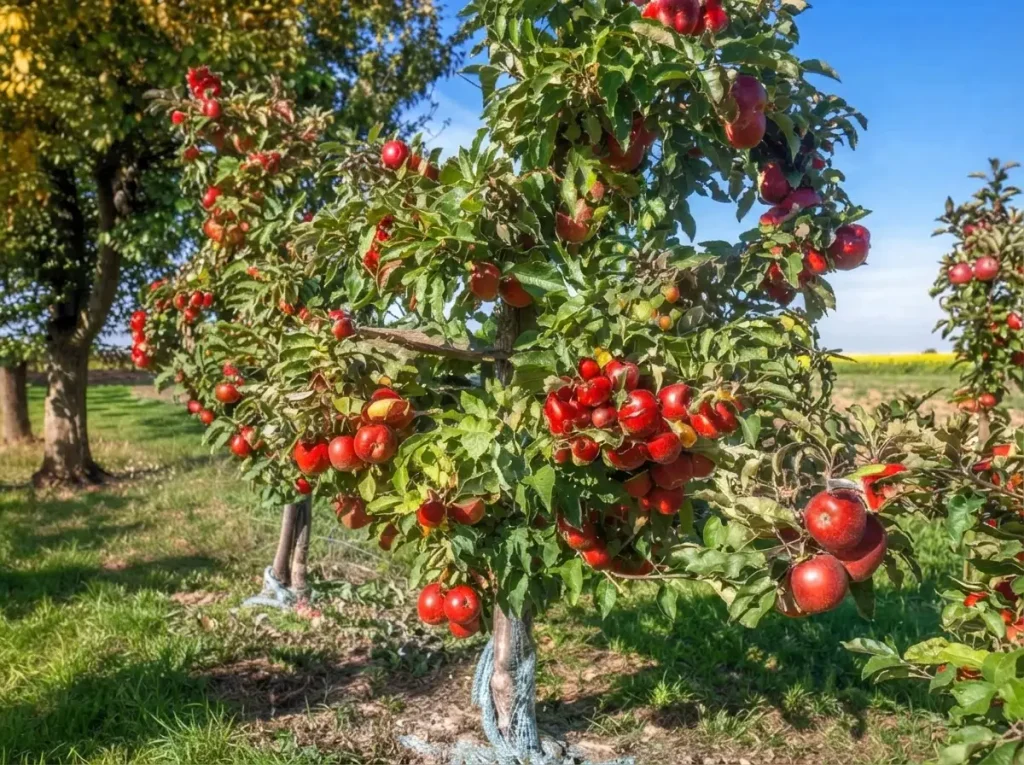
2. Honeycrisp — Best for Fresh Eating
Honeycrisp was released commercially by the University of Minnesota in 1991 under the experimental designation MN 1711. It remains the benchmark fresh-eating apple for home orchards, producing medium to large fruit with a mottled red-over-yellow skin, explosively crisp texture, and a well-balanced sweet-tart flavor. It thrives in USDA zones 3 through 8 and requires 800 to 1,000 chill hours, making it best suited to cold-winter climates.
Honeycrisp has moderate susceptibility to apple scab and fire blight, so growers in humid regions should plan a preventive fungicide rotation or pair it with a disease-resistant variety like Liberty in the same planting. It requires a pollination partner; Gala, Fuji, and Granny Smith are confirmed pollinators. Harvest falls in early to mid-September, and the fruit stores well for several weeks under refrigeration.
To understand how Honeycrisp responds to common disease pressure, see our guide on Honeycrisp apple tree diseases.
3. Enterprise — Best All-Around Low-Spray Variety
Enterprise is a product of the PRI (Purdue, Rutgers, and University of Illinois) cooperative apple breeding program and was released in 1993. According to the Ohio State University Extension fact sheet on growing apples in the home orchard, Enterprise is immune to apple scab and cedar apple rust, resistant to powdery mildew, and resistant to fire blight. This disease profile is the most complete of any variety in this guide, making Enterprise the top pick for growers who want maximum disease protection with minimal chemical inputs.
The fruit is medium to large with a dark red blush, firm flesh, and a mildly tart, aromatic flavor that sweetens and deepens after one to two months in cold storage. Enterprise ripens in October and stores for at least three months in common refrigeration. It is adapted to USDA zones 4 through 7 and requires approximately 800 chill hours. A pollinator is required; compatible options include Liberty, GoldRush, and Pristine.
4. GoldRush — Best for Long Storage
GoldRush is another PRI program release, introduced in 1993 with immunity to apple scab and high resistance to powdery mildew. According to Stark Brothers Nurseries, GoldRush is one of the most practical disease packages available for home orchardists pursuing organic or near-organic production. It is moderately resistant to fire blight but note that it is susceptible to cedar apple rust, which is a consideration in areas where eastern red cedar is common.
The fruit is medium-sized, yellow at harvest, and tangy-tart with a spiced complexity that develops and improves in storage. Under optimal refrigeration, GoldRush fruit maintains peak quality for up to seven months. Harvest falls in mid to late October in most regions. The tree is adapted to USDA zones 5 through 8 and requires approximately 800 chill hours. A pollination partner is required.
5. Gala — Best for Beginners
Gala is among the most widely grown apple varieties in the United States, surpassing Red Delicious in total acreage according to the U.S. Apple Association. For home growers, Gala offers approachable care requirements, moderate heat tolerance, and reliable annual production. It adapts well across USDA zones 5 through 9 and requires only 400 to 600 chill hours, giving it broader geographic applicability than cold-demanding varieties.
The fruit is sweet, mildly aromatic, and crisp, with a distinctive red-and-yellow striped skin. Gala ripens in late August to early September, making it one of the earliest varieties in this guide. Dwarf Gala trees on M.9 or G.65 rootstock reach about 8 to 10 feet and begin producing in two to three years. Gala has moderate disease susceptibility and will benefit from a preventive spray program in high-humidity climates. It is not self-fertile and pairs well with Fuji or Honeycrisp as a pollination partner.
6. Fuji — Best for Warm Climates
Fuji originated in Japan as a cross between Red Delicious and Ralls Janet and was introduced to U.S. commercial production in the 1980s. For home growers in warmer zones, Fuji is a standout because of its relatively low chill hour requirement of 350 to 500 hours, which makes it suitable for USDA zones 6 through 9 where colder varieties fail to perform. The fruit is exceptionally sweet, dense, and juicy with a long storage life of four to six months under refrigeration.
Fuji is moderately susceptible to apple scab and requires a structured spray program in humid environments. It is not self-fertile and pairs well with Gala, Granny Smith, or Honeycrisp. Harvest falls in mid to late October. On semi-dwarf rootstock such as MM.106, Fuji trees reach 12 to 15 feet and begin bearing in three to four years. The variety’s combination of flavor, storage life, and climate adaptability has made it one of the most planted commercial varieties in the world.
7. Granny Smith — Best for Baking and Cooking
Granny Smith originated near Eastwood, New South Wales, Australia in the late 19th century and has since become one of the most recognized apple varieties globally. Its firm, tart, bright-green fruit is the standard for baking, pies, tarts, and sauce, because the high acid content holds up to heat and complements sweeteners well. Granny Smith is adapted to USDA zones 6 through 9 and requires approximately 400 chill hours, making it broadly suitable for mid-latitude gardens.
Granny Smith is partially self-fruitful and will set a modest crop without a pollinator, though pairing with Fuji or Gala consistently improves yield. It is susceptible to apple scab and fire blight in humid conditions, so site selection with good air circulation is important. Harvest falls in mid-October to mid-November, making it the latest-ripening variety in this guide. As a result, Granny Smith suits growers who want to extend their harvest window and stock up on cooking apples for winter use.
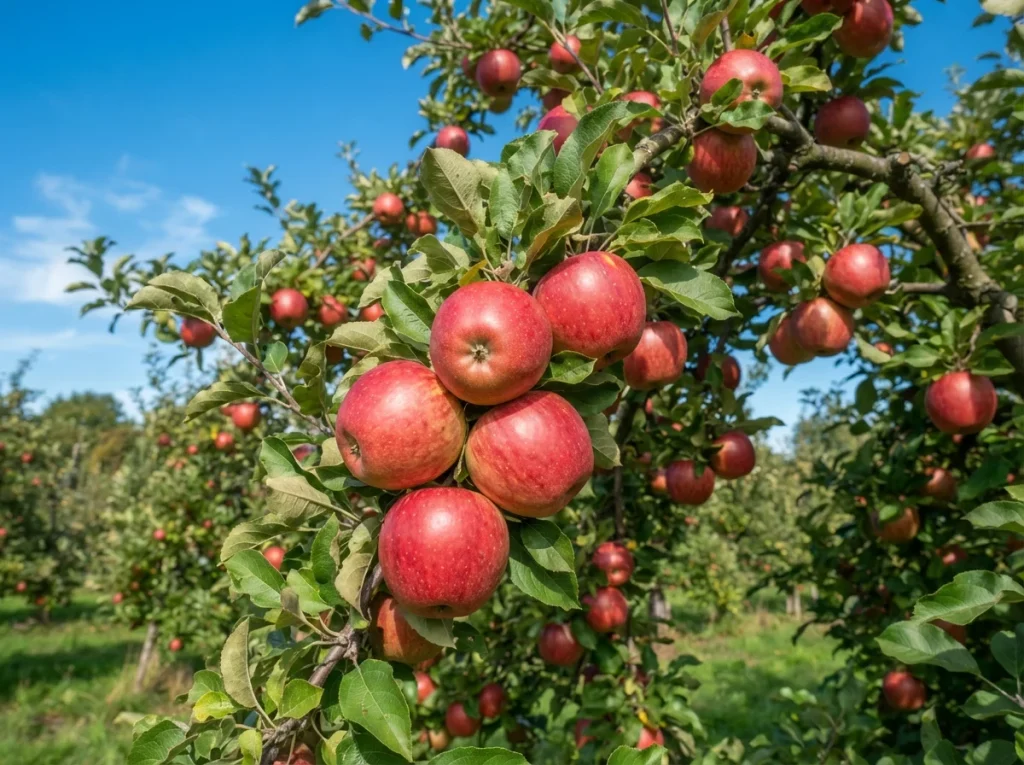
How to Match the Best Apple Trees for Home Orchard to Your Climate
Climate matching is the most overlooked step in home orchard planning. Our research team recommends using two resources before purchasing: your USDA hardiness zone map and a local chill hour estimate from your state cooperative extension service. Most state extension programs publish multi-decade chill hour averages by county, which are more reliable than zip-code weather apps for tree selection.
Growers in cold-winter zones (3 through 5) should prioritize Honeycrisp, Liberty, Enterprise, and GoldRush, all of which require 800 or more chill hours and show strong cold hardiness. In contrast, growers in zones 7 through 9 should center their selections on Gala, Fuji, and Granny Smith, which thrive on 400 to 600 chill hours. For more guidance on pairing variety selection with your local climate, see our article on apple tree varieties by zone.
Additionally, soil drainage and sun exposure remain critical site factors regardless of variety. Apple trees require well-drained soil with a pH between 6.0 and 6.5 and a minimum of six to eight hours of direct sunlight daily, according to Utah State University Extension guidance on apple production for the home garden.
Pollination Planning for Your Home Apple Orchard
With the exception of Granny Smith (partially self-fruitful) and Golden Delicious (often self-fruitful), nearly all apple varieties require pollen from a second, genetically distinct apple variety to set a reliable crop. Cross-pollination occurs when bees and other pollinators transfer pollen between trees that bloom at overlapping times. Therefore, selecting two or more varieties from the same or adjacent bloom groups is essential.
A reliable pairing strategy for beginners is to plant Liberty alongside Gala or Fuji. All three bloom in the mid-season window, Liberty provides disease resistance for the orchard, Gala provides the earliest fruit, and Fuji extends the harvest into October. For growers in warmer zones, Fuji and Granny Smith pair well and cover a mid-to-late bloom overlap. For a full look at how disease affects your orchard’s viability over time, see our guide to disease-resistant apple trees.
Crabapple trees are also effective pollinators for most standard apple varieties, provided bloom times align. If your yard has limited space, a single semi-dwarf crabapple planted within 50 feet can serve as a pollination source for multiple apple varieties. To understand how ornamental crabapples function in this role, see our profile of the Houck’s crabapple.
FAQs
What is the easiest apple tree to grow for beginners?
Liberty and Gala are the two most beginner-friendly options for the home orchard. Liberty requires virtually no fungicide program due to its near-complete disease resistance, while Gala produces reliably with moderate care and works across a wide range of USDA zones. Both are widely available on dwarf rootstocks that begin fruiting in two to three years.
Do I need two apple trees to get fruit?
For most of the best apple trees for home orchard production, yes. Most varieties are not self-fertile and require pollen from a second compatible variety blooming at the same time. Granny Smith and Golden Delicious are partial exceptions and can set a light crop alone, but fruit production consistently improves when a cross-pollination partner is present within 50 feet.
Which apple variety requires the least spraying?
Enterprise, Liberty, and GoldRush require the least spraying of any widely available variety. All three are immune to apple scab, which is the most common and damaging fungal disease in home orchards. Enterprise also shows strong resistance to fire blight and cedar apple rust, making it the most complete low-spray option of the three.
What apple tree is best for small yards?
Any variety on a dwarf rootstock such as Geneva 935, M.9, or G.65 suits small yards, reaching 8 to 10 feet at maturity. Gala and Liberty both perform well on dwarf rootstock and fit neatly in compact spaces. Columnar apple varieties, which grow 7 to 8 feet tall and only 2 to 3 feet wide, are another option for extremely tight spaces.
How long before a dwarf apple tree produces fruit?
Dwarf apple trees grafted on rootstocks such as M.9 or Geneva 935 typically begin producing fruit in two to three years after planting. Semi-dwarf trees on MM.106 or MM.111 usually begin bearing in three to four years. Standard trees may take five to eight years before producing a reliable crop, which is one reason cooperative extension programs recommend dwarf and semi-dwarf rootstocks for backyard growers.
Related Articles
- Disease-Resistant Apple Trees: The Complete Guide
- Disease-Resistant Apple Tree Varieties Compared
- Apple Tree Varieties by Zone: Choosing the Right Fit
- Honeycrisp Apple Tree Diseases: Identification and Control
- Houck’s Crabapple: Pollination Benefits for Home Orchards
Sources
- Penn State Extension — Scab-Resistant Apple Varieties for Home Orchards
- Utah State University Extension — Apple Production and Variety Recommendations for the Utah Home Garden
- Cummins Nursery — Liberty Apple Tree Variety Profile (cumminsnursery.com)
- Stark Brothers Nurseries — GoldRush Apple Tree Description (starkbros.com)
- Ohio State University Extension — Growing Apples in the Home Orchard (cfaes.osu.edu)
Disclaimer: This article provides general growing guidance based on university extension research. Soil conditions, climate zone, and variety selection significantly affect results. Contact your local cooperative extension service for region-specific recommendations.
