
Open Center Apple Tree Pruning: 7 Mistakes to Avoid
Open center apple tree pruning, also called vase-shape pruning, removes the central leader early in the tree’s life to create an open, bowl-shaped canopy that lets sunlight reach every branch. This method keeps backyard apple trees shorter, easier to harvest, and can improve airflow through the canopy, which helps lower fungal disease pressure.
Table of Contents
Key Takeaways
- Open center apple tree pruning removes the central leader and develops 3 to 4 wide-angled scaffold branches to form a vase shape.
- The best time to prune is late winter or early spring, after the coldest temperatures pass and before buds break.
- As a general rule, avoid removing more than one-third of the live canopy in a single season; spread renovation work over multiple years on heavily overgrown trees.
- Thinning cuts, not heading cuts, are the primary tool for maintaining open center form in established trees.
- Removing water sprouts from the center is an annual task that keeps the open form intact from year to year.
What Is Open Center Apple Tree Pruning?
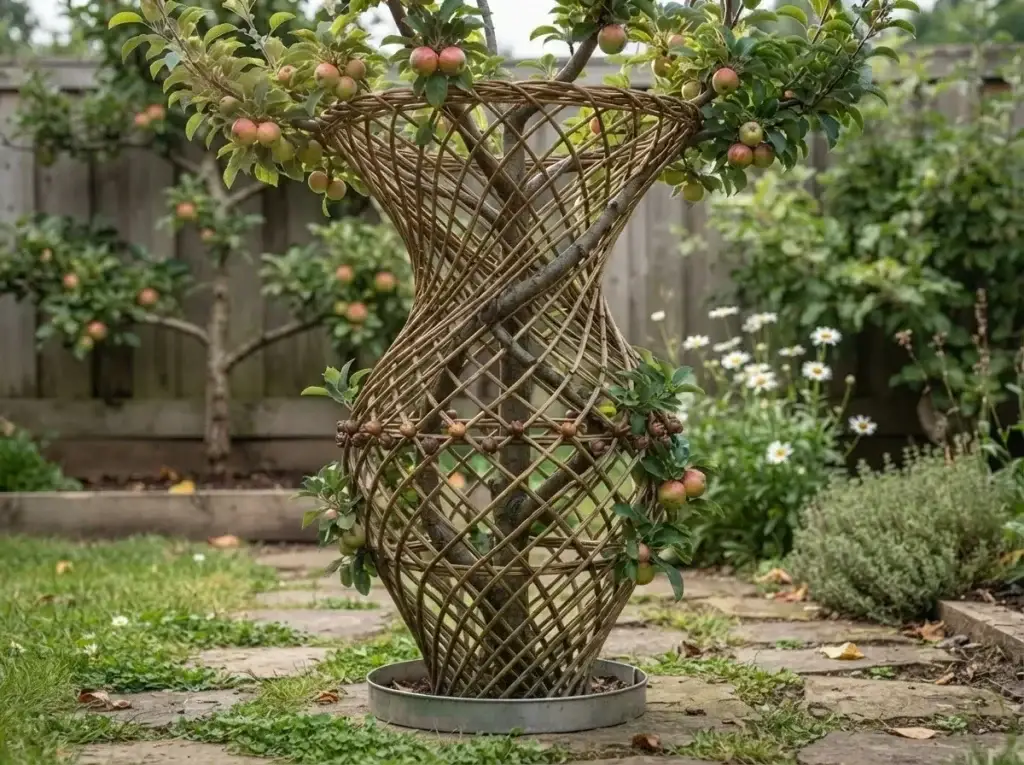
Open center apple tree pruning is a training method that eliminates the central vertical stem, called the leader, to encourage the tree to grow outward rather than upward. The result is a broad, vase-shaped canopy with 3 to 4 main scaffold branches rising from a short trunk at wide angles. Sunlight can reach the interior of the tree throughout the growing season, and air moves more freely through the canopy.
This method is more commonly associated with peaches, nectarines, and plums. Even so, it’s a recognized option for apples as well: University of Arizona Cooperative Extension notes that home growers often choose to prune apple trees to an open center specifically because it keeps the tree shorter and makes thinning fruit and harvesting easier. For home growers who do not need the maximum yield of a commercial central leader system, the open center approach is a practical, manageable choice.
When to Prune an Open Center Apple Tree
The ideal window for open center apple tree pruning is late winter to early spring, after the coldest weather has passed but before buds break and growth begins. University of Minnesota Extension recommends this same general timing for apple trees: prune every year in late winter or early spring, once the coldest weather has passed and before growth begins. Pruning during hard-freeze conditions is generally avoided, since freshly cut wood can be more vulnerable to cold injury.
Exact timing varies by USDA zone and local weather patterns, and USDA zones describe average winter minimum temperatures rather than a full climate picture. In warmer regions, pruning often starts earlier in late winter; in colder regions, growers typically wait further into early spring until the hardest freezes have passed. Because frost timing shifts from year to year, your local Cooperative Extension office is the most reliable source for the safest pruning window in your specific area.
Timing for Young Trees vs. Established Trees
For young trees (year one or two), the most important open center pruning decision happens at or shortly after planting: removing the central leader to set the vase form from the start. As a general starting point, the leader is typically cut around 24 to 30 inches above the soil line to establish a comfortable branching height, then adjusted based on the tree’s natural growth and the grower’s own reach for future harvest and maintenance. This early cut shapes the tree’s future structure, so it’s worth getting right rather than delaying.
For established trees already carrying fruit, open center pruning shifts to annual maintenance. The focus becomes removing water sprouts from the interior, eliminating crossing or inwardly growing branches, and thinning dense wood to maintain light access. The scale of annual cuts on a mature tree is typically far smaller than the initial training cuts made in the first two years.
6 Steps to Prune an Apple Tree to Open Center Form
Following a consistent sequence makes open center pruning faster and reduces the risk of removing too much wood at once. The steps below follow University Extension guidance for training and maintaining open center fruit trees, adapted for both young and established backyard apple trees.
- Remove the central leader (year one or two). At planting or in the first dormant season, cut the main upright stem to roughly 24 to 30 inches above the soil line as a starting point. This single cut initiates the open center form and should not be delayed much beyond the tree’s first year or two.
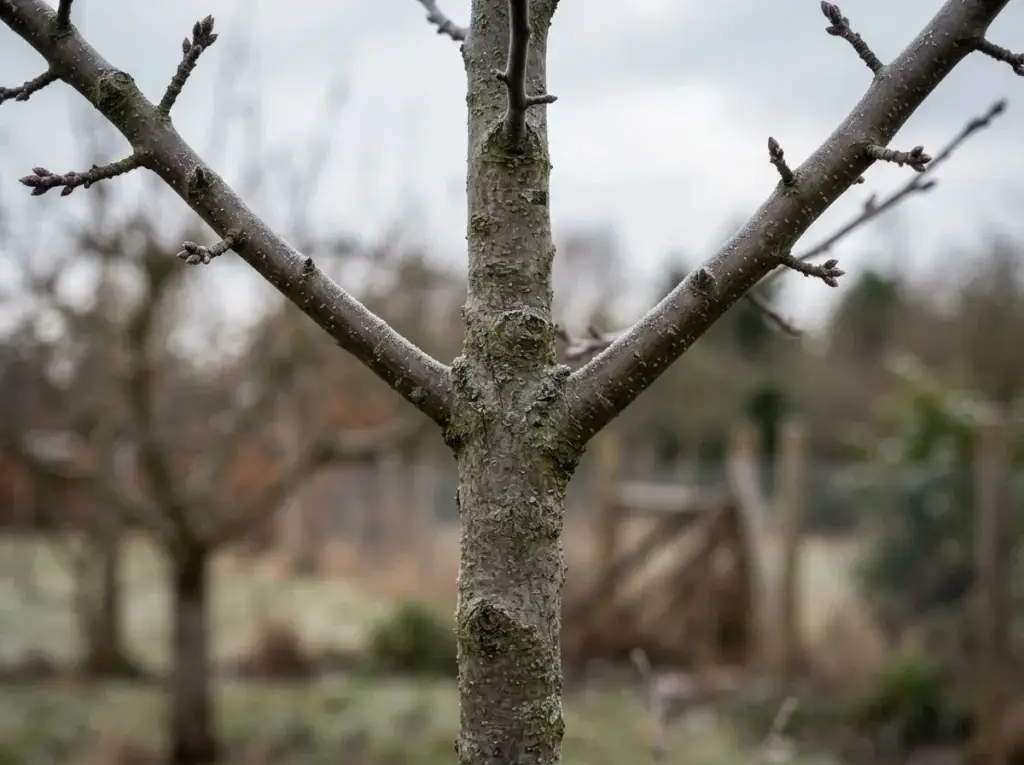
- Select 3 to 4 scaffold branches. Choose branches with wide crotch angles spaced evenly around the trunk, with at least 8 inches of vertical separation between them on the trunk. Remove competing branches at their base. Wide-angle crotches tend to be stronger and less prone to splitting under fruit load.
- Remove downward-growing and inwardly growing branches. Any branch angling toward the center of the canopy or growing downward reduces airflow and blocks light from reaching fruit-bearing spurs. Remove these at the branch collar, leaving no stub.
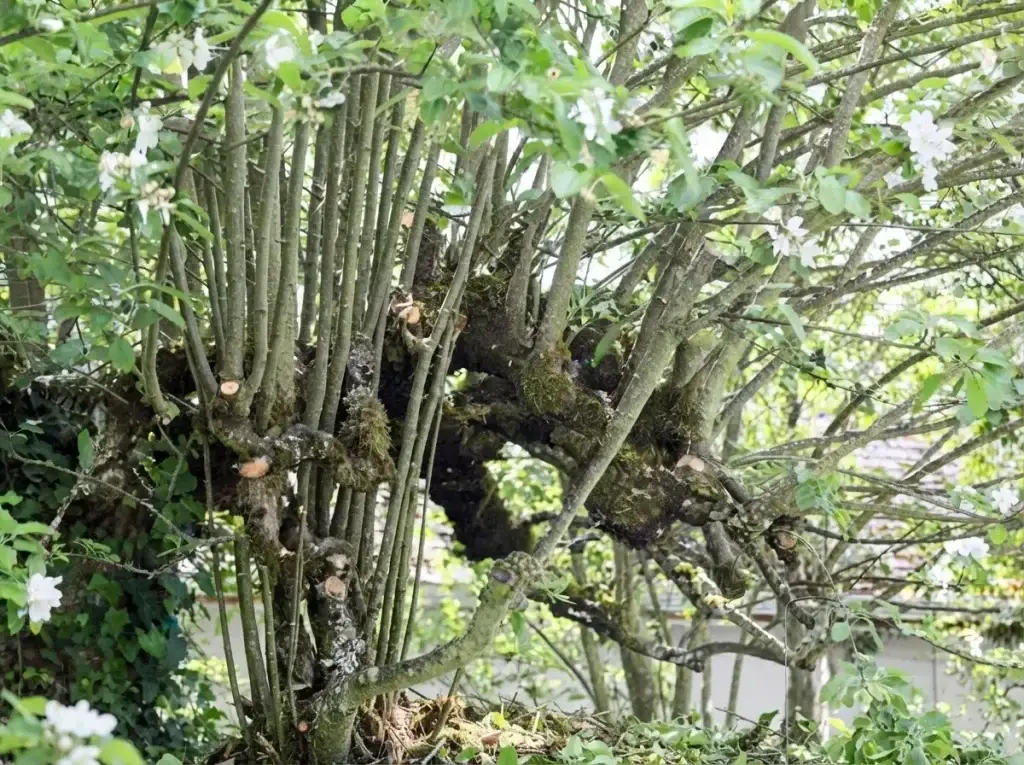
- Cut out water sprouts. Water sprouts are vigorous, nearly vertical shoots that emerge from the interior of the canopy or from old pruning sites. They grow rapidly, shade the center, and produce little fruit. Remove them flush with the branch they arise from during both dormant and summer pruning.
- Eliminate crossing and competing wood. Where two branches rub or compete for the same space, remove the weaker or more awkwardly angled of the two. Crossing branches create wounds through friction and restrict airflow in exactly the interior zone that open center form is designed to keep clear.
- Limit total removal to one-third of live wood. As a widely followed guideline across pruning systems, avoid removing more than one-third of the living canopy in any single season. For heavily neglected trees that need major renovation, spread the corrective work over two to three seasons. Removing too much at once can trigger heavy water sprout regrowth and stress the tree.
Scaffold Branch Selection: What to Look For
The quality of the scaffold branches chosen in years one through three determines the long-term structure of the open center tree, so scaffold selection deserves careful attention rather than a quick decision made under time pressure.
Extension guidance points to a similar sweet spot from two directions: Oregon State University Extension identifies 45 to 60 degrees as the strongest crotch angle range, while University of Minnesota Extension recommends training branches toward roughly 60 degrees from the main stem, noting that wider angles slow vegetative growth and encourage fruiting. Narrower angles create structurally weak unions that are prone to splitting. Space the 3 to 4 scaffolds radially around the trunk so no two compete directly above each other, with at least 8 inches of vertical separation between scaffold attachment points.
Thinning Cuts vs. Heading Cuts: Which to Use
Understanding the difference between these two cut types is fundamental to shaping and maintaining an open center tree. Applying the wrong type of cut in the wrong situation creates unnecessary problems with regrowth and form.
| Cut Type | What It Does | When to Use It | Effect on Growth |
|---|---|---|---|
| Thinning Cut | Removes an entire branch at its point of origin | Removing water sprouts, crossing branches, inward growth | Minimal regrowth response; opens canopy cleanly |
| Heading Cut | Removes only the tip or a portion of a branch | Shortening a scaffold; encouraging branching below a cut | Stimulates multiple new shoots below the cut |
According to University of Minnesota Extension, thinning cuts are usually the recommended type in most pruning situations because they open up the canopy without triggering excessive new growth. Heading cuts are appropriate when a scaffold branch needs to be shortened or when new branching is needed below a specific point. In open center maintenance pruning, most cuts will be thinning cuts removing water sprouts and unwanted interior wood.
Common Mistakes When Pruning to an Open Center
Several predictable errors show up repeatedly when growers new to open center form start making cuts. Being aware of these before picking up the pruning shears can prevent problems that take years to correct.
- Choosing scaffold branches with narrow crotch angles. A narrow V-shaped crotch looks sturdy but creates a structurally weak union that can split under fruit load as the tree matures. Favor wide-angled branches during scaffold selection, even if it means fewer ideal candidates.
- Removing too much wood in a single season. Over-pruning can trigger a flood of water sprouts the following summer, filling the interior that was just opened up. Removing one-third or less each year maintains steady progress without triggering this counterproductive response.
- Skipping the initial leader removal. Delaying removal of the central leader much beyond the tree’s first year or two makes the job harder and results in a tree that naturally wants to maintain upright central leader form. Removing a large central leader from a mature tree tends to cause heavier regrowth and more temporary canopy disruption than removing it early.
- Neglecting summer water sprout removal. Open center form requires annual vigilance. Water sprouts that fill the center through summer undo the benefits of dormant-season pruning and are best removed by midsummer before they harden into woody growth.
- Pruning during or after disease outbreaks without tool sanitation. Fire blight bacteria move readily on pruning tools. When cutting through any diseased wood, disinfect tools between cuts using a 10% bleach solution or 70% isopropyl alcohol. This matters most when fire blight is active in the orchard.
Open Center vs. Central Leader: Which Is Right for Your Backyard Tree?
Both systems produce healthy, productive apple trees when executed correctly. The right choice for a backyard grower depends on space, ladder access, rootstock, and personal preference for tree height.
| Factor | Open Center (Vase) | Central Leader |
|---|---|---|
| Tree height | Generally shorter, though actual height depends heavily on rootstock | Generally taller, though actual height depends heavily on rootstock |
| Harvesting ease | Often easier: fruit tends to be accessible without a tall ladder | Moderate: upper fruit often requires a ladder |
| Light penetration | Generally strong through the open center | Good when maintained annually |
| Airflow and disease pressure | Open canopy can improve airflow and lower fungal disease pressure | Good when the canopy is not crowded |
| Structural strength | Strong when wide-angle scaffolds are selected | Very strong: central trunk provides primary support |
| Best use case | Dwarf and semi-dwarf trees; backyard growers | Standard and semi-dwarf trees; larger orchards |
Extension Guidance Summary
University of Minnesota Extension frames the general principle behind all fruit tree pruning this way: aim for well-spaced branches and a balanced canopy while removing broken, diseased, or dead wood, and do this work every year in late winter or early spring, after the coldest weather has passed and before growth begins.
FAQs
How many scaffold branches should an open center apple tree have?
Open center apple trees typically carry 3 to 4 primary scaffold branches. Fewer than 3 concentrates fruit load on too few limbs. More than 4 tends to create crowding at the trunk base. Space these branches evenly around the trunk at wide angles to distribute weight and support light access across the canopy.
Can I convert an established central leader apple tree to open center form?
Conversion is possible, but it should happen gradually over several seasons rather than all at once. Removing a large, already-established central leader in a single cut tends to trigger a heavy flush of water sprouts and stresses the tree unnecessarily. A gradual approach that removes sections of the leader over more than one season, combined with thinning competing interior wood, is generally gentler on the tree. Because the right pace depends on the tree’s age, vigor, and condition, your local Cooperative Extension office can offer guidance suited to your specific tree.
Will open center pruning delay fruiting on my apple tree?
Heavy pruning in year one or two can redirect the tree’s energy into vegetative growth rather than fruiting, which may delay the first crop somewhat. That said, semi-dwarf apple trees generally begin fruiting within a few years of planting regardless of pruning system. Once open center form is established, the improved light penetration often supports better fruit color and size compared to a crowded, unpruned canopy.
Related Articles
- Apple Tree Pruning: Complete Season-by-Season Guide
- When to Prune Apple Trees: Best Timing by Season
- How to Prune Apple Trees: 7 Proven Steps for Beginners
- Apple Tree Not Fruiting After Pruning: 5 Proven Reasons Why
Sources
- University of Minnesota Extension — Pruning and Training Apple Trees
- Oregon State University Extension — Training and Pruning Your Home Orchard (PNW 400)
- University of Arizona Cooperative Extension (Yavapai County) — Deciduous Fruit Tree Pruning
Disclaimer: This article provides general pruning guidance based on university extension research. Pruning requirements vary by variety, rootstock, tree age, and regional climate. When in doubt, consult a certified arborist or your local cooperative extension service.
