
7 Proven Apple Tree Fertilizer Tips: When & How to Feed Your Tree
Apple tree fertilizer is one of the most misunderstood inputs in backyard orcharding. The right apple tree fertilizer, applied at the right time and in the correct amount, supports healthy shoot growth, stronger fruit set, and better long-term tree health. Most home growers either over-fertilize or fertilize at the wrong time, and both mistakes reduce fruit production.
Table of Contents
Key Takeaways
- Assess apple tree fertilizer need using annual shoot growth, soil-test results, and overall tree health rather than a fixed calendar schedule.
- Nitrogen is the primary nutrient apple trees require; phosphorus and potassium are secondary and usually addressed through a soil-test-guided complete fertilizer.
- Apply fertilizer in early spring before bud break, and stop by early summer to avoid pushing vulnerable late-season growth.
- Never fertilize apple trees in the planting hole during year one, as root burn is a serious risk.
- Over-fertilizing drives leafy growth at the expense of fruit, if shoot growth is already adequate, additional nitrogen may be unnecessary. Address other nutrients when testing indicates a need.
Most apple tree owners fertilize on habit rather than need. They buy a bag in March, scatter it under the tree, and repeat the same process each year regardless of how the tree actually performed. University extension research consistently shows this approach causes as many problems as it solves.
Additionally, apple trees are not heavy feeders compared to vegetables or fast-growing ornamental shrubs. Over-application of nitrogen is one of the most common and damaging errors in home orchard management. This guide walks through exactly how to assess what your tree needs, when to apply it, and how to avoid the mistakes that cost growers fruit year after year.
Does Your Apple Tree Actually Need Fertilizer?
Before purchasing any apple tree fertilizer, measure last season’s shoot growth. According to Utah State University Extension, young non-bearing apple trees should produce 12 to 18 inches of new shoot growth per year. Established, bearing trees should produce 8 to 12 inches. These are general reference ranges, not universal targets: some dwarf trees can grow less and remain healthy. If growth and tree health are satisfactory, additional nitrogen may be unnecessary. A soil test helps assess pH, phosphorus, and potassium.
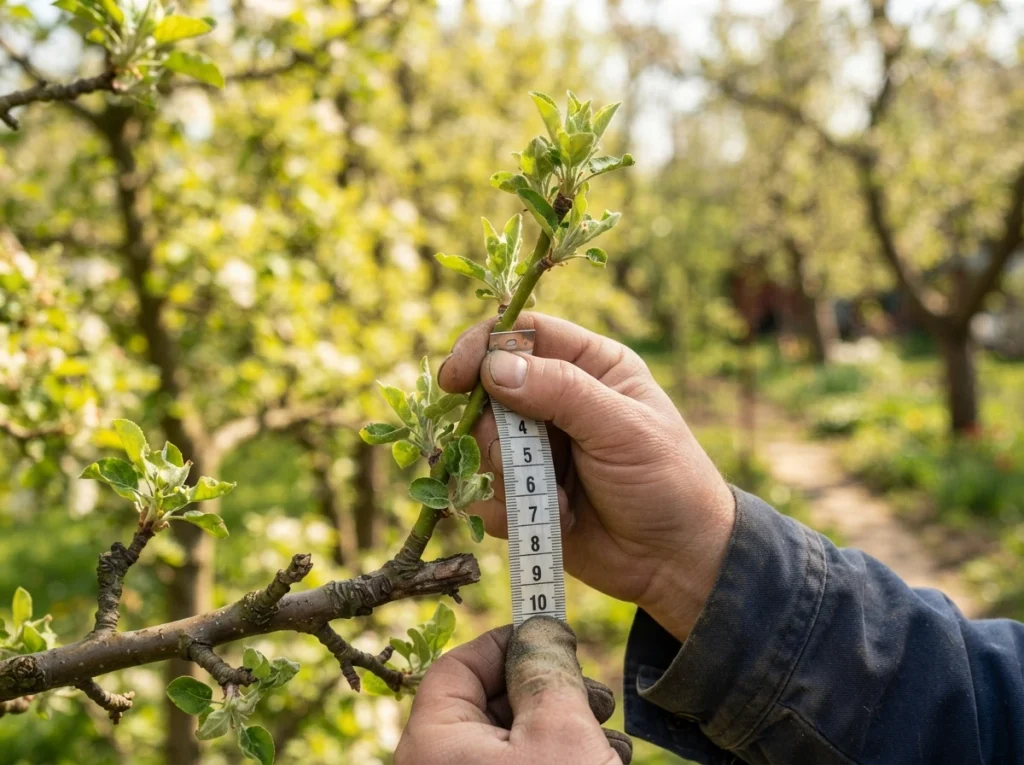
If shoot growth falls below the expected range, investigate the cause before adding nitrogen. Small, pale green leaves can accompany nitrogen deficiency, but water stress, poor drainage, root problems, and unsuitable soil pH can also affect growth or nutrient uptake. Review these conditions alongside soil-test results; persistent symptoms may justify leaf analysis with extension guidance. In contrast, very large, very dark green leaves with minimal fruit production usually signal that the tree is already receiving excess nitrogen from the soil or surrounding lawn applications.
Apple trees planted in lawns frequently receive adequate or excessive nitrogen through regular lawn fertilizer programs. Therefore, these trees should be assessed carefully before any additional apple tree fertilizer is applied. Trees established in rich garden soil or beds that receive annual compost may also not require commercial fertilizer at all.
Understanding Apple Tree Fertilizer: Nutrients and NPK Ratios
Every bag of commercial fertilizer carries three numbers in N-P-K order: nitrogen, phosphorus, and potassium. For apple tree fertilizer, nitrogen is the nutrient that most directly drives shoot growth, leaf color, and overall tree vigor. Phosphorus supports root development and early establishment. Potassium contributes to fruit quality and disease tolerance.
For established apple trees on a suitable site, nitrogen is often the main nutrient considered for supplementation, but an annual application is not automatically necessary. Assess growth, tree health, and existing nutrient inputs first. Michigan State University Extension recommends applying nitrogen between budbreak and petal fall for most soil types, as this timing aligns with peak tree demand. Phosphorus and potassium are generally added only when a soil test confirms a deficiency.
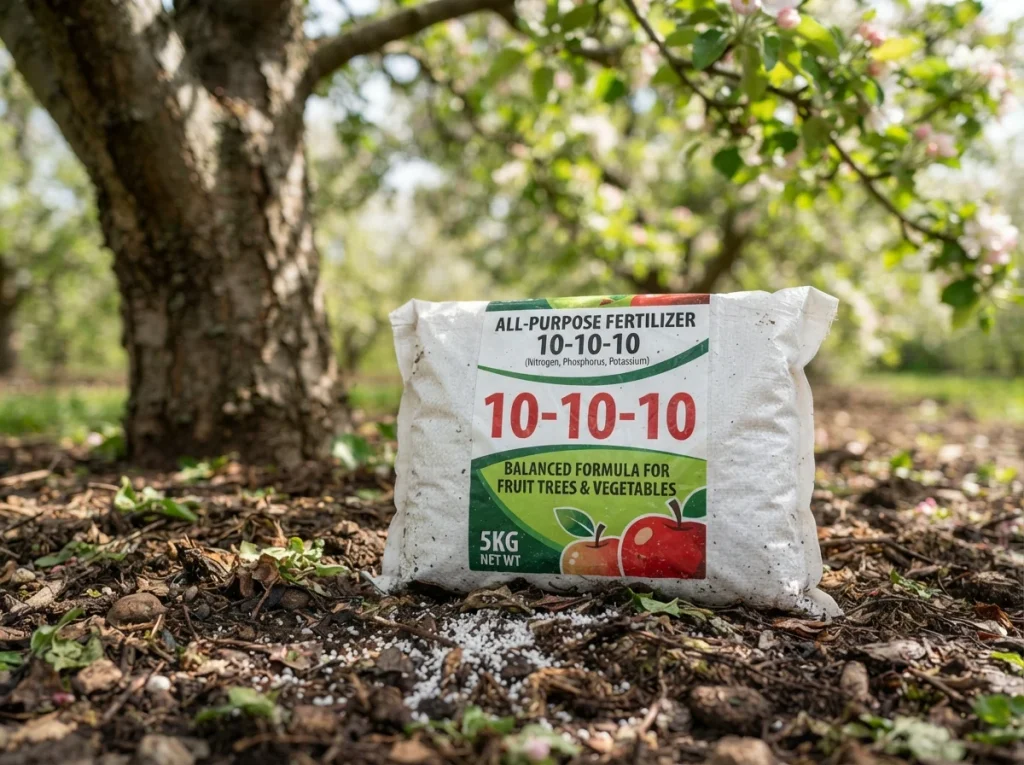
A complete fertilizer such as 10-10-10 supplies phosphorus and potassium as well as nitrogen, so it is not automatically a safer choice without a soil test. Choose a formula that matches soil-test recommendations and the tree’s assessed needs. However, the most accurate apple tree fertilizer program always begins with a soil test from your local cooperative extension service. For information on finding the right product, see our guide to the best fertilizer for apple trees.
Nitrogen and Apple Tree Shoot Growth
Nitrogen supports apple tree shoot growth, and growth measurements are a useful field indicator of fertilizer need. When supplemental nitrogen is needed, USU Extension’s regional age-based rule of thumb is one ounce of actual nitrogen per year of tree age, up to 8 ounces per tree per year. Under that guideline, 4 ounces for a 4-year-old tree is a calculation example, not a recommendation for every tree of that age.
To calculate actual nitrogen from a bag of fertilizer, multiply the required actual nitrogen by the inverse of the nitrogen percentage. For example, to deliver 4 ounces of actual nitrogen using ammonium sulfate (21% N), divide 4 by 0.21, which gives approximately 19 ounces of product. Always base application on actual nitrogen content, not total fertilizer weight.
Leaf color can support the assessment, but small, light green leaves do not confirm nitrogen deficiency on their own. Check watering, drainage, soil pH, and root health before increasing fertilizer. Conversely, very large, very dark green leaves with little fruit set typically indicate the tree is already receiving excess nitrogen from the soil or surrounding lawn applications.
Phosphorus and Potassium: Secondary but Still Important
Phosphorus and potassium are required by apple trees but are rarely deficient in established home orchard soils. A soil test from your local university extension service or certified laboratory will identify whether either nutrient falls below optimal levels. If phosphorus and potassium levels are adequate or high, adding more provides no benefit. Choose a complete N-P-K apple tree fertilizer when its nutrients match the soil-test recommendations.
Cornell Cooperative Extension research notes that potassium demand in apple trees peaks from bloom through harvest, as fruit accounts for more than two-thirds of the tree’s total potassium requirement. Therefore, trees carrying heavy crops may benefit from potassium supplementation, particularly on sandy soils prone to leaching. Understanding your apple tree soil requirements is the foundation for any effective fertilizer program.
When to Apply Apple Tree Fertilizer: A Season-by-Season Guide
Timing is as important as the type of apple tree fertilizer used. The optimal application window is early spring, before bud break or during the first flush of growth, after the coldest weather has passed. Michigan State University Extension recommends fertilizing fruit trees between April and mid-May before bud break for most northern US growing regions.
However, late-summer and fall applications of nitrogen are strongly discouraged by all major extension programs. Nitrogen applied after July pushes new, succulent growth that has insufficient time to harden before winter. This tender growth is highly vulnerable to winter injury, frost damage, and fire blight infection. As a result, experienced extension advisors consistently recommend stopping nitrogen applications by early summer at the latest.
For growers in warmer climates in Zones 7 through 9, the fertilizer window may open earlier in late winter. In cooler zones such as Zones 3 through 5, waiting until after the last hard freeze and confirmed bud swell is the safest approach. Always apply fertilizer when soil moisture is adequate so nutrients can move into the root zone effectively. If you need precise seasonal timing, see our full guide on when to fertilize apple trees.
| Season / Stage | Fertilizer Action | Reason |
|---|---|---|
| Early Spring (pre-bud break) | Apply full nitrogen dose | Aligns with peak shoot and leaf demand |
| Mid-Spring (petal fall) | Apply only if needed (foliar urea) | Supports fruit cell division and shoot growth |
| Late Spring to Early Summer | Final cutoff: no more nitrogen after July | Prevents tender late growth before dormancy |
| Late Summer / Fall | No nitrogen fertilizer | New growth will not harden before frost |
| Winter | No fertilizer | Tree is dormant; nutrients are not absorbed |
How to Fertilize Apple Trees: 7 Proven Steps
The following apple tree fertilizer process is based on guidance from university cooperative extension programs and is appropriate for home orchardists managing one to several trees. Each step builds on the previous one, so following the full sequence delivers the best results.
Step 1: Start With a Soil Test
A soil test is the most important first step in any apple tree fertilizer program. MSU Extension recommends soil testing once every three years for established orchards. Your local cooperative extension office can provide test kits, and most results include fertilizer recommendations specific to your soil’s existing nutrient levels and pH.
The target soil pH for apple trees is 6.0 to 6.5. Outside this range, nutrient uptake is impaired even when adequate apple tree fertilizer is present. A lime application to raise pH or a sulfur application to lower it may therefore be the most important correction you can make before any nitrogen program begins. A soil pH test kit for fruit trees can help you monitor this at home between full soil tests.
Step 2: Calculate the Right Amount
Once the need for supplemental nitrogen has been established, USU Extension’s backyard fruit-tree advisory offers an age-based rule of thumb: one ounce of actual nitrogen per year of tree age, up to 8 ounces per tree per year. This is a regional guideline, not a dose every apple tree must receive. Follow product-label directions and local recommendations that account for rootstock, tree size, growth, and nitrogen already supplied by compost or lawn fertilizer.
To calculate apple tree fertilizer product weight from actual nitrogen need: divide the actual nitrogen required by the nitrogen percentage in your product. For example, to apply 4 ounces of actual nitrogen using ammonium sulfate (21% N), divide 4 by 0.21, which equals approximately 19 ounces of product. Always base calculations on the first number of the N-P-K guaranteed analysis printed on the bag.
Step 3: Choose Granular or Liquid
Granular apple tree fertilizers are the most cost-effective option for home orchardists and are widely recommended by extension sources. After application, rain or irrigation within one to two days is needed to move nutrients into the root zone. Liquid fertilizers and foliar sprays are an option for addressing mid-season deficiencies but are not required for routine annual programs.
Step 4: Broadcast at the Drip Line
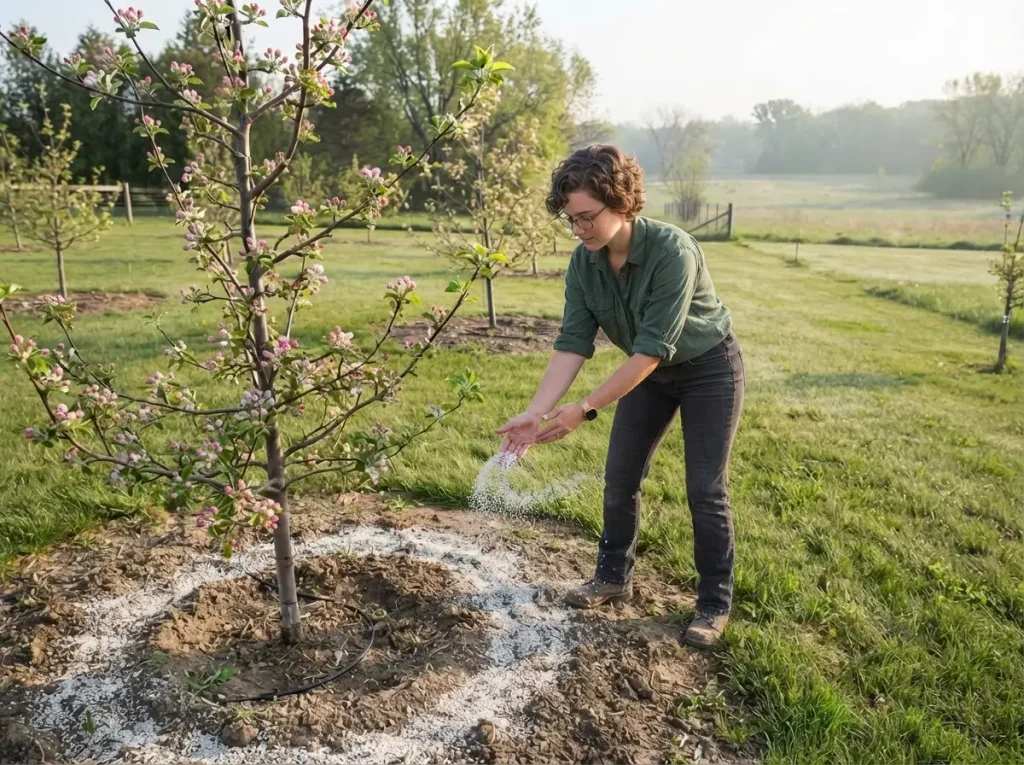
Granular fertilizer should be broadcast in a ring around the tree, starting approximately 3 feet from the trunk and extending to the outer edge of the branch canopy, known as the drip line. Most active feeder roots are located in this zone. Avoid direct application against the trunk, as this can encourage fungal growth and bark damage.
If grass is growing under the apple tree, MSU Extension recommends increasing the fertilizer application by 10 to 15 percent. Turf competition reduces the amount of nitrogen reaching the tree’s root system, so that additional amount compensates for what the grass intercepts.
Step 5: Water In After Application
Water thoroughly after applying granular fertilizer if no rain is expected within 48 hours. Apple tree fertilizer that sits on dry soil without moisture to dissolve and carry it downward provides little benefit and may be lost to volatilization or runoff. For young trees especially, adequate soil moisture at the time of application is essential for safe and effective nutrient uptake.
Step 6: Track Shoot Growth the Following Season
After applying apple tree fertilizer in spring, measure shoot growth at the end of the growing season. The benchmarks from USU Extension (12 to 18 inches for young trees and 8 to 12 inches for bearing trees) serve as your primary feedback signal. If growth is within range, your fertilizer program is working correctly.
If growth remains below the expected range, reassess watering, drainage, root health, crop load, and nutrient status before increasing nitrogen the following spring. Record the amount applied and the resulting shoot growth each year. This simple tracking approach replaces guesswork with a repeatable, evidence-based system.
Step 7: Adjust or Stop Based on Results
If shoot growth exceeds the upper benchmark for your tree’s age and stage, reduce or eliminate the nitrogen application the following year. Excess vegetative growth competes directly with fruit bud formation and reduces yield. The goal of apple tree fertilizer management is not maximum growth: it is consistent, moderate growth that supports reliable annual fruiting.
Young Trees vs. Established Trees: Different Fertilizer Needs
Fertilizer requirements change significantly as an apple tree ages. For newly planted trees in year one, no apple tree fertilizer should be applied in the planting hole or immediately after planting. Root burn from direct fertilizer contact with young roots is a serious risk and can kill newly planted trees. Allow the tree to establish over the first growing season without commercial fertilizer supplementation.
From year two onward, young non-bearing trees benefit from modest apple tree fertilizer applications to support shoot development and scaffold branch formation. The focus during this phase is building structure, not fruit production. Therefore, a conservative nitrogen-only application at the lower end of the extension-recommended range is appropriate for years two through three.
Once trees begin bearing fruit, typically in years 4 through 8 depending on rootstock and variety, the apple tree fertilizer program shifts toward maintenance. Bearing trees prioritize fruit quality over vegetative growth. Consequently, nitrogen applications should be reduced or withheld entirely in seasons when shoot growth is already meeting the 8 to 12 inch annual target.
Organic vs. Synthetic Apple Tree Fertilizer: What Extension Research Says
Both organic and synthetic apple tree fertilizer sources can supply the nitrogen, phosphorus, and potassium an apple tree needs. The key difference lies in release rate and predictability. Organic options such as compost, fish emulsion, and blood meal release nutrients slowly as soil microbes break down organic matter. Synthetic fertilizers release nutrients quickly in predictable, measurable amounts.
For home orchardists who want to minimize synthetic inputs, an annual 2 to 3 inch layer of compost applied around the drip line in spring provides slow-release nitrogen and improves soil biology. However, it is difficult to precisely control nitrogen delivery through compost alone, so shoot growth monitoring remains the essential apple tree fertilizer feedback tool. For product-specific guidance, our guide to organic fertilizer for apple trees covers the most effective options.
“If your trees are producing 12 to 18 inches of new growth each year, whatever fertilizer they are getting is sufficient. If less, the trees will benefit from additional fertilizer.” (Utah State University Extension)
| Type | Examples | N Release Speed | Best For | Key Limitation |
|---|---|---|---|---|
| Synthetic granular | Ammonium sulfate (21-0-0), 10-10-10 | Fast, within days of watering | Precise, measurable N delivery | Risk of over-application; no soil biology benefit |
| Liquid / soluble | Urea foliar spray, liquid N | Very fast, within 24 to 48 hours | Mid-season correction, foliar feeding | Short residual effect; requires repeat applications |
| Compost | Finished compost, aged manure | Slow, over weeks to months | Improving soil structure and biology | N content is variable; hard to measure precisely |
| Organic dry | Blood meal (~12% N), fish meal | Medium, releases over 4 to 8 weeks | Organic orchards needing boosted N | Higher cost per unit of actual nitrogen |
| Slow-release synthetic | Coated urea, IBDU formulas | Slow, controlled over 90 to 180 days | Single application that feeds gradually | Less responsive to real-time growth feedback |
5 Common Apple Tree Fertilizer Mistakes to Avoid
Even experienced growers make avoidable fertilizer errors. The following five mistakes account for the majority of apple tree fertilizer problems in home orchards, based on recurring patterns documented in university extension advisory resources.
- Fertilizing in fall or late summer. Nitrogen from apple tree fertilizer applied after July drives new, tender growth that has no time to harden before winter. This growth is highly susceptible to frost damage and fire blight infection. Stop all nitrogen applications by early summer without exception.
- Over-applying nitrogen. Excess nitrogen causes the tree to produce abundant vegetative growth at the direct expense of fruit bud formation. If your apple tree is producing fewer apples than expected but has vigorous leafy growth, over-fertilization is a likely contributor.
- Using lawn weed-and-feed products near apple trees. These products contain herbicides that can be absorbed by apple tree roots through soil movement. MSU Extension specifically warns against this practice, as the herbicide component can injure or kill fruit trees even when applied to nearby turf.
- Skipping the soil test. Without a soil test, it is impossible to know whether your soil pH, phosphorus, or potassium levels need correction. A soil test from your university extension lab costs $15 to $30 and provides specific, actionable recommendations that no general fertilizer guide can match.
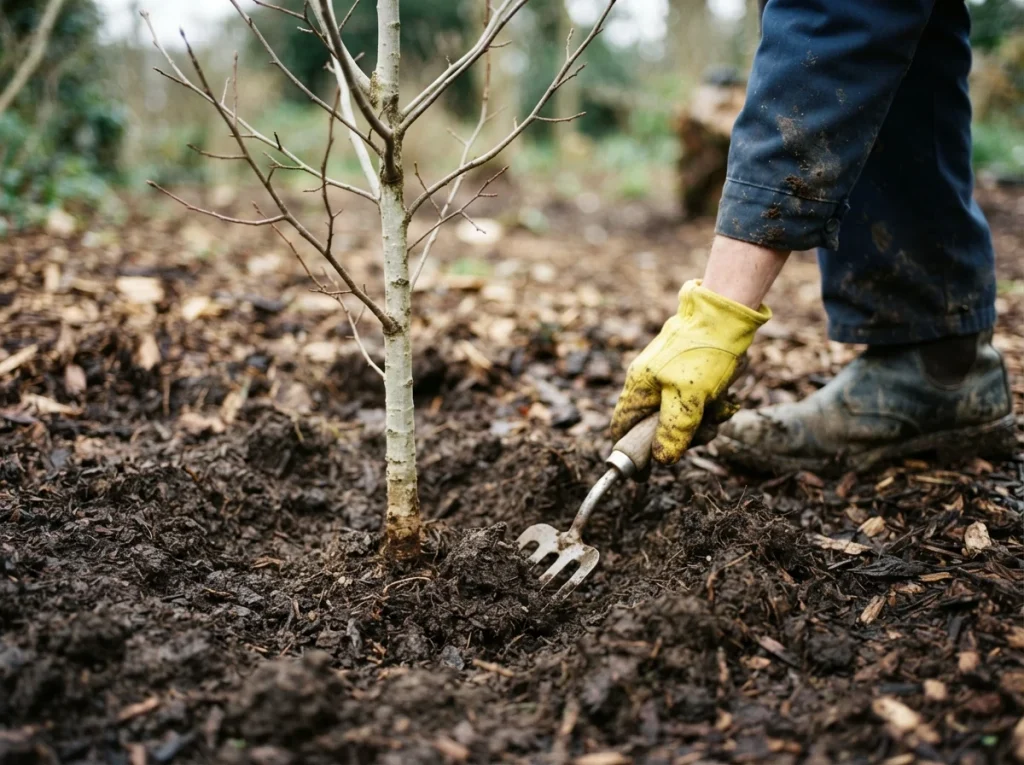
- Fertilizing in the planting hole at year one. Freshly planted apple trees have limited root systems that are highly sensitive to direct fertilizer contact. Adding fertilizer to the planting hole or broadcasting immediately after planting risks burning roots before they have established. Wait until year two for the first fertilizer application.
Proper soil amendment around the tree’s base also supports fertilizer uptake. For details on how mulch improves moisture retention and reduces nutrient competition, see our guide to apple tree mulching.
When to Call a Professional or Contact Extension
If your apple tree shows persistent yellowing, unusual leaf drop, bark discoloration, or declining shoot growth despite appropriate apple tree fertilizer applications, those symptoms may indicate a disease, pest, or soil chemistry problem that fertilizer cannot address. Apple tree diseases such as fire blight, crown rot, and root rot can mimic nutrient deficiency symptoms closely.
In these situations, contact your local university cooperative extension plant diagnostic clinic for a confirmed assessment. Most extension offices offer plant diagnostic services and can identify whether the underlying issue is nutritional, pathological, or environmental. A certified arborist can also assess tree structure and health for growers managing larger or older trees.
FAQs
What is the best fertilizer for apple trees: balanced 10-10-10 or nitrogen-only?
When supplemental nitrogen is needed and a soil test shows adequate phosphorus and potassium, a nitrogen-only formula may be appropriate. A balanced 10-10-10 apple tree fertilizer is useful when its nutrients match the soil-test recommendations; it is not a safer default without testing. Slow shoot growth alone does not identify which nutrient is deficient. See our full product comparison in the best fertilizer for apple trees guide.
When should I stop fertilizing my apple trees in the fall?
University extension research consistently recommends stopping all nitrogen fertilizer applications by early summer, and no later than July in most USDA hardiness zones. Fertilizing apple trees after this point stimulates new growth that cannot harden before frost, increasing the risk of winter injury and fire blight infection significantly.
Why are my apple tree leaves turning yellow: is it nitrogen deficiency?
Pale yellow or light green leaves, especially when combined with reduced shoot growth, are a common sign of nitrogen deficiency in apple trees. However, yellow leaves can also result from waterlogged soil, root disease, or incorrect soil pH limiting nutrient uptake. A soil test and a review of drainage conditions should be conducted before adding more fertilizer.
Can I use lawn fertilizer on my apple trees?
Standard lawn fertilizer containing only nitrogen, phosphorus, and potassium can technically provide nitrogen to apple trees. However, “weed-and-feed” lawn products that include herbicides must never be applied near apple trees. The herbicide component can be absorbed by tree roots and cause serious injury. MSU Extension explicitly warns against this practice for all fruit trees.
How do I know how much fertilizer my apple tree actually needs each year?
Combine annual shoot-growth measurements with tree health, soil-test recommendations, and existing nutrient inputs. USU’s general reference ranges are 12 to 18 inches for young non-bearing trees and 8 to 12 inches for bearing trees, but some dwarf trees can grow less and remain healthy. Growth below a range is a reason to investigate, not an automatic instruction to add nitrogen. Local extension guidance and, where needed, leaf analysis can help determine an appropriate rate.
Related Articles
- Best Fertilizer for Apple Trees: Top Options Compared
- When to Fertilize Apple Trees: Month-by-Month Guide
- Organic Fertilizer for Apple Trees: 4 Best Options
- Apple Tree Soil Requirements: pH, Drainage & Prep
- Soil pH Test Kit for Fruit Trees: Best Options Compared
- Apple Tree Mulching: 5 Proven Benefits & How to Do It Right
Sources
- University of Minnesota Extension : Growing Apples in the Home Garden
- Michigan State University Extension : Spring Fertilization of Garden Fruits
- Utah State University Extension : Fertilizing Backyard Fruit Trees
- Cornell Cooperative Extension : Nutrient Management in Apple Orchards 2023
- University of Maryland Extension: Fruit Plant Care
- NC State Extension: Soil and Plant Analysis for Apple Trees
- Utah State University Extension: Apple Production and Variety Recommendations for the Utah Home Garden
Disclaimer: This article provides general growing guidance based on university extension research. Soil conditions, climate zone, and variety selection significantly affect results. Contact your local cooperative extension service for region-specific recommendations.
