
Apple Tree Varieties By Zone: Proven Practical Guide
Apple tree varieties by zone should be filtered first by winter hardiness, then by chill requirement, disease pressure, bloom timing, rootstock, and fruit use. A cultivar that survives your coldest winter may still crop poorly if winters are too mild, spring frost kills its flowers, or no compatible pollinizer blooms nearby.
Table of Contents
Key Takeaways
- Apple tree varieties by zone are a starting point, not a complete planting recommendation.
- Disease resistance, chill requirement, and overlapping bloom periods can matter as much as minimum winter temperature.
- The cultivar controls fruit traits, while the rootstock strongly affects tree size, anchorage, and adaptation.
Choosing from a nursery tag can look simple: find your USDA zone and buy a tree whose range includes it. However, that shortcut ignores why many healthy-looking apple trees flower weakly, lose crops to spring frost, or require more disease control than a home grower expected.
This guide compares apple tree varieties by zone as practical candidates rather than guarantees. Because local recommendations vary, use the list to create a shortlist, then confirm that shortlist with your county or state cooperative extension service before ordering.
How to Use Apple Tree Varieties by Zone Correctly
Zone is a winter-survival measure
The USDA Plant Hardiness Zone Map is based on average annual extreme minimum winter temperature. Therefore, it helps estimate whether a perennial can survive local cold, but it does not measure summer heat, humidity, rainfall, soil drainage, or the timing of spring freezes.
This is why apple tree varieties by zone must be treated as a climate screen rather than a ranked shopping list.
Zone boundaries are also broad. A protected urban yard and an exposed rural slope can share a zone while creating different conditions for bark injury, flower survival, and ripening.
For that reason, compare apple tree varieties by zone only after checking the conditions in the part of the yard where the tree will actually grow. Cold-air pockets, reflected heat, and poor drainage can all change performance.
Chill hours and late frost change the answer
Apple buds need enough cool weather during dormancy to resume normal growth. In warm-winter regions, a high-chill cultivar may leaf out or bloom irregularly, so low-chill cultivars such as Anna and Dorsett Golden are usually more logical starting points.
Conversely, survival in a cold zone does not guarantee a crop. A warm spell followed by frost can damage open flowers, which is why a later-blooming choice or a less frost-prone planting site may outperform a cultivar selected only for winter hardiness.
Quick Comparison of 12 Apple Varieties
The ranges below are screening ranges commonly used in home-orchard guidance, not universal promises. Nursery stock, rootstock, microclimate, and regional disease pressure can shift the practical result, so verify every candidate locally.
| Variety | Practical zone range | Disease profile | Fruit and use | Main caution |
|---|---|---|---|---|
| Liberty | 4 to 8 | Strong resistance to apple scab, with useful resistance to several other major diseases | Crisp, balanced dessert and cooking apple | Confirm a compatible pollinizer |
| Freedom | 4 to 8 | Selected for broad disease resistance | Juicy, multipurpose fruit | Fruit quality and availability vary by region |
| Enterprise | 4 to 8 | Scab resistant, with additional resistance in several disease categories | Firm, tart-sweet, good storage potential | Late harvest may be difficult in short seasons |
| GoldRush | 5 to 8 | Scab resistant | Firm, rich, tart fruit that sweetens in storage | Very late ripening requires a long enough fall |
| Pristine | 4 to 8 | Scab resistant | Early yellow apple for fresh eating and cooking | Shorter storage life than late apples |
| Redfree | 4 to 8 | Scab resistant | Early red dessert apple | Best used relatively soon after harvest |
| Haralson | 3 to 7 | Cold-climate standard, but not a substitute for a disease-management plan | Firm and tart, especially useful for cooking | Flavor may be too tart for some fresh eaters |
| Honeycrisp | 3 to 7 | Cold hardy, but susceptible to several disorders and diseases | Very crisp, sweet-tart dessert fruit | Not a low-maintenance disease-resistant choice |
| Macoun | 4 to 7 | No broad resistance package | Aromatic, crisp dessert apple | Fruit can drop, and storage is limited |
| Arkansas Black | 5 to 8 | Regional performance varies | Dense, tart fruit that improves in storage | Needs enough season to mature well |
| Anna | 6 to 9 | Chosen mainly for low chill, not broad disease resistance | Early, mild, sweet-tart fruit | Needs a compatible low-chill partner |
| Dorsett Golden | 6 to 9 | Chosen mainly for low chill, not broad disease resistance | Sweet yellow apple for fresh use | Often paired with Anna for bloom overlap |
Apple Tree Varieties by Zone 3 to 5
For Zones 3 and 4, cold hardiness and timely ripening are the first filters. Haralson and Honeycrisp have proven northern value, while Liberty, Freedom, Pristine, and Redfree broaden the options as conditions moderate into Zone 4 or 5.
However, disease resistance is not the same as winter hardiness. Honeycrisp is popular and cold hardy, but growers should review Honeycrisp apple tree diseases before treating it as an easy-care option.
Best practical choices for cold gardens
Liberty is a strong first candidate where it is locally hardy because it combines useful fruit quality with resistance to apple scab and reduced susceptibility to other major diseases. In colder or shorter-season locations, an earlier apple such as Pristine or Redfree may mature more reliably than very late GoldRush.
When comparing apple tree varieties by zone for a northern garden, favor a cultivar with a harvest season already proven in your area. This helps separate simple winter survival from dependable fruit maturity.
Consequently, gardeners near the cold edge of a cultivar’s range should ask two separate questions: will the wood survive winter, and will the fruit ripen before damaging autumn cold? Local harvest dates answer the second question better than a national catalog.
Apple Tree Varieties by Zone 6 to 7
Zones 6 and 7 offer the broadest overlap in this list. Liberty, Enterprise, Freedom, GoldRush, Pristine, and Redfree provide disease-resistant possibilities, while Macoun and Arkansas Black serve growers who prioritize distinctive fruit character and accept more management.
Enterprise and GoldRush can extend the harvest and storage season. However, their later ripening makes site heat and fall length important, particularly in cool Zone 6 pockets or elevated locations.
A balanced two-tree planting
For a small home orchard, do not choose two names merely because both appear in the same zone. Their bloom periods must overlap, and the trees should be genetically different, compatible cultivars that can exchange pollen.
A disease-resistant early or midseason cultivar paired with a compatible later cultivar can spread harvest work and culinary use. Before buying, ask the nursery to identify bloom groups, rootstocks, and whether either selection is triploid, because triploid cultivars complicate pollination planning.
In other words, apple tree varieties by zone should be matched as a functioning pair, not selected as two independent products. Their bloom overlap is more important for pollination than their harvest dates.
Apple Tree Varieties by Zone 8 to 9
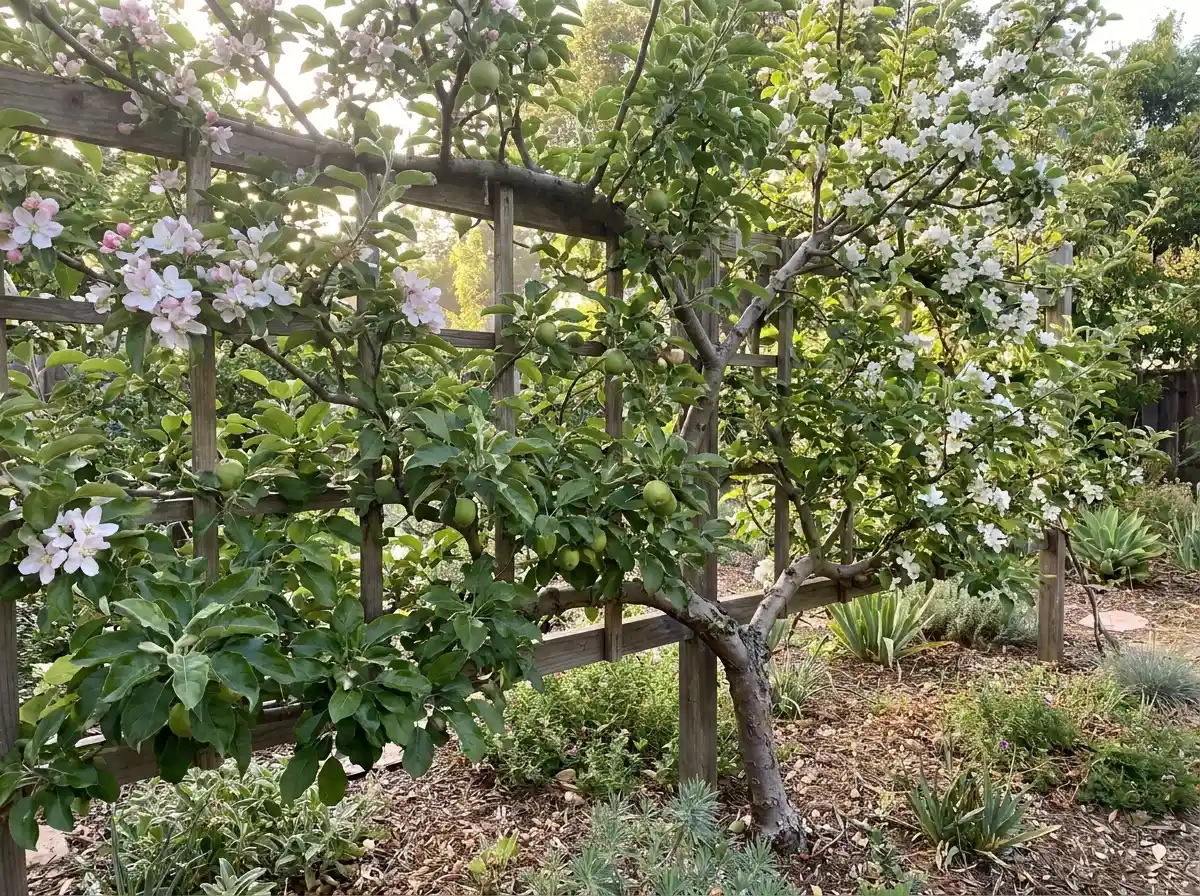
Warm-zone selection is less about surviving cold and more about receiving enough winter chill. Anna and Dorsett Golden are common low-chill candidates, and their bloom periods often overlap, but suitability still depends on measured local winter conditions.
For warm regions, apple tree varieties by zone become reliable only when the cultivar’s chill needs also match local winters.
Zone 8 includes climates with very different chill accumulation. Therefore, a disease-resistant cultivar such as Liberty or Enterprise may work in some Zone 8 regions, while a low-chill pair is safer in others.
Local chill data makes apple tree varieties by zone more useful in mild climates. If a seller cannot state the cultivar’s approximate chill requirement, ask your extension office whether that selection has fruited reliably nearby.
Humidity and disease pressure matter
Warm, humid sites may create sustained pressure from apple scab, fire blight, cedar apple rust, and other problems. Choosing from disease-resistant apple trees can reduce risk, although resistance never means immunity.
Additionally, nearby junipers can influence cedar apple rust pressure, and vigorous growth can be vulnerable to fire blight. A local extension office can identify the diseases that most often limit apples in your county.
Four Checks Before You Buy
1. Compare specific disease resistance
A label that says “disease resistant” is incomplete unless it names the disease. Compare resistance to scab, fire blight, cedar apple rust, and powdery mildew separately, then read our comparison of disease-resistant apple tree varieties.
Consequently, the best apple tree varieties by zone are those screened against the diseases that repeatedly occur in your region. A cultivar resistant to scab may still need attention for fire blight or rust.
2. Confirm pollination and bloom overlap
Most apples set better crops with pollen from a compatible cultivar flowering at the same time. A flowering crabapple can sometimes supply pollen, including a suitable selection such as Houck’s crabapple, but bloom overlap and local compatibility still need confirmation.
3. Select the rootstock separately
The named cultivar determines the apple, while the rootstock strongly influences mature size, bearing age, anchorage, soil adaptation, and support needs. Dwarf trees save space, but many require permanent staking or trellising and more consistent watering.
Therefore, the same Liberty scion on two rootstocks can create very different backyard trees. Ask for the exact rootstock code rather than accepting “dwarf” as a complete description.
4. Verify the shortlist locally
Use apple tree varieties by zone to narrow the field, then contact a cooperative extension educator, reputable regional nursery, or experienced local orchard. Ask about chill accumulation, common diseases, bloom dates, harvest dates, and whether the rootstock performs in your soil.
For a broader planning framework, compare our best apple trees for a home orchard. This final check prevents a nationally popular cultivar from outranking a less famous tree that is better adapted to your county.
FAQs
Is the USDA zone enough to choose an apple tree?
No. A list of apple tree varieties by zone estimates winter survival, but chill requirement, summer conditions, late frost, disease pressure, pollination, and rootstock also affect cropping. Use the zone as the first filter and local extension guidance as the final check.
Do I need two apple trees to get fruit?
In most cases, plan for two compatible cultivars with overlapping bloom periods. Some cultivars are described as partly self-fruitful, but a suitable pollen partner commonly improves reliability, and a nearby compatible crabapple may sometimes serve that role.
Which apple is easiest for a first-time grower?
No cultivar is easiest everywhere. Among apple tree varieties by zone, Liberty is often a useful starting candidate where adapted because of its disease-resistance package, but the best beginner tree is one confirmed for local climate, diseases, pollination, and soil.
Related Articles
- Disease-resistant apple trees
- Disease-resistant apple tree varieties
- Best apple trees for a home orchard
Sources
- University of Minnesota Extension: Growing apples in the home garden
- Utah State University Extension: Home orchard apple production
- Penn State Extension: Apple cultivar and scab resistance guidance
- USDA Agricultural Research Service: Apple cultivar disease susceptibility
Disclaimer: This article provides general growing guidance based on university extension research. Soil conditions, climate zone, and variety selection significantly affect results. Contact your local cooperative extension service for region-specific recommendations.
