
Apple Tree Diseases: 12 Proven Types, Identification and Treatment Guide
Apple tree diseases include fungal, bacterial, and virus-related problems that affect leaves, blossoms, shoots, bark, roots, and fruit. The safest way to respond is to identify the symptom pattern first, then combine sanitation, pruning, resistant varieties, canopy management, and carefully selected products when needed.
Table of Contents
Key Takeaways
- Apple tree diseases often share symptoms, so inspect the whole tree and consider weather, timing, and nearby host plants before treating.
- Apple scab, cedar-apple rust, fire blight, fruit rots, powdery mildew, and cankers require different management decisions.
- Sanitation, open-canopy pruning, resistant varieties, and accurate monitoring reduce disease pressure before sprays are considered.
- Fungicides mainly protect healthy tissue. They usually do not restore leaves, fruit, or branches already damaged by disease.
- For serious dieback, trunk lesions, repeated diagnosis failures, or pesticide decisions, contact a certified arborist or local extension diagnostic clinic.
Apple tree diseases are frustrating because a spotted leaf or damaged apple rarely identifies the cause by itself. That is why apple tree diseases should be approached as a pattern-recognition problem. For example, leaf spots can result from scab, rust, blotch, nutrient stress, drought, or insect injury. Therefore, note which plant part was affected first, how symptoms changed, and whether the weather was wet, warm, dry, or stressful.
This apple tree diseases guide organizes the main problems found on backyard apples across the United States. It explains the causal organism or disorder, the symptoms on leaves, fruit, and bark, and the prevention-first measures supported by university extension guidance. It also separates protective treatment from corrective work, because a product cannot reverse dead tissue.
What causes apple tree diseases?
Many apple tree diseases are caused by fungi or fungus-like organisms. They spread through spores and become more likely when leaves, blossoms, or fruit remain wet. However, some of the most destructive disorders are bacterial, while others are caused by viruses, root damage, drought, winter injury, or an unsuitable site.
Fungal and fungus-like diseases
Apple scab, cedar-apple rust, black rot, white rot, bitter rot, powdery mildew, sooty blotch, flyspeck, and several leaf blotches are associated with fungi. Their management often depends on reducing overwintering inoculum, improving air movement, selecting resistant varieties, and protecting new tissue before infection occurs.
Bacterial diseases
Fire blight is caused by the bacterium Erwinia amylovora. It can enter through flowers, natural openings, or wounds and then move into shoots and branches. Because bacteria can spread on water, insects, hands, and tools, sanitation and prompt removal of infected tissue are especially important.
Environmental problems that resemble disease
Herbicide drift, drought, excess fertilizer, compacted soil, root injury, winter damage, and nutrient imbalance can produce yellowing, scorching, curling, or premature leaf drop. Consequently, a diagnosis based only on one photograph can be misleading. Check irrigation, soil drainage, recent applications, trunk injury, and root-zone conditions before assuming infection.
How to identify apple tree diseases before treating them
Inspect leaves, shoots, bark, fruit, and the whole tree
Begin with a wide view. Is the problem limited to one branch, one side of the canopy, or the entire tree? Next, inspect the underside of leaves, young shoots, branch unions, trunk bark, fruit cavities, and fallen leaves. Apple tree disease identification becomes more reliable when symptoms are recorded across several plant parts, especially when apple tree diseases are active in more than one season.
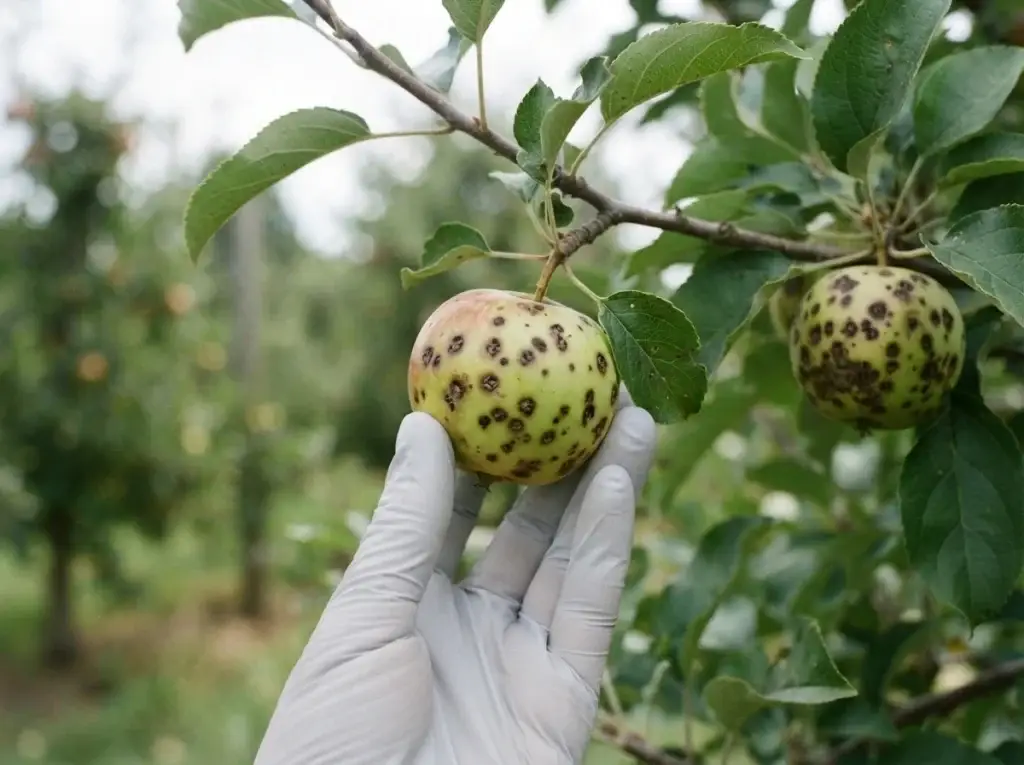
Look for olive, velvet-like leaf spots that expand and darken, bright orange spots with raised structures underneath, blackened hooked shoots, sunken cankers, white powder on young growth, or circular fruit lesions. Also note whether affected fruit is corky, shriveled, cracked, or covered with small black specks.
Match symptoms with weather and timing
Wet spring weather favors scab and rust infection, while warm, humid conditions can support fire blight and some fruit rots. Repeated leaf wetness, poor air circulation, overhead irrigation, hail, pruning wounds, and dead wood can all increase risk. Therefore, the calendar and weather history are part of the diagnosis.
Photograph the entire tree, a close view of the upper and lower leaf surface, a damaged fruit, and any bark lesion. Keep a note of the variety, rootstock if known, nearby cedar or juniper, irrigation method, recent pruning, and any products applied. This record helps an extension clinic or arborist distinguish infection from stress.
12 common apple tree diseases and their treatments
| Disease or disorder | Typical clues | Priority response |
|---|---|---|
| Apple scab | Olive, velvet-like leaf spots; corky or cracked fruit | Resistant varieties, leaf sanitation, open canopy, labeled protection |
| Cedar-apple rust | Yellow to orange leaf spots, often with structures beneath leaves | Resistant varieties and management of nearby cedar or juniper hosts |
| Fire blight | Blackened blossoms, hooked shoots, dark cankers, bacterial ooze | Remove infected tissue carefully and avoid excessive vigor |
| Black rot and frogeye leaf spot | Purple or brown leaf spots, fruit rot, dead limbs | Remove mummies and dead wood; reduce wounds and canopy humidity |
| White, bitter, and summer rots | Expanding fruit rot, often entering wounds or damaged tissue | Remove rotted fruit and dead wood; handle fruit gently |
| Powdery mildew | White powder on leaves, shoots, and blossoms | Resistant varieties and removal of infected terminals where practical |
| Sooty blotch and flyspeck | Surface blemishes on fruit, often without deep decay | Improve drying and canopy airflow; use region-specific guidance |
| Marssonina blotch | Dark blotches and premature leaf loss in susceptible conditions | Sanitation, canopy management, and local extension recommendations |
| Cankers | Sunken, cracked, discolored bark and branch dieback | Remove affected wood when appropriate and diagnose the cause |
| Root and crown rot | Weak growth, decline, sparse leaves, damaged roots or crown | Correct drainage and obtain professional confirmation |
| Virus-related disorders | Persistent patterns, abnormal growth, or declining performance | Use clean planting material and seek laboratory diagnosis |
| Noninfectious look-alikes | Pattern linked to drought, spray drift, roots, or nutrition | Correct the underlying stress rather than applying fungicide |
1. Apple scab
Apple scab is caused by the fungus Venturia inaequalis. Early leaf spots are commonly olive green, round, and velvet-like, later becoming dark and sometimes merging. Fruit infected while young can become corky, deformed, and cracked. UMN Extension explains that the fungus overwinters in fallen diseased leaves, releases spores in spring, and spreads when tissue stays wet.
Prevention is more effective than trying to repair a heavily infected canopy. Choose a scab-resistant variety where possible, rake or chop fallen leaves, avoid overcrowding, and prune for faster drying. If a fungicide is needed, use only a product labeled for apples in your state and follow its label, including harvest and personal-protection directions. See the detailed guide to common apple tree diseases.
2. Cedar-apple rust
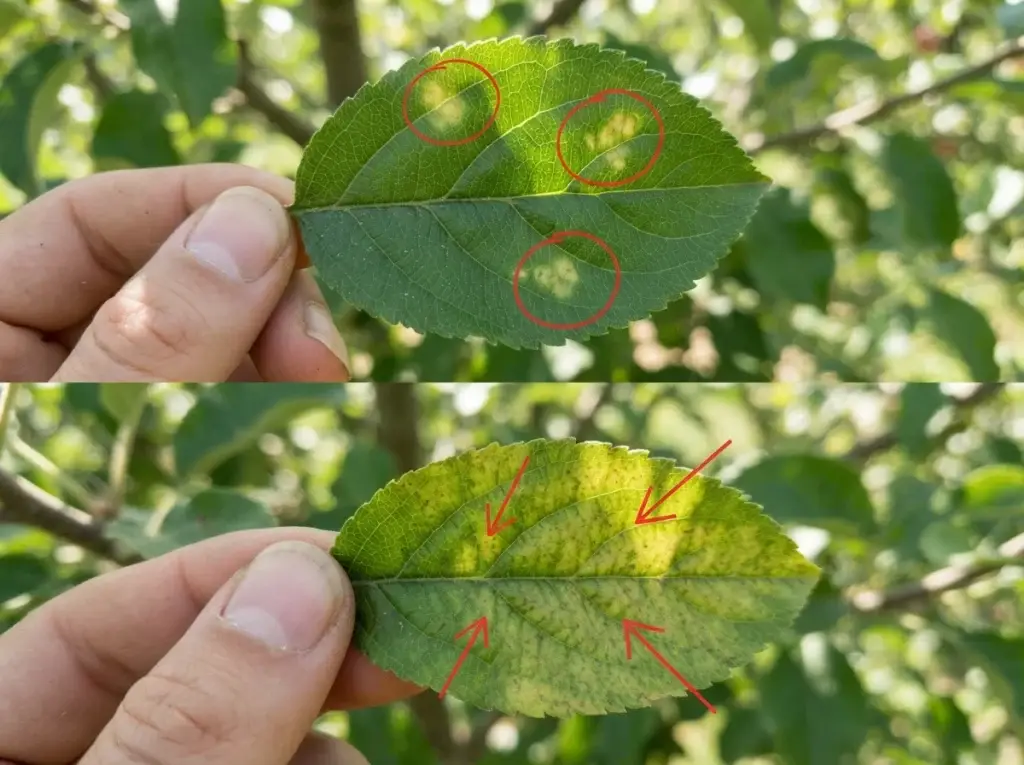
Cedar-apple rust is a rust disease that needs both an apple-family host and a cedar or juniper host to complete its life cycle. On apple leaves, look for yellow spots that become bright orange-red, often with black dots above and short tube-like structures below. Fruit symptoms are less common but can include shallow irregular spots.
The disease can travel on wind from infected junipers, so removing one tree may not solve every case of apple tree diseases. Nevertheless, planting resistant varieties and avoiding new eastern red cedar or juniper plantings close to susceptible apples can reduce risk. Pruning galls from nearby host plants may be useful where practical and legal, but local extension advice should guide the decision.
3. Fire blight
Fire blight is a bacterial disease caused by Erwinia amylovora. Blossoms may become water-soaked, brown, or black; young shoots wilt and form a characteristic downward hook; and bark lesions may be dark, sunken, cracked, or accompanied by pale ooze. Severe infections can kill young trees.
Remove infected shoots promptly using the method recommended by local extension guidance. Penn State Extension advises removing blighted shoots below visibly killed tissue and disinfecting tools between cuts when larger wood must be removed. Avoid pushing excessive soft growth with unnecessary nitrogen, and do not work through a wet canopy because water and tools can spread bacteria.
4. Black rot and frogeye leaf spot
Black rot fungi can survive in dead wood, mummified fruit, and cankers. Leaf symptoms may begin as small purple flecks that enlarge into brown lesions with a darker border, while fruit develops a firm, expanding rot that can turn black. Frogeye leaf spot is the leaf phase associated with the same disease group.
Remove mummified fruit, dead branches, and infected prunings from the orchard area. Avoid unnecessary wounds, protect bark from injury, and maintain an open canopy. Treatment plans for apple tree diseases should account for the variety, local disease pressure, and label-approved options.
5. White rot, bitter rot, and other summer fruit rots
Summer rots often begin where fruit is wounded by hail, insects, birds, rubbing, or rough handling. Lesions can expand quickly during warm, wet weather, and fruit may shrivel or remain attached as a mummy. The exact appearance of these apple tree diseases varies by rot organism and region.
Remove rotted fruit from the tree and ground, prune dead wood, and handle apples gently at harvest. Penn State Extension notes that no general variety resistance is known for some summer rots, so sanitation, airflow, wound reduction, and rapid cooling after harvest are important protective measures.
6. Powdery mildew
Powdery mildew appears as white, powdery growth on young leaves, shoots, and sometimes blossoms. Leaves may curl or become distorted, and infected terminals can fail to grow normally. Unlike many leaf-spot diseases, the fungus does not require a continuously wet leaf surface to appear, although weather and canopy conditions still influence severity.
Plant mildew-resistant varieties when available and remove infected terminals where practical. Because apple tree diseases and disease pressure vary by region, use a local extension schedule and a product label rather than copying a calendar from another climate.
7. Sooty blotch and flyspeck
Sooty blotch and flyspeck usually appear as superficial dark blemishes on fruit. They are associated with humid conditions and slow-drying surfaces, and they can be confused with deeper fruit rots. Fruit may remain firm even when its appearance is affected.
Prune for air circulation, avoid dense unmanaged growth, and use region-specific recommendations. These blemishes are not the same as every black spot on an apple, so inspect whether the mark is superficial, sunken, soft, cracked, or spreading.
8. Marssonina blotch
Marssonina blotch, also called apple blotch in some extension references, produces dark leaf lesions and can cause premature defoliation under favorable conditions. It is more likely to become serious when wet periods are prolonged, and susceptible tissue remains unprotected.
Remove fallen leaves where feasible, improve canopy drying, and consult local extension recommendations for labeled controls. Do not assume that a product effective for scab will provide the same protection for every blotch among apple tree diseases.
9. Cankers and dead-wood diseases
Among apple tree diseases, a canker is a dead or dying area of bark and underlying tissue. It may be sunken, cracked, discolored, or surrounded by swollen tissue. Cankers can be caused by fungi, bacteria, winter injury, sunscald, or wounds, so the word “canker” describes a symptom rather than one diagnosis.
Small branch cankers may sometimes be removed during dry conditions by cutting into healthy wood, but trunk cankers and recurring lesions require a more cautious assessment. Disinfect tools when working between diseased and healthy trees, and remove prunings so they do not remain as an inoculum source.
10. Root and crown rot
Root and crown problems often cause gradual decline rather than a single obvious leaf spot. Symptoms can include weak shoot growth, sparse foliage, yellowing, dieback, poor recovery from heat, and bark damage close to the soil line. Saturated soil, poor drainage, deep planting, and root wounds can increase risk.
Do not bury the trunk flare or keep the root zone continually saturated. Because roots are difficult to inspect without causing additional damage, have a certified arborist or diagnostic clinic evaluate the tree before removing soil or applying a treatment.
11. Virus-related disorders
Viruses and virus-like disorders can produce persistent mosaics, unusual leaf patterns, abnormal fruit, weak growth, or decline. Symptoms may vary with temperature, variety, and tree age, which makes visual diagnosis uncertain.
Use certified, healthy planting stock and avoid moving scion wood or tools from an unknown tree. If a virus is suspected, request a diagnostic test rather than treating with a fungicide, because fungicides do not cure viral infections.
12. Noninfectious look-alikes
Drought stress, herbicide drift, excess salts, nutrient imbalance, compacted soil, and winter injury can mimic apple tree diseases. For instance, uniform damage on the side facing a sprayed area may suggest drift, while symptoms limited to dry soil or exposed roots point toward environmental stress.
Review irrigation, soil drainage, recent fertilizer, lawn treatments, construction, trunk injury, and weather extremes. Correcting the stress can be more valuable than applying an unnecessary pesticide.
Prevention: build an integrated disease-management plan
Integrated pest management begins with prevention, monitoring, correct identification, and a combination of cultural, mechanical, biological, and chemical tools. OSU Extension emphasizes that no single tactic is a silver bullet. As a result, the most dependable plan reduces disease pressure throughout the year rather than relying on one late rescue spray.
Start with resistant varieties and a suitable site
When choosing a tree, compare disease resistance with your climate, soil, pollination needs, rootstock, and available space. Resistant does not mean immune, but it can reduce the number and severity of infections. Select a site with adequate sunlight, drainage, and room for the mature canopy.
Reduce moisture and overwintering inoculum.
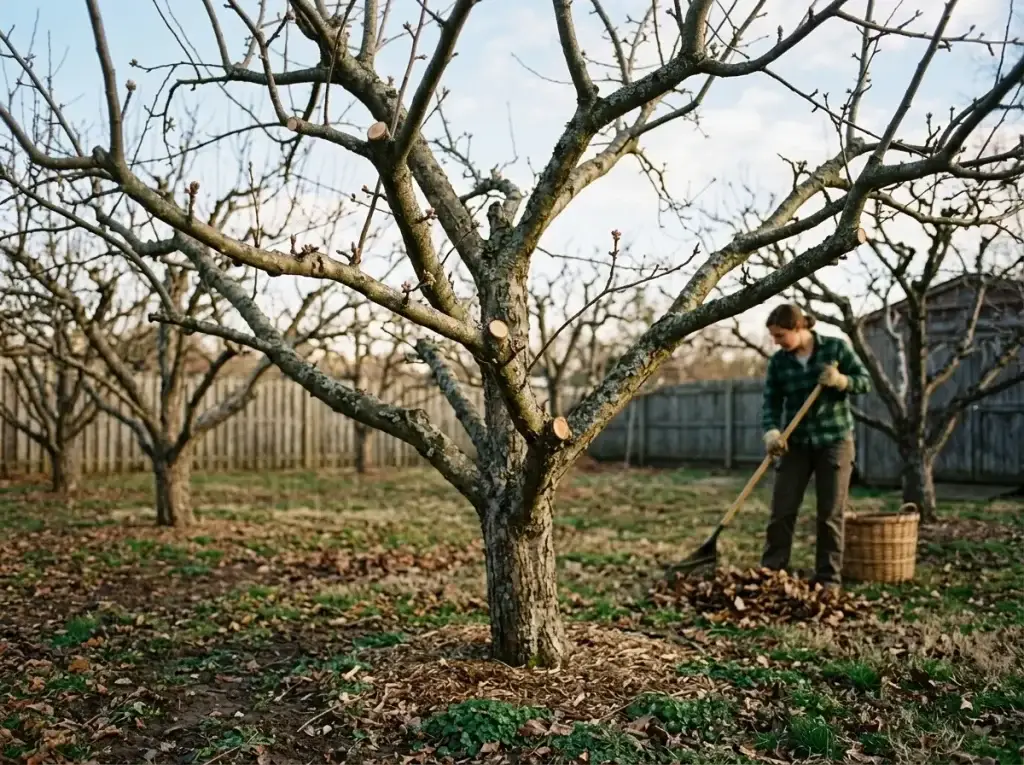
Prune crowded branches and water the root zone without repeatedly wetting foliage. Remove fallen leaves and mummified fruit where practical, and cut out dead wood that can harbor pathogens. Also, avoid leaving prunings beneath the tree or allowing fruit to remain on the ground from one season to the next.
Use sanitation and tool hygiene.
Clean tools before moving from a diseased tree to a healthy one, especially when fire blight or cankers are suspected. Work during dry conditions when possible, remove diseased material from the orchard area, and sanitize containers used for harvested fruit.
Decide when a pesticide is justified.
For apple tree diseases, fungicides are generally protective rather than curative. They work best when selected for the confirmed disease and applied according to the product label and local extension guidance. Organic products can still harm people, beneficial organisms, or plants when misused, so “organic” is not a substitute for reading the label.
Do not combine products unless the label allows it. Wear the required protective equipment, observe re-entry and harvest intervals, protect pollinators, and keep records. When resistance is a concern, follow extension guidance on rotating active ingredients rather than repeating one chemistry throughout the season.
When to call an arborist or diagnostic clinic
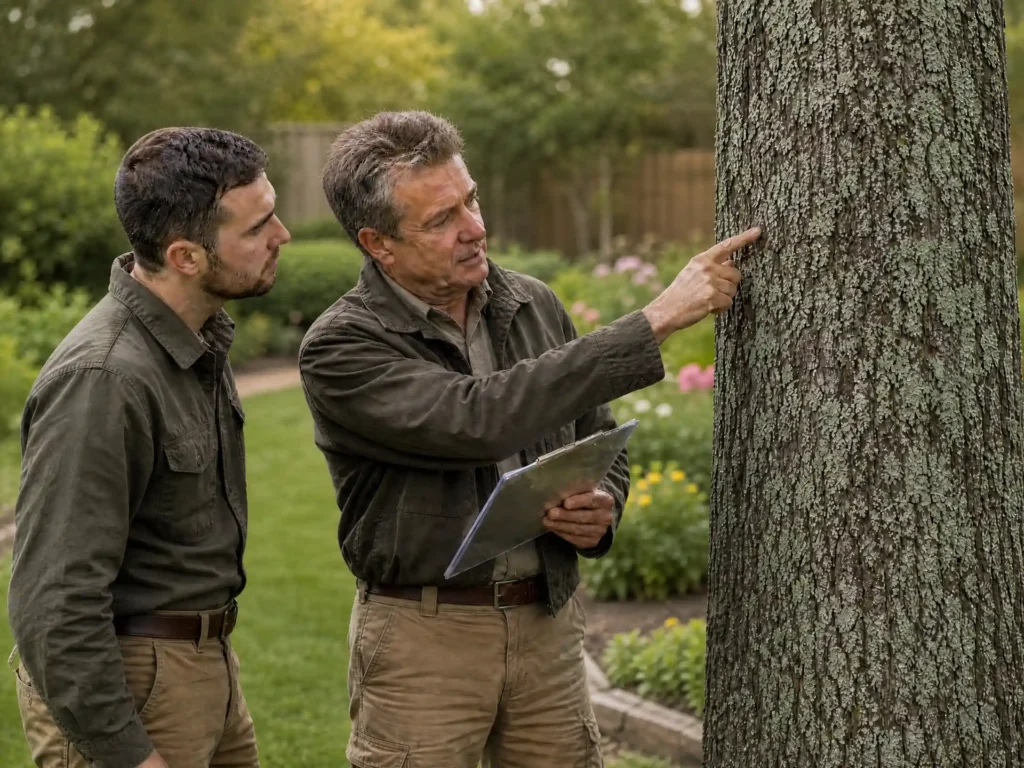
Seek professional help when a young tree is rapidly declining, a trunk or root-collar lesion is expanding, multiple large branches are dying, fire blight reaches the central leader, or the diagnosis remains uncertain after careful observation. A certified arborist can assess structural risk, while a university extension diagnostic clinic may be able to examine samples or recommend laboratory testing.
Professional evaluation is especially important before removing a mature tree affected by apple tree diseases or applying repeated pesticide treatments. Bring clear photographs, affected tissue if requested, the variety and planting location, recent weather, irrigation details, and a list of products already used.
FAQs
What are the most common apple tree diseases?
The most common apple tree diseases vary by region, variety, and weather, but apple scab, cedar-apple rust, fire blight, black rot, fruit rots, powdery mildew, sooty blotch, and flyspeck are frequent concerns. A symptom guide such as apple tree disease pictures can help organize observations, but it cannot replace a confirmed diagnosis.
Why do apple tree leaves have orange, yellow, brown, or black spots?
Orange spots often suggest a rust disease, while olive or brown spots may fit scab or a blotch. However, drought, insects, spray injury, and nutrient stress can look similar. Compare the upper and lower leaf surfaces, inspect fruit and shoots, and record the weather before choosing a treatment for apple tree diseases.
Can an apple tree with fire blight be saved?
Some trees can recover when infection is limited and infected shoots are removed correctly. Severe trunk or leader infection is more serious, particularly on young trees. Do not make a final removal decision from a single photograph. Have a certified arborist or extension diagnostic clinic assess the extent of the infection and identify the relevant apple tree diseases.
Are apples with scab or black spots safe to eat?
Surface blemishes do not all mean the same thing, and food safety depends on the specific condition, severity, storage, and local guidance. Discard fruit that is soft, leaking, moldy, or extensively rotted, and do not eat fruit exposed to a pesticide before its labeled harvest interval. When uncertain about apple tree diseases, contact a local extension service.
Should I remove a cedar or juniper near an apple tree?
Cedar-apple rust requires hosts from two plant families, so nearby juniper or eastern red cedar can contribute to the disease cycle. Still, spores may travel from farther away, and removal is not always necessary or practical. Start with resistant varieties and local guidance, then consider host management where it will provide a realistic benefit.
Related Articles
- Apple tree diseases pictures
- Common apple tree diseases
- Apple tree diseases and cures
- Apple tree disease identification
Sources
- University of Minnesota Extension, Apple scab of apples and crabapples.
- University of Minnesota Extension, Cedar-apple rust and related rust diseases.
- University of Minnesota Extension, Fire blight.
- Penn State Extension, Pest Management in Apples in Home Fruit Plantings.
- Oregon State University Extension, Fruit tree integrated pest management.
Disclaimer: This article is for informational purposes only. Apple tree disease and pest identification in the field can be challenging. For a confirmed diagnosis, consult a certified arborist or contact your local university cooperative extension plant diagnostic clinic. Always read and follow pesticide label directions before applying any product.
