
Apple Tree Rootstocks: Proven M9, MM106 & B9 Explained
Apple tree rootstocks are the root systems and lower stems onto which named apple varieties are grafted. They strongly influence tree size, anchorage, early fruiting, and tolerance of particular growing conditions. M9 and B9 produce dwarf trees that need lasting support; MM106 produces a larger tree but is a poor choice for wet ground. Choose the rootstock for your site, then confirm that the apple variety above it suits your climate and pollination plan.
Table of Contents
A nursery label that says only “dwarf apple” leaves several questions unanswered. How much room will the tree need? Will it need a permanent stake? Is it suitable for a cold garden or soil that drains slowly? The rootstock code helps answer those questions before you commit years to growing the tree.
What the rootstock controls, and what the scion controls
A typical grafted apple tree has two genetically distinct parts. The scion is the named variety, such as Gala or Honeycrisp, which forms the fruiting canopy. The rootstock forms the roots and the stem below the graft union. Look near the base of a young tree for the join, often visible as a bend or swelling.
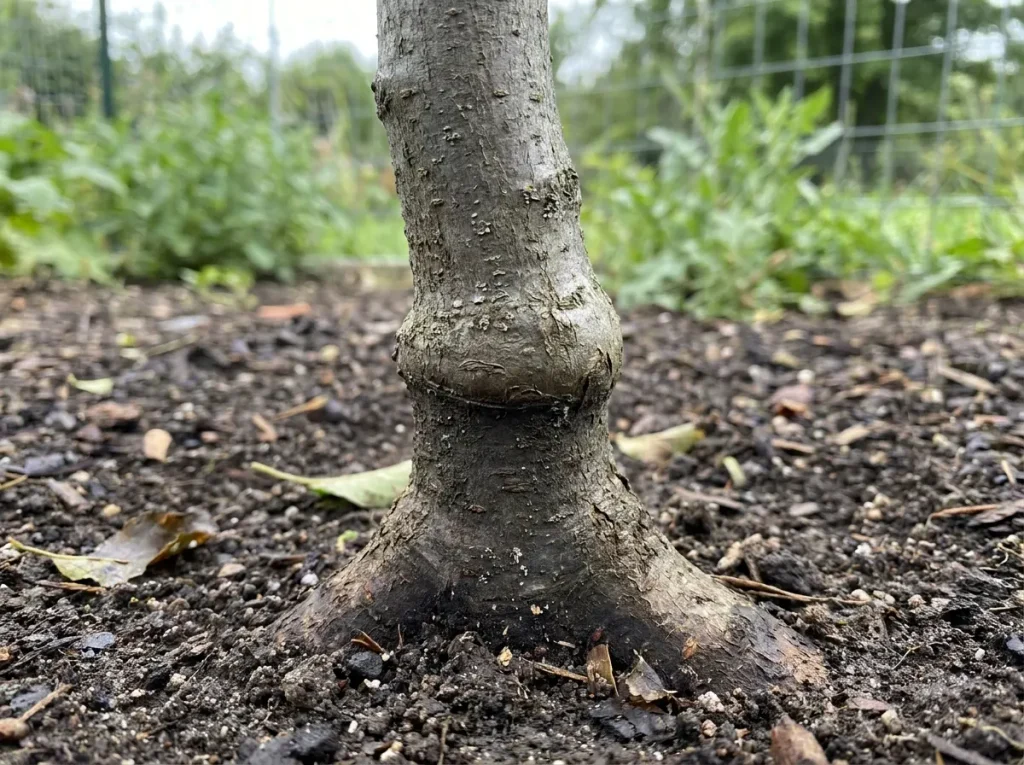
The scion determines which apple variety you harvest. The rootstock influences how that variety grows, including its vigor and how soon it begins flowering. Changing the roots under Gala does not turn its fruit into another variety. University of Minnesota Extension explains this division in its guide to growing apples.
Nurseries use several naming styles. M9 and M.9 mean Malling 9. B9, Bud 9, and B.9 mean Budagovsky 9. MM106 and MM.106 mean Malling-Merton 106. The numbers identify selections; they are not a sequence from smallest to largest. For example, M26 generally produces a larger tree than M9, while M27 is smaller.
You may also see EMLA on a label. This identifies selections developed through a program to eliminate known viruses from Malling and Malling-Merton material. It does not mean the tree resists every disease. Washington State University’s rootstock descriptions explain the naming groups and their differences.
Apple tree rootstocks compared: M9, B9, and MM106
These three rootstocks have established records in apple growing, but each comes with a different set of compromises. Use the comparison to narrow your choices. Final dimensions and performance still depend on the scion, soil, climate, and training.
| Characteristic | M9 | B9 | MM106 |
|---|---|---|---|
| General size | Dwarf | Dwarf, usually smaller than M9 | Semi-dwarf, substantially larger |
| Support | Permanent stake or trellis | Permanent support planned from planting | Often freestanding once established; assess young trees and exposed sites |
| Early cropping | Very precocious | Very precocious | Early bearing, but a different size and management commitment |
| Cold-weather consideration | Check local performance and the specific clone | Noted for cold hardiness | Check regional suitability, including early winter injury risk |
| Fire blight | Highly susceptible | Better field survival than M9 in trials; young tissue can be susceptible | Susceptible |
| Crown and root rot | Relatively resistant, but still needs drainage | Good reported crown-rot resistance; still needs drainage | Highly susceptible; avoid wet sites |
| Woolly apple aphid | Susceptible | Do not assume resistance from its cold hardiness | Resistant |
| Main reason to consider it | A small, supported tree with early production | A compact, supported tree where cold hardiness matters | A larger tree on well-drained ground |
The comparison draws on the national Cooperative Extension profiles for M9, B9, and MM106, alongside WSU’s descriptions. Resistance ratings apply to particular problems. They do not describe the health of the whole grafted tree.
For a fuller explanation of the interaction between roots, variety, and site, WSU Extension specialist Jenny Bolivar-Medina discusses rootstock selection in the video below. It uses Washington commercial-orchard examples, so apply its selection principles without copying orchard spacing or management wholesale into a backyard.
A transcript and descriptions of the video slides are available from WSU.
Where each rootstock fits
M9: compact trees with a permanent support commitment
M9 makes sense when you want a small tree and can provide the support and care it needs. Its early bearing and efficient production explain its importance in modern orchards. Poor anchorage is a real limitation: a tree carrying fruit needs more support than its small trunk might suggest.
Ask which M9 clone the nursery supplies. T337, Nic29, and Pajam selections differ in vigor, so two trees labeled M9 need not grow identically. The M9 profile documents these differences as well as its susceptibility to fire blight and woolly apple aphid.
Before ordering, include the stake or trellis in your budget and decide how you will reach the tree with water during dry weather. If permanent support is unacceptable in that part of the garden, remove M9 from the shortlist now.
B9: a dwarf option worth considering in cold regions
B9 was selected for dwarfing and cold hardiness. It generally produces a smaller tree than M9 and bears early. That combination is useful where space is limited, provided the cultivar itself also suits the climate.
Its fire blight response needs careful wording. The B9 research summary reports better survival in field outbreaks and increasing resistance as tissue ages, despite susceptibility in early inoculation tests. Calling every B9 tree fire-blight-proof would be misleading.
For a cold garden, ask a local nursery about the performance of your intended variety on B9. A recommendation based on that combination is more useful than a general claim that the roots are hardy. Plan support before planting, and keep the rootstock identity in your records.
MM106: more room required, with drainage taking priority
MM106 can suit a grower who wants a larger tree and has well-drained soil. Its resistance to woolly apple aphid is useful, but it remains susceptible to fire blight and especially crown and root rots. A low spot that stays wet is a strong reason to choose another site.
WSU describes trees on EMLA 106 as roughly half to two-thirds the size of a standard tree. Other extension descriptions give different estimates. Treat that as a broad vigor comparison, not a promise of a particular height.
Established trees are often grown without permanent support, although a newly planted tree may still need staking. Confirm the support plan for the cultivar and exposure. Do not buy MM106 simply because “semi-dwarf” sounds like a small step up from M9; allow for a much larger canopy.
Choose for your site before comparing nursery prices
Start by writing down the conditions that could rule out a tree. A rootstock with attractive features elsewhere may be an expensive mistake if it fails one essential requirement in your yard.
Check drainage and the history of the planting spot
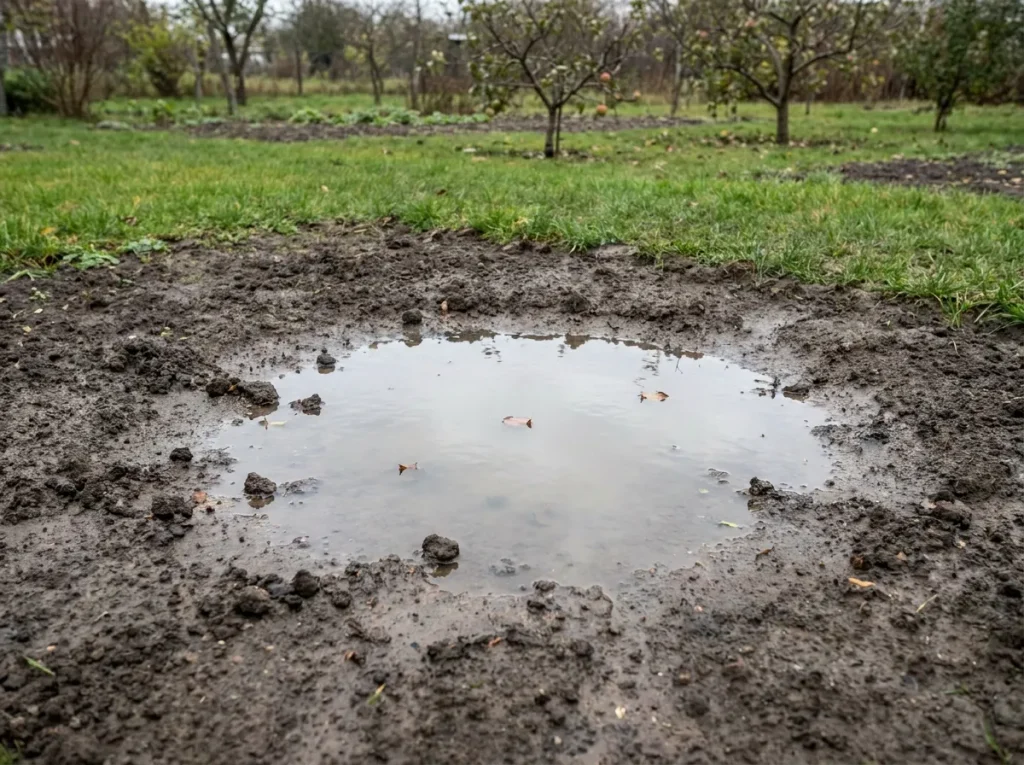
Visit the intended planting area after substantial rain. Look for standing water and persistent saturation, and ask whether the ground is wet during winter as well as summer. Soil texture alone will not answer this: a clay soil on a slope and a compacted hollow can behave very differently.
Utah State Extension explains that excessive moisture favors Phytophthora crown and collar rot. Even lighter soil can develop problems when irrigation keeps it too wet. Keep the trunk base out of a water-collecting basin and avoid placing irrigation so that it continually wets the crown. Rootstock resistance cannot supply oxygen to waterlogged roots.
If drainage is doubtful, investigate it before ordering. Our guide to apple tree soil requirements explains how to assess the planting area and use soil-test results without creating a heavily amended pocket around the tree.
Also record whether an apple tree previously occupied the spot. Apple replant disease involves soil organisms that can impair a replacement tree. WSU identifies differences in rootstock tolerance, including tolerance in several Geneva selections. If an earlier tree declined, have the cause investigated before choosing its replacement; poor drainage and replant disease require different assessments.
Check both winter survival and fruit ripening
Tell the nursery your location and how exposed the planting area is. Ask about local winter injury on the proposed combination. B9’s cold hardiness is a reason to investigate it, but choosing hardy roots does not settle whether the fruiting variety will crop well.
The cultivar still needs a suitable growing season. Utah State’s home apple guidance stresses the importance of ripening time in short-season locations. A tree may survive winter yet fail to ripen a late crop reliably. Use our apple varieties by zone guide to check the cultivar separately, including chill needs and bloom timing.
Choose a growing system you can maintain
Decide whether you want a supported tree, an espalier, or a larger freestanding form before selecting the rootstock. Include room to prune and harvest, and consider how you will inspect the highest branches. The amount of garden you can maintain matters as much as the amount you can plant.
Here are two hypothetical choices. A cold-climate gardener with reliable irrigation and room for a permanent support might shortlist B9, then check local cultivar performance. A gardener with ample space, well-drained ground, and a preference for an established freestanding tree might investigate MM106 alongside other larger rootstocks. Neither choice follows from climate or space alone.
For a third site, a small hollow that stays saturated, the next step is a drainage assessment or a different planting position. Comparing M9 with MM106 before resolving that problem skips the decision most likely to determine whether the tree survives.
How big will the tree get, and how far apart should you plant?
Rootstock size charts are estimates under particular conditions. Some describe height, others compare overall vigor or tree size against a seedling reference. Read the chart’s definition before using its percentages to lay out a garden.
The national Extension overview of dwarf, semi-dwarf, and standard trees gives broad mature-height ranges of about 6 to 12 feet for dwarf trees and 14 to 22 feet for semi-dwarf trees. These ranges describe groups, not guaranteed dimensions for every M9 or MM106 tree.
Ask the nursery for expected height and spread of the exact cultivar-rootstock combination under the training you intend to use. If its spacing advice assumes a narrow, supported orchard row, ask for a backyard recommendation instead. Closely planted commercial trees receive deliberate training that a casually pruned garden tree will not receive.
Sketch the mature canopy circles on your plan. As a simple planning example, two trees each expected to spread 10 feet would need 10 feet between their trunks merely for the canopy edges to meet: 5 feet of radius plus 5 feet. A desired 3-foot gap would increase that distance to 13 feet. These are hypothetical dimensions, not rootstock recommendations, and row access may require additional space.
Pruning remains necessary on dwarf trees. Utah State’s training guidance explains that pruning and training cannot overcome a poor scion-rootstock match. Repeatedly cutting back an oversized tree is a continuing workload, and hard dormant pruning can stimulate vigorous regrowth.
Early fruiting, yield, and apple quality
Precocity means the ability to begin bearing early in the tree’s life. Dwarfing rootstocks generally encourage earlier flowering than vigorous ones, as explained in Extension’s overview of rootstock influence on precocity. This is one reason a small grafted tree can be useful to a home grower.
Minnesota Extension gives two to three years after planting as a general expectation for first fruit on dwarf apple trees. It is a starting estimate. Tree condition, cultivar, establishment, pollination, and weather affect the actual wait, and the first few apples are not a mature harvest.
When a nursery promises early fruit, ask whether it means the first flowers, a handful of apples, or a worthwhile crop. Those are different milestones. A young tree also needs enough growth to build its structure; carrying every fruit that sets is not necessarily desirable.
A dwarf tree can produce normal-sized apples. The rootstock’s influence on vigor, crop load, and resource uptake can affect fruit performance, but the cultivar remains central to eating quality. The University of Maryland rootstock factsheet discusses these interacting traits.
For the gardener, the useful question is whether the combination makes good fruit easier to grow and manage at that site. A smaller canopy is easier to reach for thinning and harvest. Excessive crop loads can compromise growth and future cropping, while poor light within a canopy limits its usefulness. Buying a particular rootstock does not replace those management decisions.
Be cautious with claims that one rootstock always gives sweeter apples or the biggest harvest. A comparison would need to name the cultivar, growing conditions, tree age, and crop management. Without those details, the claim offers little help in predicting your own crop.
When to look beyond M9, B9, and MM106
If fire blight is a major local concern, ask about a suitable Geneva rootstock. These selections differ from one another. G41 is a dwarfing option with resistance to fire blight and Phytophthora, but its graft union needs careful support because breakage has occurred with some scions. Maryland’s factsheet describes this limitation, including problems with Honeycrisp and Cripps Pink in windy areas.
For a larger tree where dry conditions matter, MM111 is worth discussing with a local nursery. WSU describes it as well anchored and drought tolerant. That means a relative advantage once established, not permission to leave a newly planted tree without water.
M26 occupies a different place in the size range and also has fire blight and crown-rot limitations. It should not be treated as a disease-resistant substitute for M9. If a supplier proposes a substitution, compare the traits again before accepting it.
An interstem tree has an additional section between the roots and the fruiting variety. A dwarfing stem piece can combine size control with a more vigorous understock. Such trees have their own planting requirements, so request instructions for the exact combination rather than applying the planting depth of a conventional two-part tree.
Planting and early care that preserve the rootstock’s benefits
Find the graft union before digging. On an ordinary two-part grafted tree, the fruiting scion must remain above the finished soil level so it does not establish its own roots and bypass the dwarfing rootstock. Minnesota Extension recommends about 4 inches of clearance in its home-planting guidance; other recommendations vary with the rootstock. Follow the supplier’s specific instructions while allowing for soil settlement.
Do not confuse the graft union with the root flare, where the trunk broadens into the upper roots. Keeping the graft visible does not justify burying those roots excessively deep. Likewise, piling mulch against the trunk can hide the planting level you carefully set.
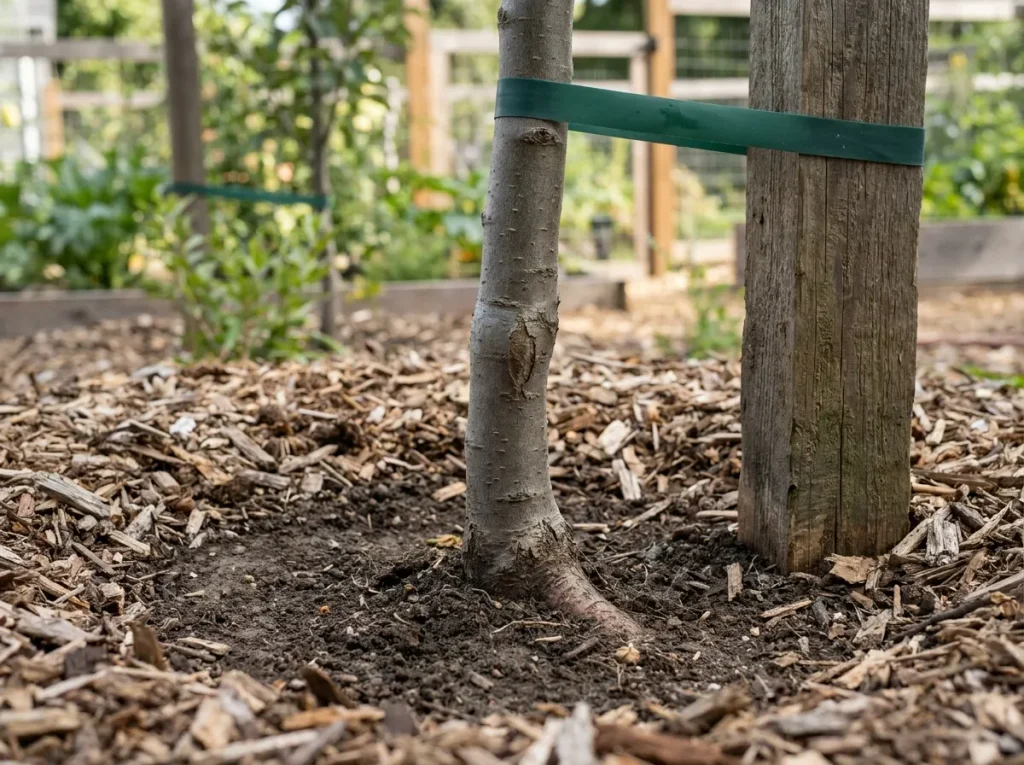
Install the required support when you plant M9 or B9. Arrange ties so they support the tree without cutting into the bark, and inspect them as the trunk expands. Check the stake or trellis after strong winds and again when the tree begins carrying a crop. Support needs can become more obvious as the fruit gains weight.
Use moisture checks to guide irrigation. Check the newly planted root zone and surrounding soil, since they may dry at different rates. The guide to how often to water apple trees explains how establishment, weather, and soil change the decision. A rootstock name alone cannot provide a watering schedule.
Remove rootstock suckers growing below the graft, and keep the tree’s label somewhere permanent. Record the cultivar, rootstock, supplier, and planting date. If growth later seems unusually strong or weak, those details let a nursery or extension adviser assess the actual tree instead of working from “a dwarf apple.”
How rootstocks relate to grafting, seedlings, and cuttings
Grafting joins scion wood of the variety you want to a chosen rootstock. A seed from that apple is genetically variable and will not reliably reproduce the named variety. A rooted cutting from above the graft would reproduce the scion on its own roots, without the separate rootstock’s size control.
University of New Hampshire Extension’s grafting guide explains why grafting is commonly used: fruit varieties do not come true from seed, and cuttings can be difficult to root. Clonal rootstock production in a nursery is a different task from trying to root a fruiting branch at home.
For a first grafting project, source correctly labeled apple rootstock and healthy scion wood. Choose a technique appropriate to their diameters. Successful grafting requires contact between the growing tissues beneath the bark and protection against drying. Practice tool handling before making the final cuts, keeping your hands out of the blade’s path.
Changing the fruiting variety on an existing tree does not replace the rootstock underground. If the original problem is an unsuitable root system or planting site, grafting another variety onto the canopy leaves that problem in place.
Questions to take to the nursery
Bring a short description of your site and ask for answers tied to the actual tree being sold. Use this checklist before accepting an order or a substitute:
- What is the full rootstock name, including the clone if it is M9?
- What mature height and spread should I expect with this cultivar and training system?
- Does it need temporary staking or permanent support?
- What local experience supports this combination in my soil and winter conditions?
- Which relevant diseases or pests is the rootstock susceptible to?
- What planting depth and graft-union clearance do you recommend?
- Which compatible cultivar will provide pollen during its bloom period?
- Will you contact me before substituting another rootstock?
Keep the written answers with the order. If the rootstock cannot be identified, treat the tree as an uncertain choice for a space where mature size or support needs are critical.
FAQs
What is the best rootstock for apple trees?
There is no universal best. M9 suits supported dwarf systems, B9 deserves consideration for a compact tree in cold regions, and MM106 needs room and well-drained ground. Local disease pressure may make another selection more suitable.
Does a dwarf rootstock mean small apples?
No. Dwarfing describes the tree’s growth. Fruit size depends on the cultivar and growing conditions, including crop load. A dwarf tree can produce full-sized fruit.
Can M9 and B9 trees grow without stakes?
Plan permanent support for both. A young tree standing upright on a calm day does not demonstrate that it can carry a mature crop safely through wind.
Is MM106 suitable for clay soil?
The deciding issue is drainage. Avoid MM106 where soil remains wet or poorly aerated because of its crown- and root-rot susceptibility. A clay label alone is not enough to establish suitability.
Do two different rootstocks provide cross-pollination?
No. Pollination depends on the flowering varieties. Two trees of the same cultivar on different rootstocks do not become different pollen partners. Check cultivar compatibility and overlapping bloom.
Can I identify an unknown rootstock by looking at the tree?
A visible graft shows where plant parts were joined, but appearance alone is not a reliable way for a home grower to assign an exact rootstock code. Check the original label, invoice, or supplier’s records.
How long will a dwarf apple tree live?
A rootstock code cannot guarantee a lifespan. Site suitability, disease, injury, care, and the continued condition of its support all matter. Ask about local experience with the specific combination rather than buying on a promised number of years.
