
Soil pH Test Kit for Fruit Trees: 5 Best Buyer Picks
Soil pH test kit for fruit trees options range from laboratory analysis to home color tests and digital meters. For the most dependable orchard decision, choose a representative sample and a method you can repeat. A lab report offers the broadest interpretation, while a suitable home kit can provide a useful screening check before you amend soil.
Table of Contents
Key Takeaways
- A soil pH test kit for fruit trees is most useful when the sample represents the root-zone area, not one unusual spot.
- Laboratory testing is the strongest choice when trees are declining, soil has been amended, or fertilizer decisions have financial or environmental consequences.
- For routine home checks, favor clear instructions, calibration information, repeatable readings, and a way to record results over a long list of unverified features.
Choosing among soil testers is difficult because “best” depends on the question you need to answer. A pH-only kit may be adequate for a quick screening check, whereas a complete laboratory report can also address organic matter, nutrients, texture, and lime requirement.
Quick answer: Which soil pH test kit for fruit trees is best?
The best soil pH test kit for fruit trees is the one that matches your needs. Select laboratory testing for planting preparation, unexplained symptoms, or amendment planning. Choose a colorimetric kit for an inexpensive occasional check, and consider a calibrated digital meter only when you will follow its sampling, cleaning, and calibration instructions consistently. In other words, the best soil pH test kit for fruit trees is the most appropriate method for the question at hand.
Why the sample matters more than the gadget
University of Minnesota Extension describes soil testing as a foundation for nutrient management and recommends a representative sample from throughout the area of interest [1]. Therefore, a premium-looking meter cannot correct a poor sample. Avoid collecting only from a compost pile, fertilizer band, mulch surface, or visibly different patch unless that is the specific area you intend to investigate.
For apples, use the test to inform the broader plan described in our guide to apple tree soil requirements. A practical target for apple-tree soil is often around pH 6.0 to 6.5, but local laboratory recommendations, soil type, rootstock, and existing nutrient levels still matter. That is why a soil pH test kit for fruit trees should support, rather than replace, site-specific advice.
5 best soil pH test kit options compared
The table compares test formats rather than making unsupported claims about individual brands. A soil pH test kit for fruit trees should be judged by how clearly it explains sampling and repeat use, not by the number of buttons or advertised functions. Product labels and specifications change, so verify calibration instructions, replacement reagents, warranty terms, and measurement range before buying.
Expert consensus: A representative sample and an interpreted soil report are more useful for orchard decisions than a gadget’s feature count. The University of Minnesota Extension and Washington State University Tree Fruit both emphasize appropriate sampling and context.
Related video: Orchard People’s Soil testing for fruit trees discusses why testing can help investigate nutrient problems. It is educational context, not a substitute for a local laboratory recommendation.
| Option | Best use | Advantages | Limitations |
|---|---|---|---|
| Laboratory soil test | Planting, diagnosis, amendment planning | Broad analysis and interpretation | Requires shipping and waiting for results |
| Colorimetric chemical kit | Occasional home screening | Low equipment cost and simple visual comparison | Color matching can be subjective; usually limited interpretation |
| Calibrated digital pH meter | Repeat checks by a careful user | Quick readings and reusable instrument | Needs calibration, cleaning, suitable soil slurry, and battery care |
| Probe-style pH meter | Rough field screening | Fast to insert and portable | Readings may vary with moisture, contact, and soil preparation |
| Multi-function 4-in-1 meter | Convenience checks for moisture and light | Several household measurements in one tool | Extra features do not equal laboratory-grade fertility advice |
1. Laboratory soil test: best for decisions that matter
A laboratory test is the most defensible first choice when you are establishing an orchard, changing soil substantially, or trying to understand poor growth. For a soil pH test kit for fruit trees, laboratory analysis also provides the clearest path from a result to a responsible amendment decision. UMN Extension says a regular series can report soil texture, organic matter, phosphorus, potassium, pH, and lime requirement [1]. As a result, it answers more than “is this soil acidic?”
2. Colorimetric chemical kit: best for a low-cost screening check
A color kit can be practical when you want a rough indication between laboratory tests. In that role, a soil pH test kit for fruit trees is a screening aid, not a substitute for crop-specific laboratory interpretation. However, follow the water, soil, mixing, settling, and color-comparison directions exactly. Treat the number as a screening result rather than a complete prescription for lime, sulfur, or fertilizer.
3. Calibrated digital pH meter: best for repeatable home monitoring
A digital meter is worth considering when you calibrate it with the specified buffer solutions and test a prepared soil-water mixture as directed. For a soil pH test kit for fruit trees, those maintenance steps are essential because a digital readout alone does not establish accuracy. Do not assume that a sharper digital display means sharper accuracy. Record the date, sample location, moisture condition, and result so later readings can be compared fairly.
4. Probe-style pH meter: best for quick checks, not diagnosis
Probe meters are attractive because they are quick and do not require a visible reagent color. Nevertheless, direct insertion into compacted, dry, stony, or uneven soil can produce inconsistent contact. Use this format as an early warning tool for a soil pH test kit for fruit trees, then confirm a surprising result with a properly prepared sample or laboratory test.
5. Multi-function 4-in-1 meter: best only when convenience is the priority
Many growers search for one device that measures pH, moisture, light, and fertility. Those functions can be convenient, but a multi-function label does not establish that the instrument provides crop-specific nutrient recommendations. Therefore, a soil pH test kit for fruit trees with extra sensors should not outrank a reliable sampling process. For serious amendment decisions, a complete soil report is more informative than a single consumer display.
How to choose a soil pH test kit for fruit trees
Start with the decision, not the feature list
Before buying, ask whether you need a quick screen, a documented baseline, or an explanation for symptoms. If the answer is diagnosis or amendment planning, prioritize a lab that provides recommendations for fruit crops. Otherwise, a simple soil pH test kit for fruit trees may be sufficient for tracking broad changes.
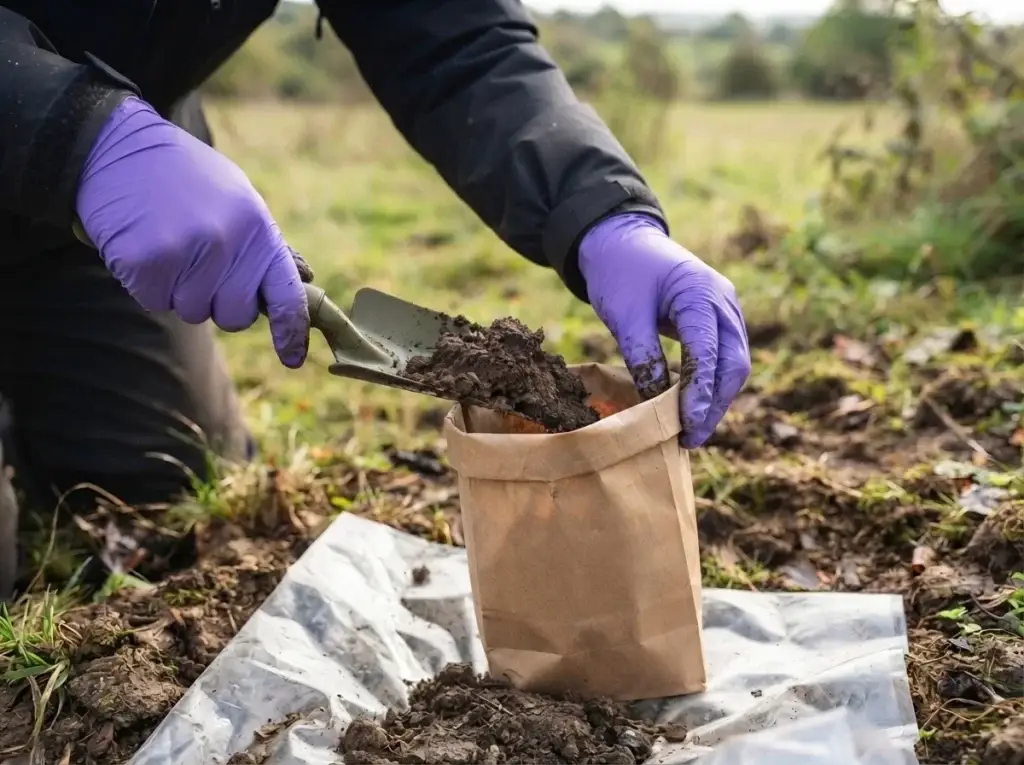
Check calibration, sample preparation, and repeatability.
Look for written instructions that explain calibration, cleaning, sample moisture, and the required soil mixture. Furthermore, favor a soil pH test kit for fruit trees that lets you repeat the test without changing several variables at once. A device that cannot be maintained or interpreted consistently is poor value even if its purchase price is low.
Do not confuse pH with fertility.
Soil pH affects nutrient availability, but it does not measure every nutrient or diagnose every tree problem. Yellow leaves, weak shoots, poor fruiting, and decline can also involve drainage, roots, water stress, pests, disease, planting depth, or incompatible site conditions. Use the result alongside the recommendations in our guide to apple tree fertilizer, not as a reason to add products blindly. A soil pH test kit for fruit trees is one input in that wider care plan.
How to test soil around fruit trees correctly
Use a clean shovel or soil probe and a clean bucket. Collect several small subsamples from the same management area, mix them thoroughly, remove obvious roots and debris, and submit or test the combined sample according to the kit directions. This preparation is essential whether you use a soil pH test kit for fruit trees at home or send the sample to a lab. WSU Tree Fruit provides orchard-specific soil-sampling guidance for tree-fruit sites [2].
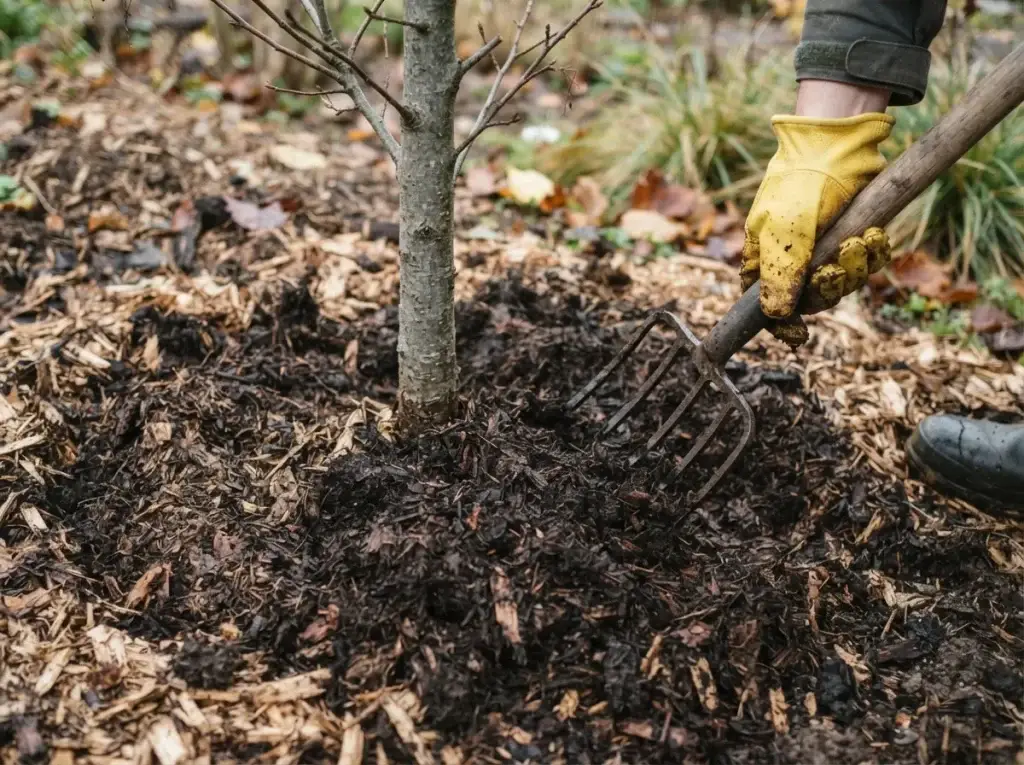
Sample consistently from the area you want to manage. Keep a separate sample if soil differs sharply by slope, drainage, fill, or planting bed. Also, avoid interpreting a single reading as the condition of an entire orchard.
UMN Extension notes that early spring or late fall is generally convenient, and that sampling at the same time each year improves comparisons [1]. For established orchards, the extension guidance says testing every three to five years is generally sufficient, with more frequent testing useful for diagnosing problems or evaluating recent amendments [1].
Keeping a useful orchard testing record
Use the same sampling areas and method whenever possible. A soil pH test kit for fruit trees becomes more useful when each reading is tied to a date, location, recent amendment, and weather context. If readings change sharply without a management explanation, confirm them with a laboratory sample.
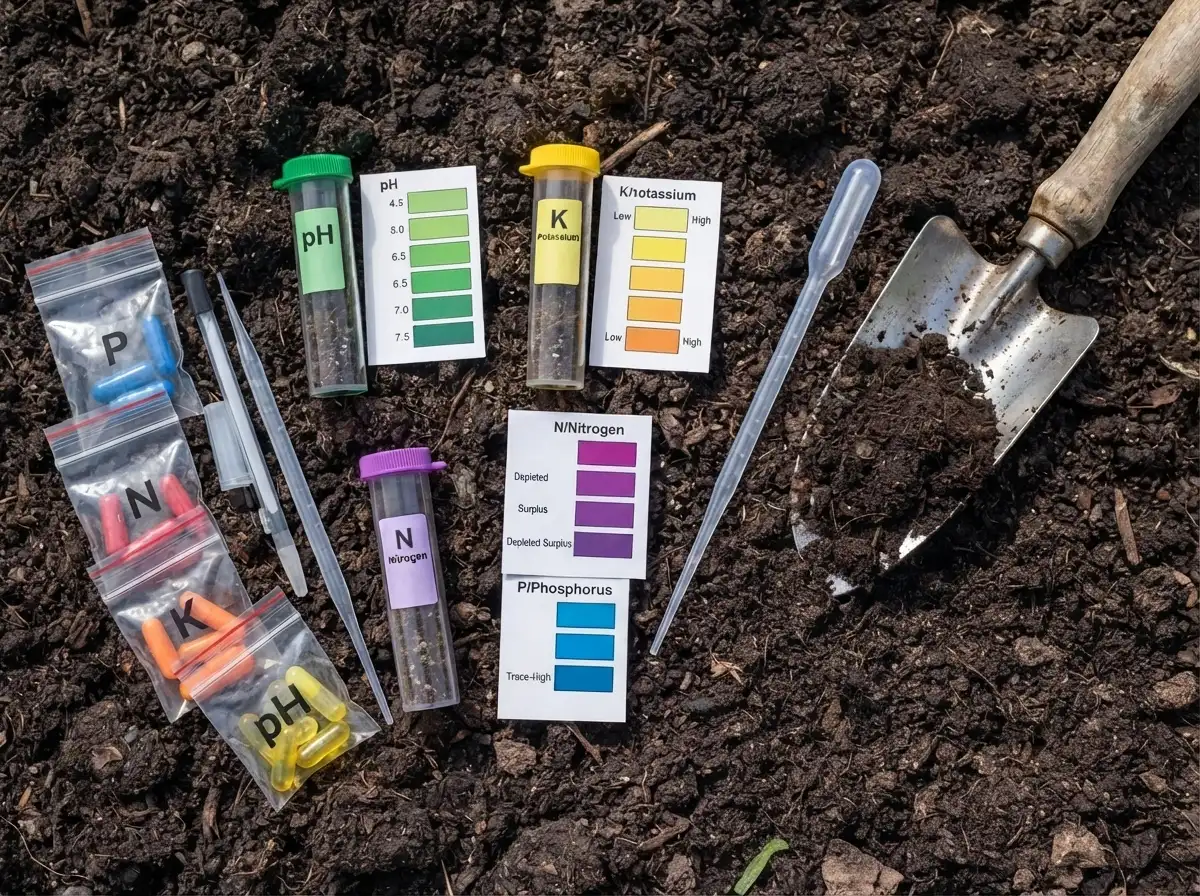
What to do after you receive the result
First, compare the result with the crop and the laboratory’s interpretation, rather than chasing a universal number. If pH is outside the desired range, change it gradually and base any lime or sulfur application on a soil-test recommendation. Do not apply a corrective material simply because a consumer kit produced one surprising value.
Next, keep a simple orchard record with the date, location, pH, organic matter, nutrient values if available, amendments, and weather context. Then retest on a consistent schedule. This process makes a soil pH test kit for fruit trees useful as part of a management record, not merely as a one-time purchase. In practice, the record helps you judge whether a soil pH test kit for fruit trees is producing a consistent trend.
FAQs
Is a home soil pH meter accurate enough for fruit trees?
It can be useful for screening, but accuracy depends on sampling, moisture, calibration, and instrument design. A home soil pH meter should not replace laboratory testing when trees are declining or an amendment decision is significant.
Should I buy a pH-only kit or a 4-in-1 meter?
Choose a pH-only kit when pH is the specific question and choose a 4-in-1 meter only if its extra convenience matters to you. Neither format automatically provides a complete fertility diagnosis.
Can a soil pH test kit diagnose yellow apple-tree leaves?
No. A soil pH test kit for fruit trees can identify one possible contributor, but yellow leaves may also reflect water stress, root problems, nutrient imbalance, pests, or disease. Use a laboratory report and local extension advice when symptoms persist.
Related Articles
Sources
- University of Minnesota Extension, Soil testing on fruit and vegetable farms.
- Washington State University Tree Fruit, Soil Sampling for Tree Fruit Orchards.
- University of Maryland Extension, Growing Apple and Pear Trees in a Home Garden.
- Orchard People, Soil testing for fruit trees.
Disclaimer: This article provides general growing guidance based on university extension research. Soil conditions, climate zone, and variety selection significantly affect results. Contact your local cooperative extension service for region-specific recommendations.
