
Best Fertilizer for Apple Trees: 7 Types Compared
Best fertilizer for apple trees depends on your soil test, tree age, growth rate, and nutrient needs. For most backyard growers, the right choice is a clearly labeled granular or compost-based product applied around the dripline, not against the trunk. Choose the lowest effective rate and correct a documented deficiency rather than fertilizing by guesswork.
Table of Contents
Key Takeaways
- The best fertilizer for apple trees is the formula that matches a soil test and the tree’s growth, not necessarily the highest NPK analysis.
- For a new tree, avoid putting nitrogen fertilizer in the planting hole, and follow regional extension guidance before feeding.
- Established trees usually need fertilizer only when soil results, pale growth, or below-target annual shoot growth indicate a need.
- Apply granular products evenly beneath the dripline, keep them away from the trunk, and water them in according to the label.
- Use compost and mulch to improve the root-zone environment, but do not treat them as a substitute for a needed nutrient diagnosis.
Shopping for the best fertilizer for apple trees can feel harder than it should. Product bags use three numbers, organic and synthetic products release nutrients differently, and a struggling apple tree may actually be dealing with drought, poor drainage, root damage, pests, disease, or inadequate pollination.
This roundup compares seven fertilizer types by fit, strengths, limitations, and best use. It does not rank unverified brands or promise a particular yield. Instead, it gives backyard orchardists a practical way to select a product that supports the tree without encouraging wasteful or damaging applications.
What is the best fertilizer for apple trees?
The best fertilizer for apple trees is a soil-test-informed product with an NPK ratio that addresses an actual need. The first number represents nitrogen, the second represents phosphate, and the third represents potash. However, a “complete” fertilizer is not automatically better than a one-nutrient product, because excess phosphorus or potassium can accumulate when the soil already supplies enough.
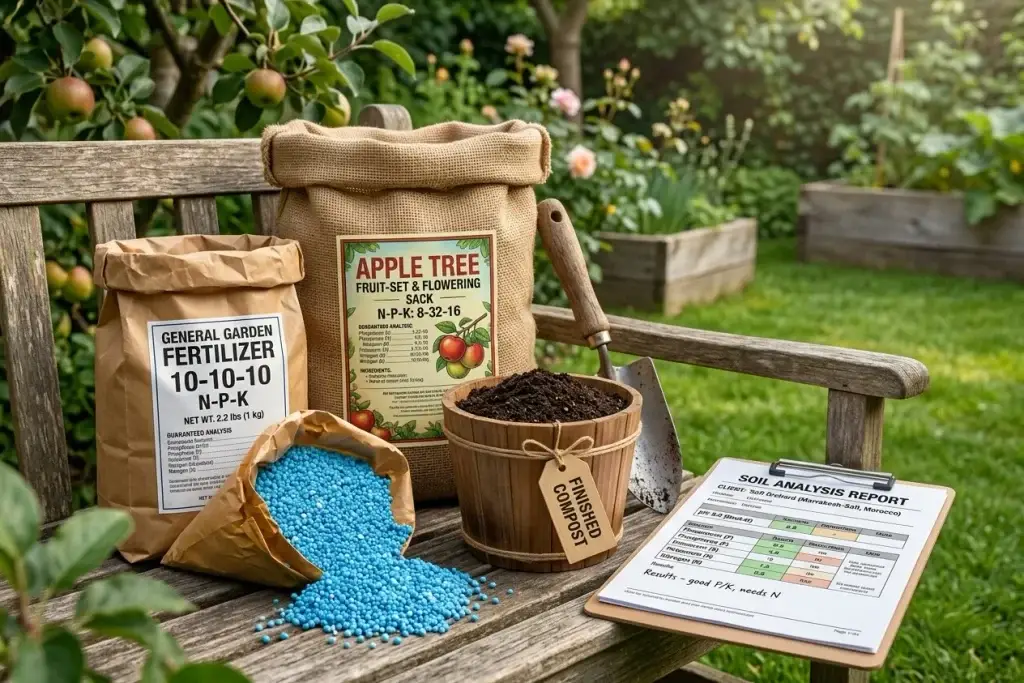
Start with the root zone rather than the product aisle. University of Maryland Extension explains that soil tests provide baseline information about pH, nutrients, and organic matter, along with recommendations for fertilizing and adjusting pH. Its guidance also notes that do-it-yourself kits are less complete and accurate than laboratory testing. Read the soil-testing guidance before buying a large bag. This step often does more to guide fertilizer selection than any product ranking.
Match the formula to the tree, not the label promise
For apple trees, nitrogen supports green growth, while phosphorus and potassium have different roles in roots, flowers, fruit development, water regulation, and plant metabolism. That is why the right formula should be selected from the soil report rather than from a generic ranking. Adding more of any nutrient does not correct a problem caused by poor drainage, compacted soil, drought, insects, disease, or a lack of cross-pollination.
Use annual shoot growth as a second check. Extension guidance commonly uses roughly 12 inches of new growth as a useful benchmark for a bearing apple tree, although variety, rootstock, age, climate, pruning, and site conditions affect the interpretation. A tree making excessive soft shoots may need less nitrogen, not more.
Compare the 7 best fertilizer types for apple trees
These categories are not seven guaranteed winners. They are seven ways fertilizer is commonly formulated and applied. Instead, they show how shoppers can compare fertilizer options without confusing convenience with suitability. Compare the nutrient analysis, release pattern, application instructions, and fit with your soil report before deciding which option belongs in your orchard.
| Fertilizer type | Best fit | Main advantage | Important limitation |
|---|---|---|---|
| Balanced granular | Documented need for more than one major nutrient | Clear analysis and simple broadcasting | Can add unnecessary phosphorus or potassium |
| Nitrogen-forward | Low nitrogen or weak shoot growth confirmed by diagnosis | Targets nitrogen without automatically adding much P or K | Overuse can cause excess vegetative growth or root injury |
| Slow-release granular | Growers who want a gradual-release product | Less frequent application may be needed | Release depends on moisture, temperature, and formulation |
| Finished compost | Improving organic matter and soil structure | Adds organic material with variable nutrients | Not a precise substitute for a fertilizer analysis |
| Organic granular | Growers seeking a labeled organic nutrient source | Often releases nutrients more gradually than highly soluble products | Nutrient availability and analysis vary by material |
| Liquid fertilizer | Situations where a label specifically supports liquid feeding | Easy to measure and distribute with water | Mis-measuring can produce concentrated root-zone salts |
| Fertilizer spikes | Only when the label and soil plan support them | Pre-portioned and convenient | Concentrate nutrients in small areas and are easy to misplace |
1. Balanced granular fertilizer
A balanced granular product can be reasonable when a soil report or local extension recommendation calls for nitrogen, phosphorus, and potassium together. It is often the first category shoppers consider. The numbers matter more than the words “fruit,” “tree,” or “premium” on the front of the package. For example, a 10-10-10 analysis supplies equal percentages by weight of N, phosphate, and potash, not equal amounts of elemental nutrients.
2. Nitrogen-forward fertilizer
A nitrogen-forward formula may fit a tree with documented low nitrogen or inadequate shoot growth after other causes have been considered. It can be a good fit only when nitrogen is actually limiting. It is a poor default for every apple tree, though: too much nitrogen can produce lush, weak growth, delay winter hardening, and increase the chance that the tree’s real problem remains unresolved.
3. Slow-release granular fertilizer
Slow-release granules appeal to growers who want a more gradual nutrient supply. For some sites, this release pattern makes them a practical choice. They can reduce the need for repeated applications, but they are not automatically risk-free. Read how the label defines release, apply only to moist soil when directed, and avoid stacking a slow-release product with compost, lawn fertilizer, and another tree fertilizer without calculating the combined nutrient input.
4. Finished compost or compost-based fertilizer
Finished compost is most useful as a soil-building material with a modest, variable nutrient contribution. It may support the root zone, but it is not automatically the right choice when a specific nutrient is deficient. University extension guidance supports using compost in appropriate situations, while also warning that fertilizer needs decrease as organic matter increases. Keep compost and mulch off the trunk, and use only finished material rather than fresh manure.
5. Organic granular fruit-tree fertilizer
Organic granular fertilizer can be a suitable option when its analysis is clear and it matches the soil plan. For shoppers comparing organic options, the guaranteed analysis still matters. “Organic” does not mean unlimited or automatically gentle, because salts in both organic and synthetic fertilizers can injure roots when overapplied. Compare the guaranteed analysis and application rate, then follow the label.
6. Liquid fertilizer
Liquid fertilizer is convenient when a product label specifically recommends it for the tree and site. It can be a good fit in a narrow, label-supported situation, but convenience does not replace measurement. It also makes measurement errors more consequential, so use the stated dilution and volume rather than estimating. Foliar feeding should not be treated as a routine replacement for correcting the root-zone nutrient supply.
7. Fertilizer spikes
Fertilizer spikes are convenient, but they deserve caution around apple trees. They are rarely the first choice when even root-zone distribution is the priority. A spike places nutrients in a small point instead of distributing them through the active root zone. If a label permits use, follow the spacing and depth instructions exactly. Otherwise, a properly measured broadcast application is easier to audit and usually gives roots a more even nutrient distribution.
“Fruit plants should be fertilized based on soil test results and plant needs.”University of Maryland Extension, Fruit Plant Care
How to choose an apple tree fertilizer by tree age and soil
Tree age changes the decision. Newly planted trees are establishing roots, while established trees are balancing shoot growth, fruit production, pruning response, and winter preparation. Fertilizer needs change as the tree matures, and a newly planted tree often needs no fertilizer at all until it has settled in and a local recommendation identifies an actual need.
Newly planted and young trees
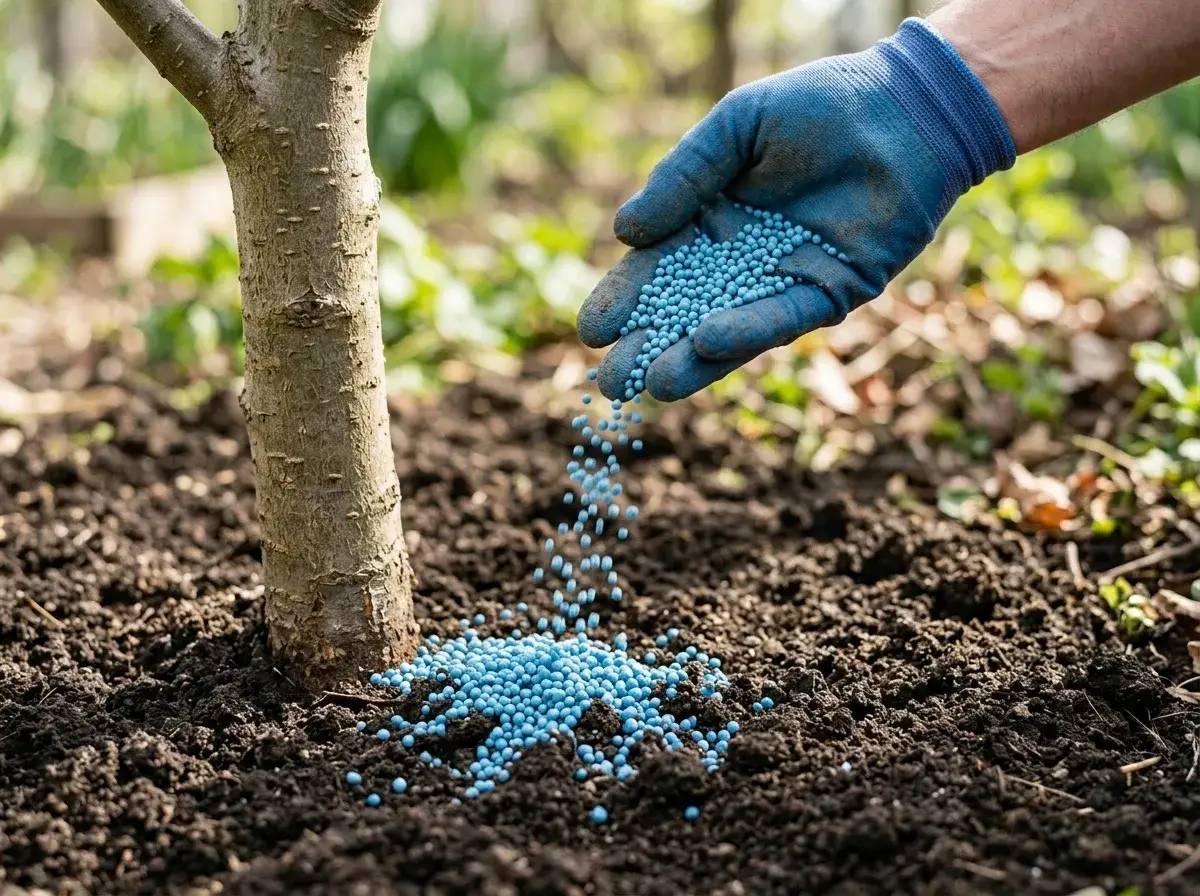
Do not put nitrogen fertilizer into the planting hole. OSU Extension advises allowing a new tree to grow for several months before applying nitrogen on the soil surface. Concentrated nitrogen against tender young roots is a common reason extension programs give for avoiding fertilizer at planting time. UMN Extension similarly connects spring compost applications with a specific growth check, such as less than 12 inches of growth the previous year.
For a young tree, first confirm watering, planting depth, weed competition, mulch placement, drainage, and trunk protection. These checks often matter more than the fertilizer choice itself. Then, if feeding is warranted, use a measured surface application that stays away from the trunk and follows the product label.
Established and bearing trees
Established trees should not receive fertilizer simply because the calendar says spring. Check the soil report, observe shoot growth, inspect leaf color and canopy density, and consider whether lawn fertilizer is already reaching the root zone. UMD Extension notes that lawn fertilizer applied near fruit plants may reduce their additional fertilizer need.
Keep the soil pH near the commonly recommended apple-tree range of about 6.0 to 6.5, while recognizing that regional recommendations may differ. If the pH is outside range, do not guess at lime or sulfur rates. Use the laboratory recommendation and connect it with the apple tree soil requirements and a suitable soil pH test kit for fruit trees. That evidence helps narrow the fertilizer choice for the site.
How to apply fertilizer without damaging roots
Apply fertilizer evenly beneath the canopy and toward the dripline, not in a mound beside the trunk. Extension guidance for fruit trees emphasizes distributing fertilizer through the root zone, keeping it away from the trunk, and watering it in when the label directs.
- Read the analysis and label. Record the NPK numbers, rate, timing, safety instructions, and whether the product is intended for fruit trees.
- Check the soil and tree. Use a laboratory soil test when possible, then compare the result with annual shoot growth and site conditions.
- Measure accurately. Do not estimate by handfuls, and do not combine products without accounting for total nutrient input.
- Broadcast carefully. Spread the product across the active root zone beneath the canopy while keeping fertilizer off the trunk and exposed roots.
- Water as directed. Watering can move soluble nutrients into the root zone and reduce the risk of concentrated salts at the surface.
- Stop and reassess. If leaves scorch, growth becomes excessively soft, or the tree declines, do not add more fertilizer. Check water, drainage, pests, disease, and roots.
Timing also matters. Many fruit plants are fertilized in spring around flowering, but late summer and early fall feeding can encourage tender growth that is vulnerable to winter injury. For a seasonal schedule, use the guide to when to fertilize apple trees, then revisit whether fertilizer is still needed at all.
Finally, mulch can moderate soil moisture and reduce competition from turf, but it must not touch the trunk. Review apple tree mulching before adding material, especially if the site stays wet. Good root-zone management makes any fertilizer choice easier to use responsibly.
FAQs
What is the best fertilizer for a newly planted apple tree?
Usually, the first decision is whether fertilizer is needed at all. Avoid nitrogen in the planting hole, establish reliable watering, and follow a soil test or local extension recommendation before applying a surface product. A measured, low-risk approach is better than forcing rapid top growth.
Are fertilizer spikes safe for apple trees?
They can be used only when the product label supports the application and the placement is correct. However, spikes concentrate nutrients in small areas, so a measured broadcast product may be easier to distribute evenly. Never exceed the label rate or place a spike against the trunk.
Should I fertilize without a soil test?
A soil test is the strongest starting point, especially before adding phosphorus, potassium, lime, or sulfur. If testing is not immediately available, follow the product label conservatively and avoid repeated applications while investigating watering, drainage, mulch, disease, pests, and pollination.
Is organic fertilizer better than synthetic fertilizer?
Neither category is automatically better. Compare the guaranteed analysis, release pattern, application rate, and soil need. Organic materials can contribute organic matter, while synthetic products can offer predictable nutrient analysis. Both can injure roots or pollute water when overused.
Can fertilizer fix an apple tree with no fruit?
Not usually by itself. No fruit can result from age, variety, rootstock, poor cross-pollination, frost, pruning, drought, disease, or pests. Diagnose the limiting factor first, because extra fertilizer may create leaves and shoots without solving fruit set.
Related Articles
- Apple tree fertilizer: when and how to feed your tree
- Apple tree soil requirements
- Best soil pH test kit for fruit trees
- Organic fertilizer for apple trees
Sources
- University of Minnesota Extension, Growing apples in the home garden.
- University of Maryland Extension, Garden Fertilizer Basics.
- University of Maryland Extension, Soil Testing and Soil Testing Labs.
- University of Maryland Extension, Fruit Plant Care.
- Oregon State University Extension, It’s time to buy, plant, prune and protect backyard fruit trees.
- Utah State University Extension, Soil Management for Fruit Trees.
- University of Georgia Cooperative Extension, Backyard fruit trees need fertile soil, sunny location.
Disclaimer: This article provides general growing guidance based on university extension research. Soil conditions, climate zone, tree age, rootstock, and variety affect results. Contact your local cooperative extension service for region-specific recommendations. Always read and follow the fertilizer product label, and consult a certified arborist or local extension diagnostic clinic when tree decline or nutrient symptoms are difficult to identify.
