
When To Fertilize Apple Trees: Best Month-by-Month Guide
When to fertilize apple trees depends on the tree’s age and growth stage, but most home orchardists apply the first feeding in early spring just before bud break, then track new shoot growth through the season to decide whether a second application is needed.
Table of Contents
Key Takeaways
- The best window for when to fertilize apple trees is early spring, roughly two to four weeks before bud break.
- Newly planted trees should not be fertilized until they have been in the ground for one full growing season.
- Nitrogen fertilizer should be finished by early summer so new growth can harden off before fall.
Home growers often ask when to fertilize apple trees because timing affects far more than just leaf color. Therefore, our research team reviewed university cooperative extension guidance to build a practical, season-by-season answer for backyard orchardists.
Fertilizing at the wrong time can push soft, late-season growth that never hardens off before frost. However, fertilizing too early or skipping feeding altogether can leave a tree short on the nitrogen it needs for spring shoot growth and fruit set. This guide breaks down when to fertilize apple trees by tree age, growth stage, region, and fertilizer type, so home growers can build a simple annual routine instead of guessing.
Knowing when to fertilize apple trees also protects the investment already made in planting, pruning, and pest management. A tree that is fed at the right moment channels nutrients into shoot growth, flower bud formation, and fruit development. In contrast, a tree fed at the wrong moment often wastes those same nutrients on growth the tree cannot use before winter.
When to Fertilize Apple Trees by Season
The clearest answer to when to fertilize apple trees is early spring, before growth resumes. For example, Penn State Extension recommends broadcasting fertilizer in a circle around newly planted trees about one month after planting, then repeating a similar application the following June1. For established trees, most extension programs favor a single early spring application timed to bud swell.
Additionally, nitrogen availability matters most right before petal fall. Cornell Cooperative Extension notes that nitrogen demand is highest before petal fall, and where fertigation is used, applications can continue from bloom through the end of shoot growth in late June2. As a result, most home orchards need only one or two feedings per year rather than a constant summer-long schedule.
Spring Bud Break: The Primary Window
Spring bud break is the single most important marker for when to fertilize apple trees. As the tree exits dormancy, stored carbohydrates are mobilized to support new leaves and flower clusters. Therefore, applying nitrogen just ahead of this stage supports strong shoot growth without wasting fertilizer on a tree that is still dormant.
Early Summer: The Cutoff Point
In contrast to spring, early summer marks the point where fertilization should stop for the season. Applying nitrogen after this window can trigger tender new growth that has no time to harden off before cold weather arrives. Therefore, most extension programs recommend finishing nitrogen applications well before midsummer in colder USDA zones.
How Tree Age Changes When to Fertilize Apple Trees
Tree age is one of the biggest factors in when to fertilize apple trees, since young and mature trees have very different nutrient demands. However, newly planted trees are still developing their root systems, so early feeding can do more harm than good.
Penn State Extension guidance for home fruit plantings recommends waiting about one month after planting before the first light application, then adding a second application the following June as the tree settles in. Consequently, patience in year one supports stronger root establishment and fewer problems later.
Young, Non-Bearing Trees
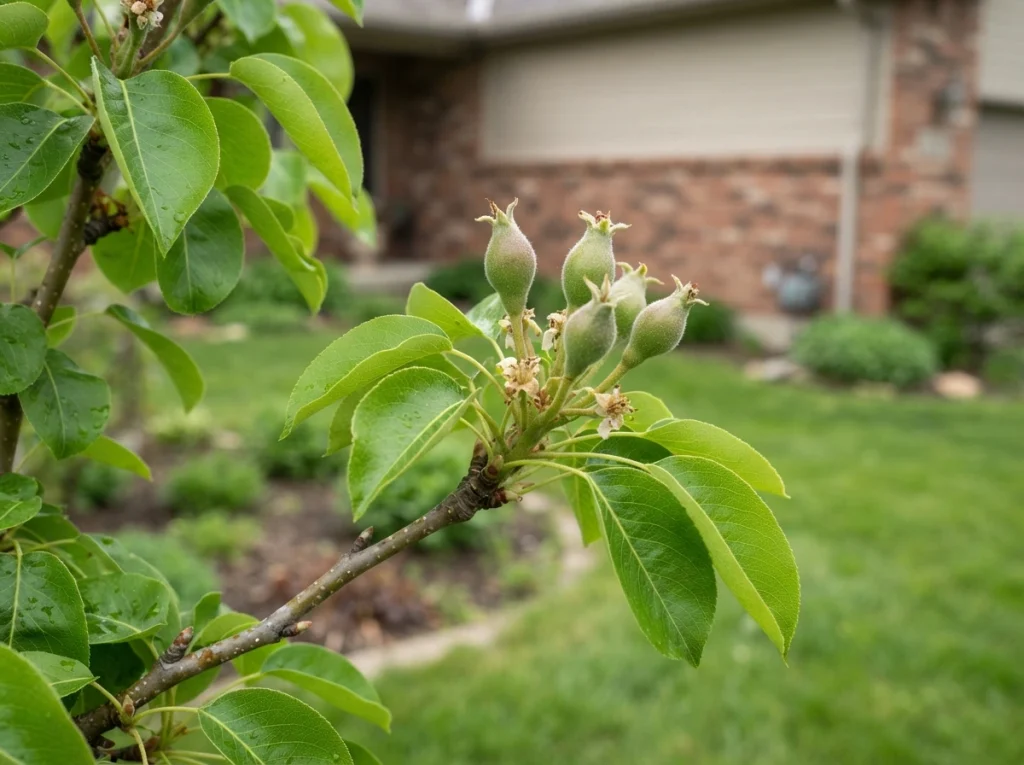
Young apple trees that have not yet begun bearing fruit need enough nitrogen to support vigorous shoot extension. For example, Utah State University Extension notes that young, non-bearing trees should produce 12 to 18 inches of new shoot growth each year, and if growth falls short of that, the tree will likely benefit from additional fertilizer3.
Mature, Bearing Trees
Once an apple tree begins bearing fruit regularly, its nitrogen needs typically level off. The same Utah State guidance points to 8 to 12 inches of new growth per year as the healthy benchmark for bearing trees, with a general rule of up to eight ounces of actual nitrogen per tree per year as an upper limit3. However, soil fertility, mulch, and rainfall all affect how much a given tree actually needs.
Signs Your Apple Tree Needs Fertilizer
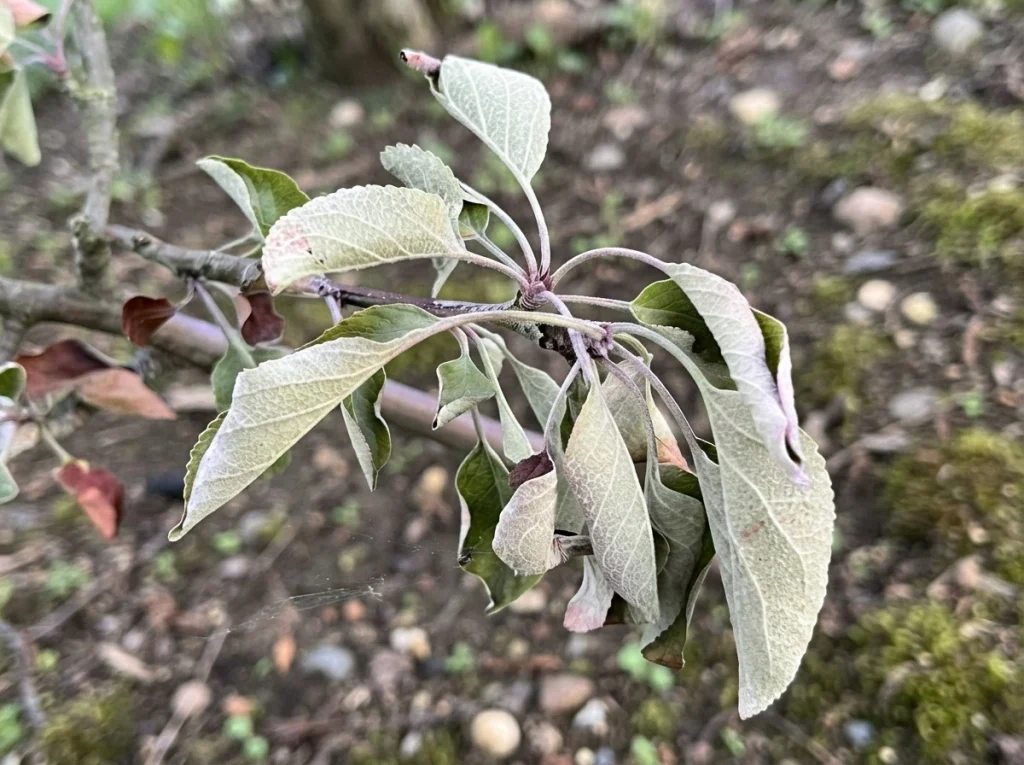
Instead of fertilizing on a fixed calendar alone, our research team recommends checking the tree itself before deciding when to fertilize apple trees each year. Additionally, shoot growth, leaf color, and fruit size all offer useful clues about nutrient status.
- Shoot growth noticeably shorter than the benchmarks above for the tree’s age and bearing status.
- Pale green or yellowish leaves during the active growing season
- Small, poorly colored fruit despite otherwise normal watering and pruning
- Sparse flowering compared to previous seasons on an otherwise healthy tree
For example, a five-year-old tree producing only three or four inches of new growth is likely under-fertilized, while a tree pushing 20 inches of growth with poor fruit color may already be getting too much nitrogen. As a result, measuring shoot growth each dormant season is one of the simplest ways home growers can fine-tune their fertilizer timing year to year.
Organic vs. Synthetic Fertilizer Timing
The type of fertilizer used also affects when to fertilize apple trees, since organic and synthetic products release nutrients at different speeds. For example, synthetic, water-soluble fertilizers become available to the tree within days, so they work well when applied close to bud break for a fast, targeted nitrogen boost.
Organic options such as compost, aged manure, or blended organic fertilizer release nutrients more slowly as soil microbes break them down. As a result, organic fertilizers are often applied slightly earlier, in late winter or very early spring, to give the soil time to warm and microbial activity time to ramp up before the tree needs the nutrients. Growers who prefer an organic approach can find variety-specific guidance in our companion guide to organic fertilizer for apple trees.
Either fertilizer type can support healthy shoot growth if the timing matches the tree’s growth stage. Therefore, the choice between organic and synthetic fertilizer matters less than sticking to a consistent, extension-backed schedule year after year.
Regional Timing and Soil Testing Considerations
Climate zone plays a real role in when to fertilize apple trees, since bud break can vary by several weeks between a warm coastal zone and a colder inland region. For instance, growers in USDA zones 3 and 4 typically fertilize later in spring than growers in zones 7 and 8, simply because dormancy breaks later.
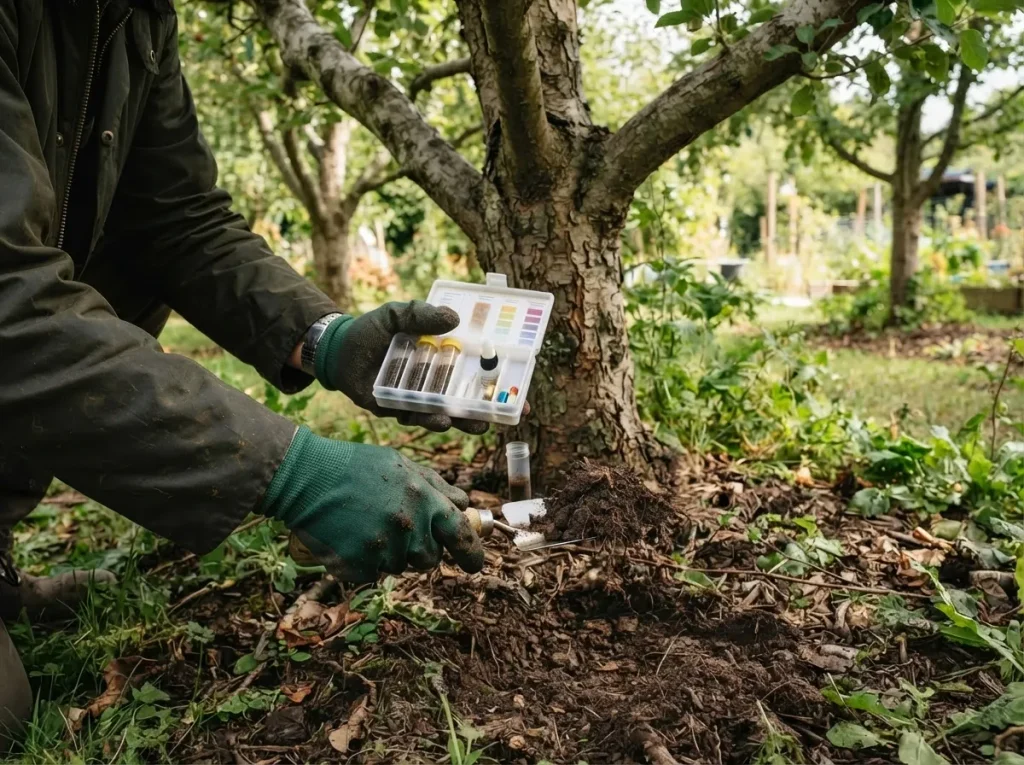
In addition, a soil test remains the most reliable way to confirm whether fertilizer is even necessary. Many home orchards, particularly those with a history of compost or mulch use, already have adequate nitrogen and therefore do not need annual feeding.
Consequently, testing every two to three years helps prevent the over-fertilization that can delay fruit coloring and increase disease pressure. As a result, growers in colder climates should treat these zone differences as the starting point for deciding when to fertilize apple trees each spring, then adjust based on the tree’s own shoot growth.
Fertilizer Timing Quick Reference
The table below summarizes when to fertilize apple trees at each life stage, from the first year in the ground through full bearing maturity.
| Tree Stage | Best Timing | Typical Nitrogen Guidance |
|---|---|---|
| Newly planted (year 1) | No fertilizer at planting; light feeding about 1 month after planting | Light, single application |
| Young, non-bearing | Early spring, before bud break | Enough to support 12 to 18 inches of new growth per year |
| Mature, bearing | Early spring, before bud break to petal fall | Up to about 8 ounces of actual nitrogen per tree per year |
| Any age, after early summer | Avoid nitrogen applications | None; risk of late, tender growth |
University cooperative extension programs consistently point to the same underlying principle: nitrogen delivered before active spring growth begins is used far more efficiently than nitrogen applied later in the season, when the risk of pushing unwanted late growth outweighs the benefit.
When to Call a Professional
Most questions about when to fertilize apple trees can be answered with a soil test and a season of careful observation. However, a tree with unusual leaf discoloration, dieback, or stunted growth that does not respond to standard fertilization may be dealing with a disease, pest, or root problem instead of a nutrient issue.
In that case, a certified arborist or the local university cooperative extension plant diagnostic clinic can rule out other causes before more fertilizer is applied. Applying additional nitrogen to a tree with an underlying disease or root problem can make the situation worse rather than better.
Building a Simple Annual Fertilizer Schedule
Once a grower understands when to fertilize apple trees for their specific tree age and region, the routine becomes fairly simple to repeat each year. Most home orchards need only one early spring application, a shoot growth check in fall, and a soil test every two to three years.
For a young, non-bearing tree, that means checking for 12 to 18 inches of new growth each dormant season and adjusting the following spring’s application accordingly. For a mature, bearing tree, an 8 to 12 inch growth benchmark serves the same purpose. As a result, deciding when to fertilize apple trees becomes less about guessing and more about reading what the tree itself is telling you.
FAQs
What month should I fertilize my apple tree?
Most home growers fertilize apple trees in March or April, timed to bud break rather than a fixed calendar date. In colder USDA zones, this window shifts later into April or even early May.
Can you fertilize an apple tree too late in the season?
Yes. Applying nitrogen after early summer can stimulate late, tender growth that does not harden off before winter, which increases the risk of cold injury. Most extension programs recommend finishing nitrogen applications well before midsummer.
Do newly planted apple trees need fertilizer right away?
No. Extension guidance recommends waiting until a newly planted tree has had time to establish roots, with a light first application about a month after planting rather than at planting time itself.
How often should an established apple tree be fertilized?
Many established apple trees only need one application per year, applied in early spring, especially if mulch or compost is already used around the root zone. A soil test every two to three years helps confirm whether that single application is still necessary.
Does soil pH affect when to fertilize apple trees?
Soil pH does not usually change the timing itself, but a pH outside the ideal 6.0 to 6.5 range can prevent the tree from using nitrogen efficiently no matter when it is applied. For that reason, checking soil pH is a useful first step before deciding on a fertilizer schedule, and our guide to apple tree soil requirements covers testing and adjustment in more detail.
Related Articles
- Apple Tree Soil Requirements: pH, Drainage & Prep
- Organic Fertilizer for Apple Trees
- Apple Tree Mulching: Benefits & How-To
- Apple Tree Fertilizer: When & How to Feed Your Tree
Sources
- Penn State Extension: Nutritional Requirements of Apples in Home Fruit Plantings
- Cornell Cooperative Extension: Nutrient Management in Apple Orchards
- Utah State University Extension: Fertilizing Backyard Fruit Trees
Disclaimer: This article provides general growing guidance based on university extension research. Soil conditions, climate zone, and variety selection significantly affect results. Contact your local cooperative extension service for region-specific recommendations.
